




Miss This? King County Metro To Install Operator Safety Partitions Fleetwide
King County and City of Seattle Plan Bus Stop Upgrades for Safer, Faster Service
Planned improvements along First Avenue South aim to ease bus merging delays, enhance safety, and keep buses moving in traffic lanes.
July 14, 2025

King County Metro buses on First Avenue South near South Lander and Hanford streets often face safety risks and delays when merging back into traffic.
Photo: King County Metro
2 min to read
King County Metro is working alongside the Seattle Department of Transportation (SDOT) to make bus stop improvements for routes 21 and 50 in Seattle neighborhoods. Improving the bus services at three locations along First Avenue South in the SODO area could provide more reliability and safety to the bus service.
According to agency analysis and transit operator feedback, buses face safety challenges and travel time delays when merging back into traffic from bus stops near South Lander and Hanford streets.
From July 11 through August 8, the agency will inform nearby businesses and property owners about early concept designs that will provide improved or relocated bus shelters, improved lighting, and wider sidewalks that will allow buses to stay in-lane while riders board and exit.
Design Concept Improvements
King County Metro and SDOT will work together on the design and construction phases for each proposed location of this project. Preliminarily, design work and public outreach are planned for 2025, construction in 2026, and project completion in 2027.
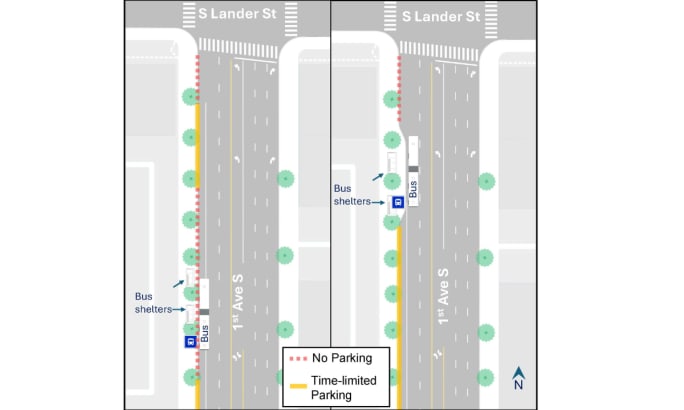
This map shows the current bus stop on the west side of First Avenue South located south of South Lander Street. This proposed stop location will be relocated closer to South Lander Street.
Photo: King County Metro
First Avenue South and South Lander Street changes include:
The sidewalk on the west side of First Avenue South will be widened to allow buses to stay in the traffic lane while riders board and exit the bus.
The bus stop will be relocated closer to the crosswalk.
The existing shelters will be replaced by a new shelter.
SDOT may create additional time-limited parking and/or load zones.
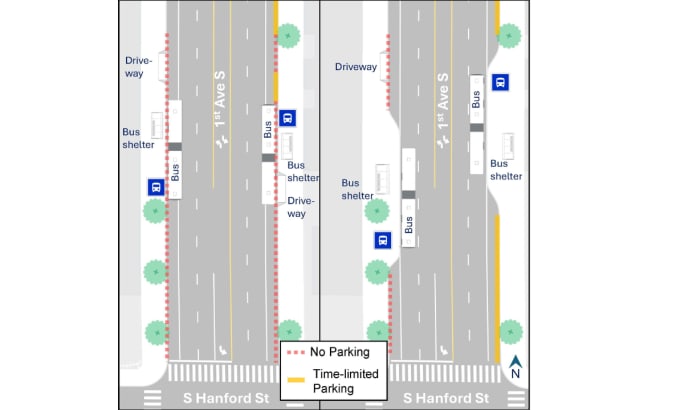
This map shows the current bus stops on First Avenue South located north of South Hanford Street. The proposed stop locations would move about a half of a bus length in each direction, farther south on the west side of First Avenue South and farther north on the east side of the same street.
Photo: King County Metro
First Avenue South and South Hanford Street changes include:
Sidewalks on both sides of First Avenue South will be widened to allow buses to stay in the traffic lane while riders board the bus. The left lane will remain open for other vehicles to pass a bus serving the stop.
SDOT may adjust time-limited parking and passenger load zones.
The driveway on the east side of First Avenue South near the bus zone will be removed and become part of the sidewalk that will be widened.
The passenger load zone on the west side of First Avenue South, north of South Hanford Street near the bus stop, will be removed.
More Bus

New York MTA Plans Largest Bus Fleet Upgrade in More Than a Decade
The agency is seeking manufacturers for 650 new CNG buses to replace aging vehicles, improve reliability, and advance its broader fleet modernization strategy.
Read More →
Building a Flexible Path to Transit Electrification
John Hroncich discusses BAE Systems’ modular and scalable approach, lessons learned from decades of real-world operations, and how agencies can identify electrification strategies that fit their fleets.
Read More →
Bus Tech Talk: Keeping Transit Technicians Ahead of the Technology Curve
LA Metro’s Obed Mejia discusses technician training, evolving maintenance technology, fleet replacement, and strategies for getting the most out of today’s transit fleets.
Read More →
Biz Briefs: RIPTA Unveils New Frontrunners, Clevland RTA Adds New Siemens, and More
In METRO's latest installment, we take a look at recent news from Siemens, Prevost, Dodge, and more partnerships making headlines across the transportation sector.
Read More →
People Movement: Holly Arnold Joins Transdev and More
In this edition, we also cover recent appointments and announcements at Pace, CamTran, MCI, and more, showcasing the individuals helping to shape the future of transportation.
Read More →
The High Cost of Transit Buses: Industry Leaders Look to Procurement Reform
Transit leaders and policymakers examine how standardized bus designs, streamlined procurement, and predictable funding could help agencies stretch budgets and deliver better service.
Read More →
The Business Voice Behind Public Transportation
As chair of APTA’s Business Members Board of Governors, Ray Melleady explains how more than 850 business members are partnering with transit agencies to advance funding, innovation, and industry-wide collaboration.
Read More →
From Surviving to Thriving: Building Stronger Transportation Organizations
Bus Business Consultants founder Brian Dickson shares lessons on leadership, organizational health, and creating options for long-term success in a changing transportation industry.
Read More →
Finding the ‘Happy Medium’: Optimizing Maintenance Without Sacrificing Reliability
The key to maintenance optimization isn’t doing less work—it’s doing the right work at the right time on the right assets.
Read More →
LA Metro, City of West Hollywood, and Partners Advance Smarter Bus Lane Enforcement
The award-winning partnership combines AI-powered detection with human oversight to improve bus reliability, accessibility, and enforcement efficiency.
Read More →