



L.A. Metro board approves light rail extension
The $1.3-billion transit project eliminates BRT as an option and will now move from the draft to the final environmental review stage.

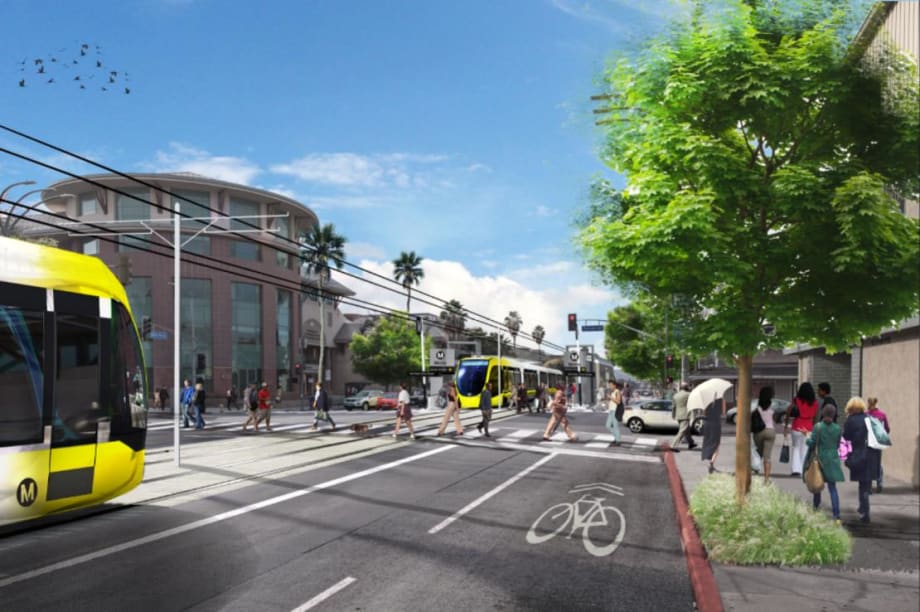
A rendering of the East San Fernando Valley Transit Corridor Project.
L.A. Metro
A rendering of the East San Fernando Valley Transit Corridor Project.
L.A. Metro
The Los Angeles County Metropolitan Transportation Authority (Metro) board of directors approved light rail as the official technology for the East San Fernando Valley Transit Corridor Project, which will connect the Metro Orange Line Station in Van Nuys with the Metrolink Station in Sylmar/San Fernando.
The $1.3-billion transit project, which is funded by Measure R and M voter-approved sales taxes as well as SB-1 gas tax funds, eliminates bus rapid transit as an option and will now move from the draft to the final environmental review stage. If the final environmental document is certified by the Metro board early next year, construction could begin in 2021, with the rail line opening in 2027 ahead of the 2028 Olympic and Paralympic Games in the Los Angeles area.
Spanning 9.2 miles, the project will include 14 new stations and will travel in the median of Van Nuys Boulevard before turning northwest on Metro-owned rail right-of-way adjacent to San Fernando Road. Destinations that will be available along the line include the Van Nuys Civic Center, Van Nuys Amtrak/Metrolink Station, Panorama Mall, Van Nuys multi-residential housing, Arleta High School, downtown San Fernando, and others. A one-way trip from end-to-end on the rail line is expected to take approximately 31 minutes.
The board’s action marks the planned return of street-level local stop rail service in the Valley. The Pacific Electric Red Cars discontinued service along portions of Van Nuys Boulevard back in 1952.
The Metro Board also approved the agency’s recommendation to build a rail yard to store and maintain Metro light rail vehicles across the street from the Van Nuys Amtrak/Metrolink Station. The approved site contained the least community and economic impacts of any of the options Metro studied. The site also received the most community support.
As part of its ongoing study, Metro will coordinate the rail line’s possible connections in Van Nuys with other planned transit projects, including the Metro Orange Line Improvements Project and the Sepulveda Transit Corridor Project. Other planned transit projects in the area include the North San Fernando Valley Bus Rapid Transit (BRT) Project, the North Hollywood to Pasadena BRT Corridor Project, and the 2020 electrification of all Metro Orange Line buses. The Orange Line is planned to be converted to light rail by 2057 unless it can be delivered sooner via a public-private partnership.
“Metro has no less than five major transit projects planned to improve mobility in the San Fernando Valley in the near future,” said Metro CEO Phillip A. Washington. “We are delivering on our promise to Valley voters to dramatically increase their transit choices for traveling across town or across the region on Metro.”
Metro began its alternatives analysis for the project in 2010. Originally, 29 alternative routes and transit modes were studied. As Metro moved through the environmental process, those choices were narrowed to a single project that could be built with available funding. In 2016, Metro was able to secure additional Measure M funding and this year Metro received more than $400 million for the project from SB-1, the state’s gas tax and vehicle fee transportation funding program that was approved by the California Legislature and signed into law by Gov. Jerry Brown last year.
More Rail

New York MTA Advances Final Contract for Second Avenue Subway Expansion
Contract Four is the largest in the Second Avenue Subway Phase 2 project and includes construction of station infrastructure, tracks, and signals for the subway expansion, MTA officials said. Work on Contract Four will begin in 2027.
Read More →
San Diego MTS Breaks Monthly Trolley Ridership Record
Agency officials said July’s ridership indicates MTS’s continued recovery from the pandemic.
Read More →
Report Examines NJ TRANSIT Reliability, Funding Challenges
The Garden State Initiative analysis examines the roles of Amtrak infrastructure, fleet management, and agency operations while recommending a more performance-based approach to improving reliability.
Read More →
Stadler, CapMetro Sign Long-Term Rail Fleet Support Agreement
Beginning in 2027, Stadler will provide on-site technical expertise, spare parts support, training, and obsolescence management to help extend the reliability and longevity of CapMetro’s GTW fleet.
Read More →
Biz Briefs: Alstom Lands Canadian Contract, LYT to Supply California TSP, and More
In METRO's latest installment, we take a look at recent news from Complete Coach Works, Beep, FlixBus, and more partnerships making headlines across the transportation sector.
Read More →
CATS Gold Line Marks 5 Years of Service, 2.8M Passenger Trips
With a six-mile expansion planned, the Charlotte streetcar is positioned to connect more neighborhoods and major transit hubs across the region.
Read More →
Why Simulating Pedestrian Movement Has Become Essential for Modern Rail Stations
Pedestrian microsimulation is helping rail planners identify bottlenecks, test station designs, and prepare complex transit hubs for growing passenger volumes.
Read More →
Amtrak Begins Major Construction at New York’s Sunnyside Yard
The new maintenance facility will support Amtrak’s Airo trainsets while improving maintenance efficiency and turnaround times in New York.
Read More →
Chicago Leaders Unveil Plans for O’Hare Airport Express Train
The privately developed project would offer a 15-minute trip between downtown and O’Hare’s Terminal 2, with trains operating every 15 minutes on a dedicated track. The service would use battery-electric trains and three existing freight rail rights-of-way.
Read More →
OCTA Maps Out 30-Year Strategy to Protect Coastal Rail Corridor
The draft feasibility report identifies strategies to protect the coastal rail line for decades as the agency continues near-term stabilization and sand placement efforts.
Read More →