



LADOT Releases First City-Run Count of Walkers, Bikers
The study, which took place at 63 Los Angeles intersections over several weekends in 2019, shows a 22% increase in people biking and a 6% drop in walking from 2017.

The Los Angeles Department of Transportation (LADOT) has published findings and data from its inaugural study counting the number of people biking and walking on Los Angeles streets. The count, which took place at 63 intersections over several weekends in 2019, reveals trends in active transportation while observing the demographics of Angelenos traveling through the city.
LADOT was set to capture data at 40 additional locations in spring 2020; however, due to city and statewide stay-at-home orders as a result of the COVID-19 pandemic, the count was postponed indefinitely.
Observations show a significant increase in the number of people walking and biking in locations where LADOT has made safety and complete street improvements. While the survey showed that women make up only 14% of people biking, there is a 120% increase in female riders on streets with dedicated bike paths.
“What gets measured matters,” said LADOT GM Seleta Reynolds. “Thanks to this report, LADOT gained valuable insights into how people move through Los Angeles neighborhoods so that our investments can deliver the most effective improvements for people walking and biking.”
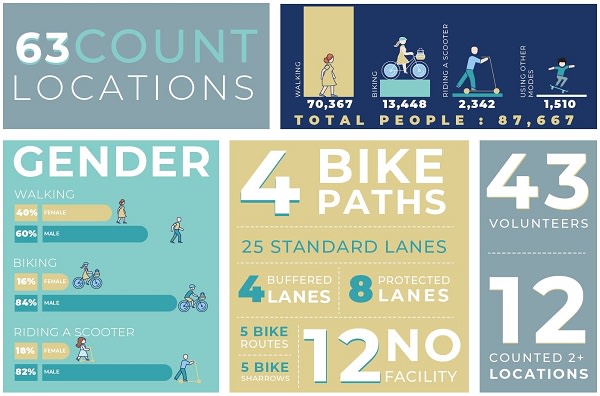
Infographic courtesy LADOT
Information gathered during the count will be used to guide future pedestrian and bike infrastructure projects throughout the city. The data provided in the report is intended to:
Identify locations for future bicycle and pedestrian improvements.
Understand how travel trends and behaviors vary across geographic areas and street typologies.
Track usage before and after transportation projects and programs are implemented.
LADOT’s Walk & Bike Count was one of the first large scale tests of SCAG’s recently launched Active Transportation Database, which provides ways for agencies to collect and store data for public use. Data from the report will also be available on city websites such as NavigateLA and at Los Angeles Open Data.
The data helps LADOT better understand traveler attributes as the department focuses on creating livable and sustainable streets that offer multiple modes of transit options to get around the city.
Some significant observations include:
The count recorded that while women make up only 16% of people biking, there was a 120% increase in female riders on streets with bike paths compared to streets with no bike facilities.
The count showed 73% increase in ridership on Figueroa Street in DTLA since the installation of the MyFigueroa streetscape project, compared to counts that took place in 2017.
A 22% increase in biking citywide from comparable data in 2017.
40% of people walking are female. This increases to 44% female walkers on weekends.
LADOT will perform biennial counts in the Fall of every odd year consistent with the former Bike + Ped Count organized by LACBC. The next LADOT Walk & Bike Count is scheduled for Fall 2021 and is expected to increase to 100 locations throughout the city.
Access the full report.
More Management

METRO Opens Submissions for 2026 Motorcoach Awards
Nominations are now being accepted for METRO Magazine’s Operator of the Year and Innovative Operator of the Year awards.
Read More →
New York MTA Advances Final Contract for Second Avenue Subway Expansion
Contract Four is the largest in the Second Avenue Subway Phase 2 project and includes construction of station infrastructure, tracks, and signals for the subway expansion, MTA officials said. Work on Contract Four will begin in 2027.
Read More →
Transit Agencies Highlight Safety Gains at National Summit
Leaders from 15 major transit systems shared crime-reduction results and safety initiatives while discussing the role of continued federal support.
Read More →

NITA Names New Leadership, Expands Reduced-Fare Program at First Board Meeting
The new regional transit authority appointed its first board chair and interim executive director while extending reduced fares across CTA, Metra, and Pace for eligible riders.
Read More →
Beyond the Checklist: A Structured Approach to Transit Maintenance
Reliability-Centered Maintenance helps transit agencies move beyond routine checklists to focus limited resources on the assets and failures that have the greatest impact on safety, reliability, and service.
Read More →
APTA 2026 Nominating Committee Selects Leadership Slate, Names Chair and Vice Chair Nominees
Leadership changes will help shape the association’s priorities and its representation of the transportation industry during the 2026–2027 term.
Read More →
DART Launches Major Security, Fare Enforcement Initiative
The 90-day demonstration will deploy coordinated security teams at five light rail stations while testing controlled access and gathering data to guide future investments.
Read More →
Advancing Fare Collection Through Technology and Innovation
Learn about delivering 1300 gates at 91 stations while managing fare evasion. Explore the large scale deployment, solution customization and real-world results that affect the region. Prepare for deployment in your region now.
Read More →
Game Day in Motion: Moving Millions During the 2026 World Cup
Between packed transit stations and team motorcoaches, see how agencies and operators across North America tackled the transportation demands of the 2026 FIFA World Cup.
Read More →
Surface Transportation Extension Averts Shutdown, Leaves Transit Funding Gap
The stopgap keeps federal transportation programs moving, but missing advance funding could complicate the transit and rail projects agencies are planning next.
Read More →