




TfL's advertising estate accounts for 20% of the UK's, and 40% of London's, outdoor advertising by value.
London transport's innovative advertising methods generate $195M
Strategies included introducing full-motion cross-platform screens, which customers can watch when standing on station platforms.
January 24, 2019
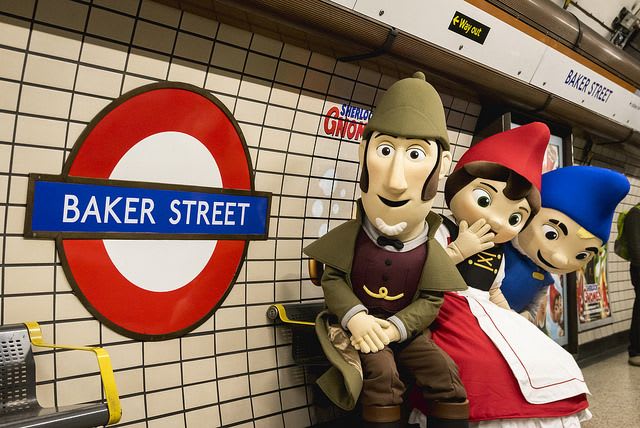
Transport for London's Baker Street Tube station was taken over by gnomes to celebrate the release of the Sherlock Gnomes film. Photo: TfL
2 min to read
Transport for London's Baker Street Tube station was taken over by gnomes to celebrate the release of the Sherlock Gnomes film. Photo: TfL
A new report revealed Transport for London generated more than $195 million in advertising revenue for the 2017/18 period. During this time, more than 16,000 advertisements ran on the TfL network.
As part of TfL's new growth strategy, advertising is one of the key ways that it is making the most of commercial opportunities and building revenue, according to the network.
To improve opportunities for advertising, TfL has introduced 260 new full-motion screens across the London Underground network and 60 full-motion cross-platform screens, which customers can watch when standing on station platforms.
Outside of the Tube and rail network, TfL has installed 12 large digital landscape advertising screens at six key locations along London's main arterial roads.
The start of 2019 has also seen the first advertising campaigns going live on new digital "ribbons" at Tottenham Court Road, Piccadilly Circus and King's Cross St. Pancras Tube stations. Each consists of several aligned digital screens alongside escalators enabling an advertising campaign to seamlessly flow along the length of the escalator.
Experiential advertising opportunities were also par of the TfL platform, from brands such as Netflix covering the walls and ceilings at Oxford Circus and Old Street Tube stations for their Black Mirror and Stranger Things series, to Baker Street Tube station being taken over by gnomes to celebrate the release of the Sherlock Gnomes film.
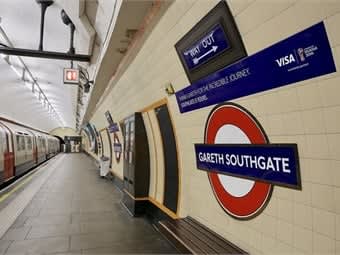
Visa teamed up with TfL to honour the success of the England national football team at the World Cup in Russia and renamed Piccadilly line station Southgate to Gareth Southgate. Photo: TfL
Visa also teamed up with TfL to honour the success of the England national football team at the World Cup in Russia and renamed Piccadilly line station Southgate to Gareth Southgate, gaining global media coverage.
Leading advertisers are also using TfL's new segmentation data to engage its audience on the network. It overlays depersonalized and grouped data from smart ticketing with Experian Mosaic groups to give advertisers more in-depth information about the types of people that use our network.
As well as raising revenue, TfL is also supporting the Mayor's aim to create a healthier, more active London and in particular to tackle the problem of childhood obesity in London.
Following the results of the consultation on the Mayor's draft London Food strategy, it was confirmed that, from 25 February 2019, there will be restrictions on advertising food that is high in fat, salt or sugar on the TfL network.
More Management

METRO Opens Submissions for 2026 Motorcoach Awards
Nominations are now being accepted for METRO Magazine’s Operator of the Year and Innovative Operator of the Year awards.
Read More →
New York MTA Advances Final Contract for Second Avenue Subway Expansion
Contract Four is the largest in the Second Avenue Subway Phase 2 project and includes construction of station infrastructure, tracks, and signals for the subway expansion, MTA officials said. Work on Contract Four will begin in 2027.
Read More →
Transit Agencies Highlight Safety Gains at National Summit
Leaders from 15 major transit systems shared crime-reduction results and safety initiatives while discussing the role of continued federal support.
Read More →

NITA Names New Leadership, Expands Reduced-Fare Program at First Board Meeting
The new regional transit authority appointed its first board chair and interim executive director while extending reduced fares across CTA, Metra, and Pace for eligible riders.
Read More →
Beyond the Checklist: A Structured Approach to Transit Maintenance
Reliability-Centered Maintenance helps transit agencies move beyond routine checklists to focus limited resources on the assets and failures that have the greatest impact on safety, reliability, and service.
Read More →
APTA 2026 Nominating Committee Selects Leadership Slate, Names Chair and Vice Chair Nominees
Leadership changes will help shape the association’s priorities and its representation of the transportation industry during the 2026–2027 term.
Read More →
DART Launches Major Security, Fare Enforcement Initiative
The 90-day demonstration will deploy coordinated security teams at five light rail stations while testing controlled access and gathering data to guide future investments.
Read More →
Sponsored•September 9, 2026
Advancing Fare Collection Through Technology and Innovation
Learn about delivering 1300 gates at 91 stations while managing fare evasion. Explore the large scale deployment, solution customization and real-world results that affect the region. Prepare for deployment in your region now.
Read More →
Game Day in Motion: Moving Millions During the 2026 World Cup
Between packed transit stations and team motorcoaches, see how agencies and operators across North America tackled the transportation demands of the 2026 FIFA World Cup.
Read More →
Surface Transportation Extension Averts Shutdown, Leaves Transit Funding Gap
The stopgap keeps federal transportation programs moving, but missing advance funding could complicate the transit and rail projects agencies are planning next.
Read More →