



MCI Academy first motorcoach training provider to receive ASE accreditation
The accreditation validates that MCI Academy’s live-instructor and self-study online training meets CASE standards.

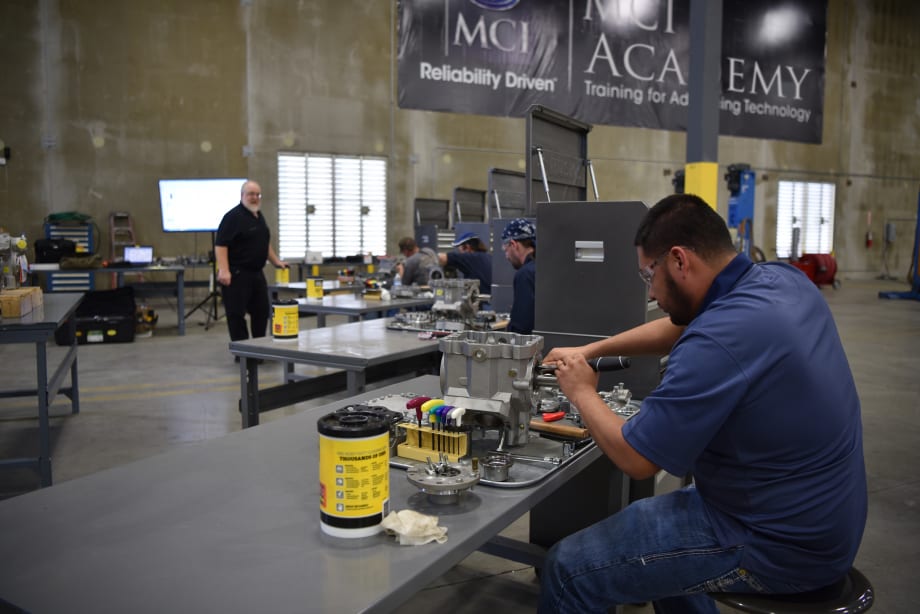
MCI launched LMS in 2015, and has more than 6,100 registered users accessing a growing library of more than 430 online courses. And to date, MCI has trained more than 1,200 technicians at its Tech Tune Up Louisville sessions.
MCI launched LMS in 2015, and has more than 6,100 registered users accessing a growing library of more than 430 online courses. And to date, MCI has trained more than 1,200 technicians at its Tech Tune Up Louisville sessions.
Motor Coach Industries (MCI), a subsidiary of New Flyer Industries Inc., announces in an industry first, the National Institute for Automotive Service Excellence (ASE) awarded MCI Academy accreditation for its comprehensive training program that elevates the skill levels of motorcoach equipment professionals.
ASE is responsible for defining the rigorous Continuing Automotive Service Education (CASE) standards. The accreditation validates that MCI Academy’s live-instructor and self-study online training meets CASE standards. As the first motorcoach industry training institution to win this prestigious accreditation, MCI Academy joins an elite group including 3M Automotive Aftermarket Division, BMW of North America, General Motors Service Technical College, Toyota, and Penske Truck Leasing.
“With this achievement, we join some pretty big names and it’s a testament to the quality of the training we provide,” said Brian Dewsnup, president of Aftermarket Parts. “The ASE accreditation makes official that MCI Academy is the training destination for any organization in the private and public sectors struggling to bring new hires up to speed quickly or advance the skills of experienced technicians.”
MCI Academy has built a multifaceted hands-on, and online training program to further professionals’ skills on multiple coach systems — whenever they need it. Live events at MCI Academy’s training headquarters in Louisville, Ky., include the popular Technical Tune-Up series, and professionals can access the Academy’s online Learning Management System (LMS) any time of the day or night.
At MCI Academy, technicians can earn:
System Qualifications - Develops a high-level of competence on the major systems; students must complete a combination of online courses, instructor-led training, and testing.
Levels 1, 2 and 3 Certification - To earn certificates, students need to complete designated System Qualifications.
Specialty diplomas in HVAC and electrical systems for various coach models.
MCI launched LMS in 2015, and has more than 6,100 registered users accessing a growing library of more than 430 online courses. And to date, MCI has trained more than 1,200 technicians at its Tech Tune Up Louisville sessions.
More Management

Castro to Lead RTC of Southern Nevada and More in People Movement
In this edition, we also cover recent appointments and announcements at the STV, MCI, and more, showcasing the individuals helping to shape the future of transportation.
Read More →
STraffic Expands North American Presence with Fare Collection Technology
John Moon, Associate Director, Product Strategy at STraffic, discusses the company's growth in North America, its efforts to reduce fare evasion, and more.
Read More →
Study: Denver RTD Generates $2.1 Billion in Annual Economic Activity
An economic impact study finds the agency supports approximately 17,500 jobs, delivers $1.6 billion in annual community and mobility benefits, and generates $2.42 in economic value for every dollar invested.
Read More →
Mark Aesch Nominated to Lead Federal Transit Administration
The former Rochester transit chief and TransPro founder, who has also contributed to METRO Magazine, brings decades of industry experience and a focus on performance, accountability, and financial sustainability to the nomination.
Read More →
Best and Worst U.S. Cities for Public Transportation in 2026
A new analysis of 50 major U.S. urban areas ranks public transit systems based on accessibility, affordability, usefulness, and safety, highlighting where transit performs best and where challenges remain.
Read More →
Laketran Cuts Fuel Costs, Boosts Efficiency with Propane-Powered Fleet
The Ohio transit agency is using propane-powered vehicles and on-site fueling infrastructure to cut fuel and maintenance costs while meeting growing demand for paratransit services.
Read More →
Canada’s Public Transit Supports $65.6 Billion in Annual GDP
New research from the Canadian Chamber of Commerce examines transit's economic contributions, including job creation and the financial implications of transportation investment.
Read More →
Pierce Transit Moves to Expand Fleet Following Proposition 1 Approval
The agency authorized the purchase or refurbishment of up to 60 buses to support a 47% service expansion, as voters nationwide approved billions in new transit funding.
Read More →
Right-Sizing Rural Transit: Lessons from North Grenville’s On-Demand Model
A small municipality shows how flexible service, rider needs, and public accountability can expand mobility with limited resources.
Read More →
Transit Ballot Victories Signal Strong Voter Support: What Comes Next?
Voters approved billions in public transportation investments in 2026, giving agencies opportunities to preserve service, expand operations, and strengthen regional connections amid a changing political landscape.
Read More →