



MCI's D45 CRT LE Commuter Coaches completes Altoona Testing
The vehicle received a 10-month battery of tests accelerating a 12-year, 500,000 miles service life.

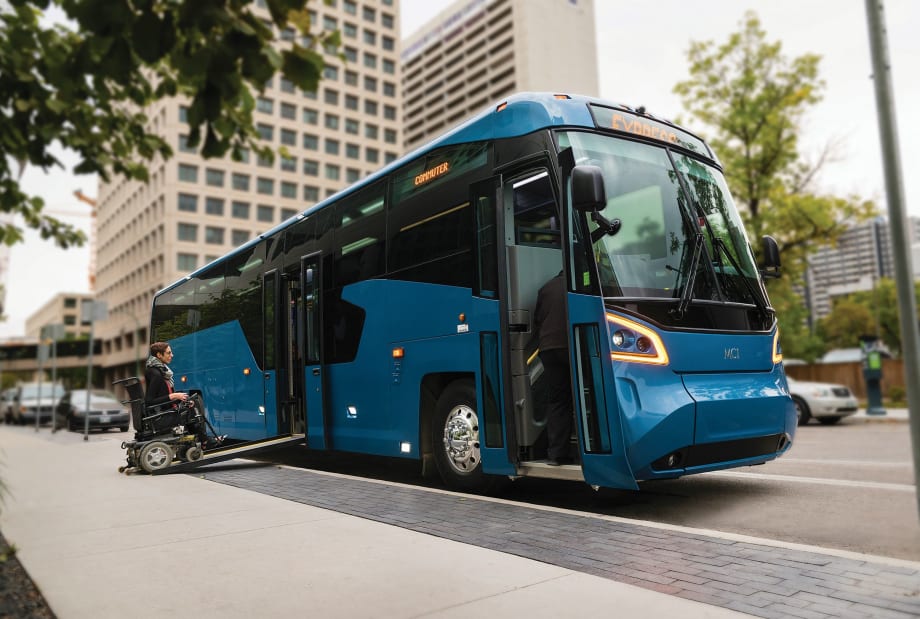
The ADA- and Buy America-compliant MCI D45 CRT LE incorporated a whole new design process at MCI, which included direct participation from various advocacy groups including the National Council on Independent Living and the American Association for People with Disabilities.
MCI
The ADA- and Buy America-compliant MCI D45 CRT LE incorporated a whole new design process at MCI, which included direct participation from various advocacy groups including the National Council on Independent Living and the American Association for People with Disabilities.
MCI
Motor Coach Industries (MCI), a U.S. subsidiary of NFI Group Inc., announced its all-new MCI D45 CRT LE has passed the mandated U.S. Federal Transit Administration (FTA) Altoona test for new bus models.
FTA’s bus testing program, named for the Altoona, Pa. testing center, rigorously tests the reliability of all new bus models for use in federally funded public transit systems procurement.
RELATED: MCI's Maitland discusses innovation at BusCon 2018
The MCI D45 CRT LE received a 10-month battery of tests accelerating a 12-year, 500,000 miles service life. According to Paul Fazio, MCI engineer and director of new product development, the model sent to Altoona was set for the heaviest level of customer usage, just shy of the model’s full GVWR (Gross Vehicle Weight Rating) of 54,000 lbs. to equal a real-life, rush hour load of fully-seated and standing passengers at peak travel time.
The D45 CRT LE is MCI’s first complete redesign of an MCI model in 20 years. “The D45 CRT LE passed its durability tests with flying colors. This is a significant outcome as the platform will also be the basis for our battery-electric D-model planned for a production start in 2020,” said Fazio.
MCI has a long, successful history with the Altoona program. In fact, MCI demonstrated its industry leading innovation and safety by becoming one of North America’s first motorcoach manufacturers to test at Altoona, submitting a 102 DL 3 to the facility in 1995. And in the line of new MCI models launched in following years, MCI would place the industry’s first hybrid-electric coach through Altoona testing in 2008. Today, the D4500 and its variants are the leader in commuter express bus service throughout North America.
The Altoona tests on the D45 CRT LE began in Sept. of 2017 and concluded last month. MCI is planning to return to Altoona with other variants of the new design. “We’ll be back at Altoona in April with our first battery-electric MCI D45 CRTe LE and with the non-vestibule version of the D45 CRT in September,” said Fazio.
The ADA- and Buy America-compliant MCI D45 CRT LE incorporated a whole new design process at MCI, which included direct participation from various advocacy groups including the National Council on Independent Living and the American Association for People with Disabilities. The CRT LE’s mid-vehicle vestibule features an automatic curb-level ramp that enables most mobility devices swift entry and exit. And, its forward door also has an enhanced ergonomic spiral entryway to facilitate ease of boarding the dual-entry system cuts dwell times to equal conventional low-floor transit boarding times.
More Bus

New York MTA Plans Largest Bus Fleet Upgrade in More Than a Decade
The agency is seeking manufacturers for 650 new CNG buses to replace aging vehicles, improve reliability, and advance its broader fleet modernization strategy.
Read More →
Building a Flexible Path to Transit Electrification
John Hroncich discusses BAE Systems’ modular and scalable approach, lessons learned from decades of real-world operations, and how agencies can identify electrification strategies that fit their fleets.
Read More →
Bus Tech Talk: Keeping Transit Technicians Ahead of the Technology Curve
LA Metro’s Obed Mejia discusses technician training, evolving maintenance technology, fleet replacement, and strategies for getting the most out of today’s transit fleets.
Read More →
Biz Briefs: RIPTA Unveils New Frontrunners, Clevland RTA Adds New Siemens, and More
In METRO's latest installment, we take a look at recent news from Siemens, Prevost, Dodge, and more partnerships making headlines across the transportation sector.
Read More →
People Movement: Holly Arnold Joins Transdev and More
In this edition, we also cover recent appointments and announcements at Pace, CamTran, MCI, and more, showcasing the individuals helping to shape the future of transportation.
Read More →
The High Cost of Transit Buses: Industry Leaders Look to Procurement Reform
Transit leaders and policymakers examine how standardized bus designs, streamlined procurement, and predictable funding could help agencies stretch budgets and deliver better service.
Read More →
The Business Voice Behind Public Transportation
As chair of APTA’s Business Members Board of Governors, Ray Melleady explains how more than 850 business members are partnering with transit agencies to advance funding, innovation, and industry-wide collaboration.
Read More →
From Surviving to Thriving: Building Stronger Transportation Organizations
Bus Business Consultants founder Brian Dickson shares lessons on leadership, organizational health, and creating options for long-term success in a changing transportation industry.
Read More →
Finding the ‘Happy Medium’: Optimizing Maintenance Without Sacrificing Reliability
The key to maintenance optimization isn’t doing less work—it’s doing the right work at the right time on the right assets.
Read More →
LA Metro, City of West Hollywood, and Partners Advance Smarter Bus Lane Enforcement
The award-winning partnership combines AI-powered detection with human oversight to improve bus reliability, accessibility, and enforcement efficiency.
Read More →