



Metra customers select new subjects for 'Ride Nice' courtesy campaign
"Taking over the train with a rowdy group” was the behavior that most concerned survey respondents, followed by “hands-free sneezing and coughing."

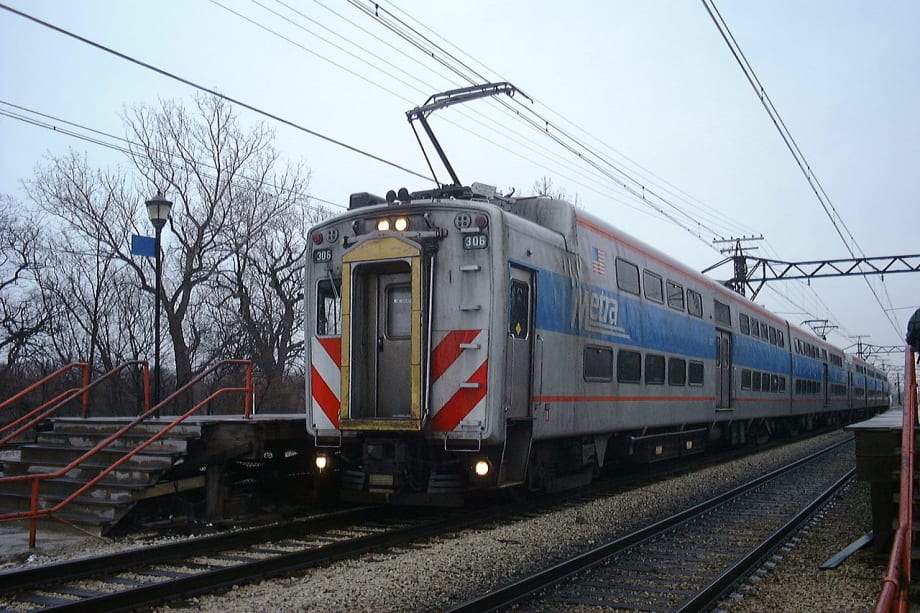
Peter van den Bossche
Peter van den Bossche
Rowdy groups, saving seats and “hands-free coughing and sneezing” are the winning gripes in a customer survey that will be used to choose the next set of posters in Metra’s “Ride Nice” courtesy campaign.
The survey in January asked customers to vote for the subjects they would like to see addressed in the second series of posters in the onboard courtesy campaign. Customers were asked to choose from a list of suggestions — such as littering and saving seats — or submit their own. “Taking over the train with a rowdy group” was the behavior that most concerned survey respondents, followed by “hands-free sneezing and coughing,” “saving a seat for a sometimes imaginary sometimes not friend,” “eating something stinky,” and “prematurely clogging the aisles.”
The first series of posters, which launched in July 2016, addressed hogging seats, blocking aisles, talking too loudly, excessive personal grooming, and putting feet on seats. The humorous posters remind customers to think about how their behavior may affect their fellow passengers.
“We were very pleased with the amount of feedback and input we received from our customers in this survey,” said Metra Executive Director/CEO Don Orseno. “Our campaign will continue to gently remind riders to behave courteously toward one another, and we hope our customers will enjoy the new posters as much as the previous ones.”
Help us decide! Vote on the next topics to be covered in our “Ride Nice” courtesy campaign: https://t.co/wJM5gi2ZtM#MetraManners#RideNicepic.twitter.com/eUrCeq7p8S
— Metra (@Metra) January 3, 2017
Customers can expect to see the new series, which will reflect their survey responses, in the summer. As with the entirety of the “Ride Nice” courtesy campaign, the new posters will be produced in-house, and printing them will be the agency’s only expense.
About a quarter of survey respondents chose to submit their own suggestions. The most popular subject was passenger noise, with customers noting behaviors such as phone conversations on the Quiet Cars and excessively loud snoring. Discourteous behavior with regard to seating was also commonly suggested, including riders pretending to be asleep so that they wouldn’t have to move their things and folks kneeing the back of the seat in front of them.
More Rail

New York MTA Advances Final Contract for Second Avenue Subway Expansion
Contract Four is the largest in the Second Avenue Subway Phase 2 project and includes construction of station infrastructure, tracks, and signals for the subway expansion, MTA officials said. Work on Contract Four will begin in 2027.
Read More →
San Diego MTS Breaks Monthly Trolley Ridership Record
Agency officials said July’s ridership indicates MTS’s continued recovery from the pandemic.
Read More →
Report Examines NJ TRANSIT Reliability, Funding Challenges
The Garden State Initiative analysis examines the roles of Amtrak infrastructure, fleet management, and agency operations while recommending a more performance-based approach to improving reliability.
Read More →
Stadler, CapMetro Sign Long-Term Rail Fleet Support Agreement
Beginning in 2027, Stadler will provide on-site technical expertise, spare parts support, training, and obsolescence management to help extend the reliability and longevity of CapMetro’s GTW fleet.
Read More →
Biz Briefs: Alstom Lands Canadian Contract, LYT to Supply California TSP, and More
In METRO's latest installment, we take a look at recent news from Complete Coach Works, Beep, FlixBus, and more partnerships making headlines across the transportation sector.
Read More →
CATS Gold Line Marks 5 Years of Service, 2.8M Passenger Trips
With a six-mile expansion planned, the Charlotte streetcar is positioned to connect more neighborhoods and major transit hubs across the region.
Read More →
Why Simulating Pedestrian Movement Has Become Essential for Modern Rail Stations
Pedestrian microsimulation is helping rail planners identify bottlenecks, test station designs, and prepare complex transit hubs for growing passenger volumes.
Read More →
Amtrak Begins Major Construction at New York’s Sunnyside Yard
The new maintenance facility will support Amtrak’s Airo trainsets while improving maintenance efficiency and turnaround times in New York.
Read More →
Chicago Leaders Unveil Plans for O’Hare Airport Express Train
The privately developed project would offer a 15-minute trip between downtown and O’Hare’s Terminal 2, with trains operating every 15 minutes on a dedicated track. The service would use battery-electric trains and three existing freight rail rights-of-way.
Read More →
OCTA Maps Out 30-Year Strategy to Protect Coastal Rail Corridor
The draft feasibility report identifies strategies to protect the coastal rail line for decades as the agency continues near-term stabilization and sand placement efforts.
Read More →