



Minn. Metro Transit launches new express bus service
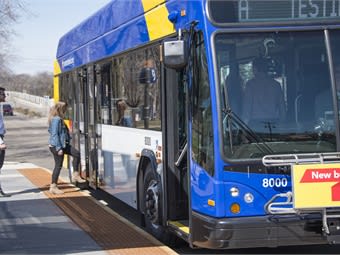
Pre-paid boarding, technology that gives buses priority at intersections and redesigned buses with wider doors and aisles are among the features that will speed service and improve the rider experience on the A Line.


Metro Transit
Metro Transit
A new rapid bus line that will provide up to 25% faster service than regular route local buses opened on Saturday in Minneapolis.
The first of a dozen rapid bus lines to be built by Metro Transit throughout the region, the A Line runs from Rosedale Center in Roseville, down Snelling Avenue through Falcon Heights and St. Paul, to Ford Parkway, where it crosses the Mississippi River into Minneapolis on 46th Street. The A Line connects to the METRO Green Line's Snelling Avenue Station in St. Paul and to the METRO Blue Line's 46th Street Station in Minneapolis.
Community members and officials from across the region, state and country celebrated the A Line's opening on Saturday morning with a ribbon-cutting.
Pre-paid boarding, technology that gives buses priority at intersections and redesigned buses with wider doors and aisles are among the features that will speed service and improve the rider experience on the A Line.
The placement and design of the A Line’s stations are also a significant part of the improved service. Stations are located a half-mile apart to speed service and connect customers to major destinations.
“Our riders are at the forefront of the design of the A Line and its stations,” Metro Transit GM Brian Lamb said. “Features including heated shelters with improved lighting, security cameras and real-time displays that let riders know when buses will arrive are only a few of the things that show how we work to act on our riders’ needs. By doing this, we have worked to make good on our commitment to improving service in one of the busiest transportation corridors in the area.”
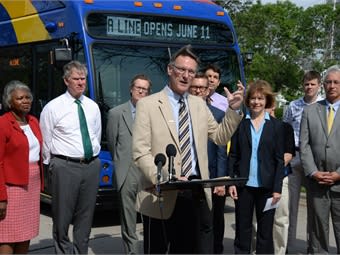
Metro Transit GM Brian Lamb.
The A Line is expected to provide up to 8,700 average weekday rides by 2030. Nearly 31,000 people live within a quarter-mile of an A Line station and there are nearly 11,000 jobs in the corridor. Workers who live within a half-mile of A Line stations will be able to reach 4,500 more jobs within a half hour than they could have prior to the A Line's opening.
Built at a cost of $27 million, the A Line is part of a network of a dozen rapid bus lines planned throughout the Twin Cities metro area. The planned network includes the C Line, which will connect Brooklyn Center to downtown Minneapolis with service on Olson Memorial Highway and Penn Avenue. Construction on the C Line is scheduled to begin in 2018, pending full project funding. When completed, the rapid bus entire network will span more than 100 miles and carry about a third of Metro Transit’s daily riders.
More Bus

New York MTA Plans Largest Bus Fleet Upgrade in More Than a Decade
The agency is seeking manufacturers for 650 new CNG buses to replace aging vehicles, improve reliability, and advance its broader fleet modernization strategy.
Read More →
Building a Flexible Path to Transit Electrification
John Hroncich discusses BAE Systems’ modular and scalable approach, lessons learned from decades of real-world operations, and how agencies can identify electrification strategies that fit their fleets.
Read More →
Bus Tech Talk: Keeping Transit Technicians Ahead of the Technology Curve
LA Metro’s Obed Mejia discusses technician training, evolving maintenance technology, fleet replacement, and strategies for getting the most out of today’s transit fleets.
Read More →
Biz Briefs: RIPTA Unveils New Frontrunners, Clevland RTA Adds New Siemens, and More
In METRO's latest installment, we take a look at recent news from Siemens, Prevost, Dodge, and more partnerships making headlines across the transportation sector.
Read More →
People Movement: Holly Arnold Joins Transdev and More
In this edition, we also cover recent appointments and announcements at Pace, CamTran, MCI, and more, showcasing the individuals helping to shape the future of transportation.
Read More →
The High Cost of Transit Buses: Industry Leaders Look to Procurement Reform
Transit leaders and policymakers examine how standardized bus designs, streamlined procurement, and predictable funding could help agencies stretch budgets and deliver better service.
Read More →
The Business Voice Behind Public Transportation
As chair of APTA’s Business Members Board of Governors, Ray Melleady explains how more than 850 business members are partnering with transit agencies to advance funding, innovation, and industry-wide collaboration.
Read More →
From Surviving to Thriving: Building Stronger Transportation Organizations
Bus Business Consultants founder Brian Dickson shares lessons on leadership, organizational health, and creating options for long-term success in a changing transportation industry.
Read More →
Finding the ‘Happy Medium’: Optimizing Maintenance Without Sacrificing Reliability
The key to maintenance optimization isn’t doing less work—it’s doing the right work at the right time on the right assets.
Read More →
LA Metro, City of West Hollywood, and Partners Advance Smarter Bus Lane Enforcement
The award-winning partnership combines AI-powered detection with human oversight to improve bus reliability, accessibility, and enforcement efficiency.
Read More →