




(See below for Metro Transit's actions to address the racial disparities)
Minorities more likely to be cited by Metro Transit police for fare evasion, study says
Immediate actions being taken to address these disparities include, impartial policing classes, disabilities training, examining best practices and diversifying the police department.
December 22, 2015
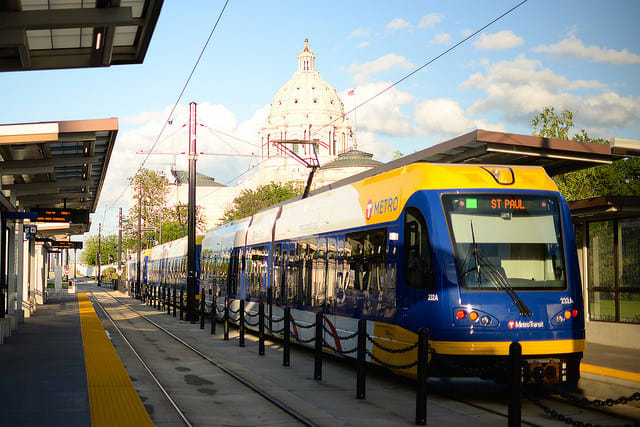
Metro Transit. Photo: Eric Wheeler
4 min to read
Metro Transit. Photo: Eric Wheeler
MINNEAPOLIS — Blacks and American Indians are far more likely to be ticketed than warned by Metro Transit police for fare evasion, according to an agency review that unearthed “troubling” disparities in the way some minorities are treated by law enforcement on public transit, reported the StarTribune.
The analysis of light-rail and bus passengers was conducted by Metro Transit after the Minnesota chapter of the American Civil Liberties Union submitted a request for public data following several high-profile incidents involving police and people of color earlier this year, the report said.
Data collected from January 2014 through August involving 7,136 arrests and citations indicate that American Indians are 152% more likely and black adults are 26% more likely to be cited for first-time fare evasion than their white counterparts, according to the StarTribune.
"This study demonstrates a clear and compelling need to investigate the reasons behind these disparities in our policing," GM Brian Lamb said. "These disparities cannot be ignored and we must hold ourselves accountable. It is important that we work in partnership with our community to come to a deeper understanding of these statistics and how we improve our policing practices."
For the full story, click here.
Taking Action to Address Racial Disparities
Based on the data collected in this study, and building on training efforts already underway, MTPD will continue its efforts to build an agency that is both responsive to and reflective of the communities it serves. MTPD is also in ongoing conversations with the NAACP of Minneapolis about potential changes to the police force’s policies and procedures.
Efforts already underway by MTPD include:
Disabilities training for officers – Training officers to safely, fairly and equitably treat people with disabilities. The most recent graduating class of police officers have undergone additional training regarding working with people who may be Autistic. This training will be incorporated into all future officer training.
Impartial policing classes – Training officers to be fair and impartial in their policing practices amongst all people, including people of color. This training has been scheduled for all officers and will also be incorporated into future training.
Examining best practices – Metro Transit will examine best practices at similar transit-oriented police forces across the country and consider implementing those tactics to help ensure fair, unbiased policing.
Diversifying the police department – Metro Transit Police officers are 35 percent diverse, which is one of the most diverse law enforcement agencies in the state. Many officers have taken Spanish classes and will also be taking Somali language classes.
In response to the study and discussions with the NAACP, MTPD is undertaking these additional efforts to address disparities in its treatment of people of color:
Directive regarding first-time fare evaders – Earlier this month, Chief Harrington directed all MTPD officers to follow a policy of issuing warnings to all people on their first encounter with fare evasion.
Comprehensive examination of policies and procedures – MTPD has asked the Minneapolis-based Council on Crime and Justice, a non-profit organization committed to building a criminal justice system that is equitable and just, to conduct a comprehensive examination of the Department’s policies and procedures and recommend improvements to ensure racial equity in MTPD policing practices.
Seeking community input – Metro Transit will work with community leaders to plan a series of meetings where community members and leaders can share their experiences and offer suggestions for needed changes.
Once feedback is gathered from the Council on Crime and Justices and community meetings, recommendations will be presented to members of the Metropolitan Council for consideration.
"The Metropolitan Council touches people’s lives all throughout our region," said Metropolitan Council Chair Adam Duininck. "We are committed to addressing equity both internally and externally. We can’t help the region thrive if only some in the community are prospering. The disparities we see in employment, education, housing, life expectancies, and in this case, the criminal justice system, hold our region back from being exceptional. I’m looking forward to the community’s recommendations on how we serve the region more equitably."
Within a year of any changes being implemented, those changes and data similar to these will again be reviewed and the results will be publicly reported.
More Management

METRO Opens Submissions for 2026 Motorcoach Awards
Nominations are now being accepted for METRO Magazine’s Operator of the Year and Innovative Operator of the Year awards.
Read More →
New York MTA Advances Final Contract for Second Avenue Subway Expansion
Contract Four is the largest in the Second Avenue Subway Phase 2 project and includes construction of station infrastructure, tracks, and signals for the subway expansion, MTA officials said. Work on Contract Four will begin in 2027.
Read More →
Transit Agencies Highlight Safety Gains at National Summit
Leaders from 15 major transit systems shared crime-reduction results and safety initiatives while discussing the role of continued federal support.
Read More →

NITA Names New Leadership, Expands Reduced-Fare Program at First Board Meeting
The new regional transit authority appointed its first board chair and interim executive director while extending reduced fares across CTA, Metra, and Pace for eligible riders.
Read More →
Beyond the Checklist: A Structured Approach to Transit Maintenance
Reliability-Centered Maintenance helps transit agencies move beyond routine checklists to focus limited resources on the assets and failures that have the greatest impact on safety, reliability, and service.
Read More →
APTA 2026 Nominating Committee Selects Leadership Slate, Names Chair and Vice Chair Nominees
Leadership changes will help shape the association’s priorities and its representation of the transportation industry during the 2026–2027 term.
Read More →
DART Launches Major Security, Fare Enforcement Initiative
The 90-day demonstration will deploy coordinated security teams at five light rail stations while testing controlled access and gathering data to guide future investments.
Read More →
Sponsored•September 9, 2026
Advancing Fare Collection Through Technology and Innovation
Learn about delivering 1300 gates at 91 stations while managing fare evasion. Explore the large scale deployment, solution customization and real-world results that affect the region. Prepare for deployment in your region now.
Read More →
Game Day in Motion: Moving Millions During the 2026 World Cup
Between packed transit stations and team motorcoaches, see how agencies and operators across North America tackled the transportation demands of the 2026 FIFA World Cup.
Read More →
Surface Transportation Extension Averts Shutdown, Leaves Transit Funding Gap
The stopgap keeps federal transportation programs moving, but missing advance funding could complicate the transit and rail projects agencies are planning next.
Read More →