



Model helps agencies predict more accurate staffing for bus routes
To accommodate unplanned employee absences (illness, emergencies, etc.), transit agencies must employ a sufficient number of transit vehicle operators to meet the demands of scheduled service, according to a new report by the Mineta National Transit Research Consortium.

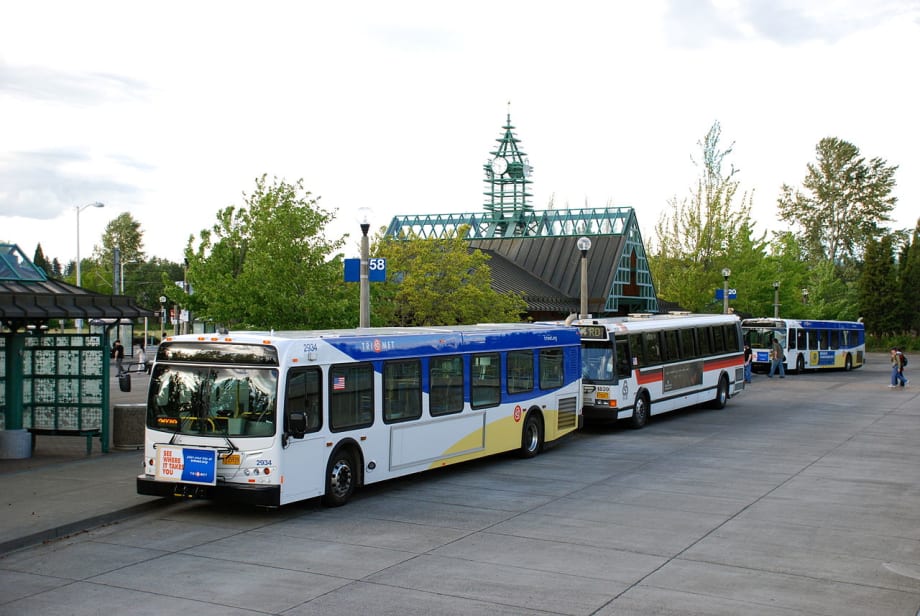
Photo courtesy Steve Morgan
Photo courtesy Steve Morgan
The Mineta National Transit Research Consortium's latest peer-reviewed study, "Understanding and Modeling Bus Transit Driver Availability," has tested three models and provided a series of recommendations to help transit agencies plan for a sufficient number of drivers without over-scheduling.
To accommodate unplanned employee absences (illness, emergencies, etc.), transit agencies must employ a sufficient number of transit vehicle operators to meet the demands of scheduled service. Therefore, agencies employ extraboard operators or on-call backups.
Overestimating the number of extraboard operators can be costly, and underestimating can cause service problems. This study proposes stochastic (i.e., random or probability) mathematical models so transit agencies can predict necessary staffing more accurately.
"Currently, decision makers estimate their staffing by using personal experience and intuition," said Dr. Kaan Ozbay, who served as the principal investigator of the report, along with Ender Faruk Morgul. "However, our mathematical models account for measures of risk and reliability with probability distributions based on historical data. Implementing these models could allow agencies to realize meaningful cost reductions while maintaining proper staffing."
The proposed models could also improve policies for daily transit operations, allowing agencies to better determine the minimum extra driver run hours for different levels of reliability while better understanding the relationship between social costs and operational costs. Social costs are defined using clearly identified measures estimated for the case study area, such as the value of riding per hour and the average number of passengers.
Implementing these models in a user-friendly computer tool could lead to other improvements by creating various scenarios to increase the speed and efficiency of decision-making. The demand and supply data required for the model validation was obtained from historical data of Portland, Ore.'s TriMet.
As seen in several U.S. and European studies, average absenteeism among bus drivers is considerably higher than in other industry groups. In one U.S.-based study, researchers found that an average transit operator misses approximately 12% of annual scheduled workdays, excluding vacations and holidays. Other studies have noted that absenteeism places a significant economic burden on an overall transportation budget.
In this study the researchers consider the tactical planning problem, in which extra workforce numbers are determined daily, depending on schedule requirements and garage assignments.
The report's figures and tables include a TriMet daily extraboard profile, stochastic model graphs, garage location map, model results for cost scenarios and more.
For a free PDF of the research report, click here.
More Bus

Report: Transit Bus Manufacturing Supports 34,100 Jobs, $5.1B in GDP
The “Buses Mean Business” report examines the transit bus manufacturing industry’s economic footprint, supply chain, and rising demand for vehicle replacements.
Read More →
Biz Briefs: New Flyer Delivers in Columbus, Houston, Beep and Freebee Merge, and More
In this edition of Biz Briefs, we spotlight the latest developments shaping the future of mobility.
Read More →
People Movement: Dan Dipert Coaches Adds Third-Generation Leader, Keolis Names New Valley Metro VP/GM, and More
In this edition, we also cover recent appointments and announcements at the Wabtec, SilverRide, HNTB, and more, showcasing the individuals helping to shape the future of transportation.
Read More →
New York MTA Plans Largest Bus Fleet Upgrade in More Than a Decade
The agency is seeking manufacturers for 650 new CNG buses to replace aging vehicles, improve reliability, and advance its broader fleet modernization strategy.
Read More →
Building a Flexible Path to Transit Electrification
John Hroncich discusses BAE Systems’ modular and scalable approach, lessons learned from decades of real-world operations, and how agencies can identify electrification strategies that fit their fleets.
Read More →
Bus Tech Talk: Keeping Transit Technicians Ahead of the Technology Curve
LA Metro’s Obed Mejia discusses technician training, evolving maintenance technology, fleet replacement, and strategies for getting the most out of today’s transit fleets.
Read More →
Biz Briefs: RIPTA Unveils New Frontrunners, Clevland RTA Adds New Siemens, and More
In METRO's latest installment, we take a look at recent news from Siemens, Prevost, Dodge, and more partnerships making headlines across the transportation sector.
Read More →
People Movement: Holly Arnold Joins Transdev and More
In this edition, we also cover recent appointments and announcements at Pace, CamTran, MCI, and more, showcasing the individuals helping to shape the future of transportation.
Read More →
The High Cost of Transit Buses: Industry Leaders Look to Procurement Reform
Transit leaders and policymakers examine how standardized bus designs, streamlined procurement, and predictable funding could help agencies stretch budgets and deliver better service.
Read More →
The Business Voice Behind Public Transportation
As chair of APTA’s Business Members Board of Governors, Ray Melleady explains how more than 850 business members are partnering with transit agencies to advance funding, innovation, and industry-wide collaboration.
Read More →