



MTA awards contracts for East Side Access Manhattan tunnels, caverns
Contractors will line more than 10,000 linear feet of newly excavated tunnels with permanent structural concrete walls, and install complex communications systems in Grand Central Terminal’s future Long Island Rail Road concourse.

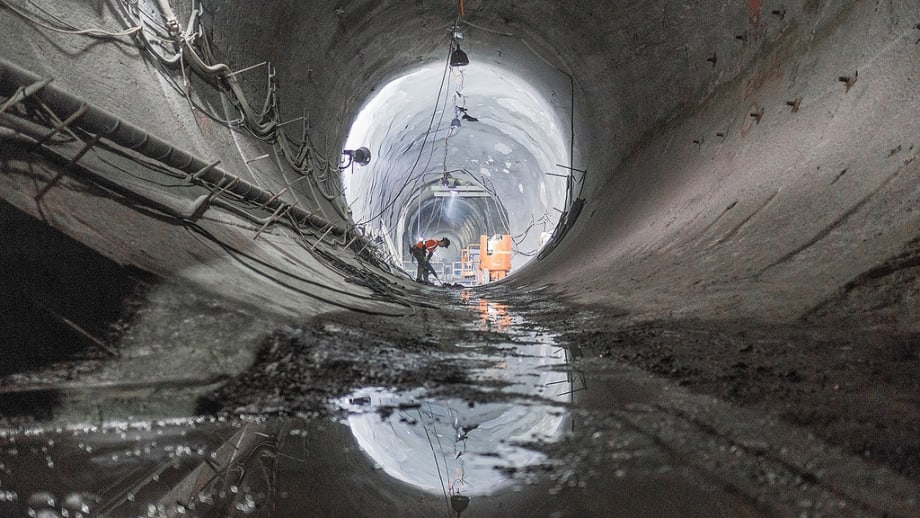
Photo: MTA Capital Construction / Rehema Trimiew
Photo: MTA Capital Construction / Rehema Trimiew
The New York Metropolitan Transportation Authority (MTA) awarded two contracts valued at $627.79 million to contractors who will line more than 10,000 linear feet of newly excavated tunnels with permanent structural concrete walls and install complex communications systems in Grand Central Terminal’s future Long Island Rail Road (LIRR) concourse.
“The work to be performed through these contracts will significantly advance East Side Access, the most complex and largest transportation infrastructure project underway in North America,” said Michael Horodniceanu, president of MTA Capital Construction. “Tunnels that have been drilled through Manhattan bedrock will be waterproofed and lined with concrete and readied for tracks. A cavern that is presently a raw concrete space will be activated with advanced communications networks that will be used by tens of thousands of people each day."
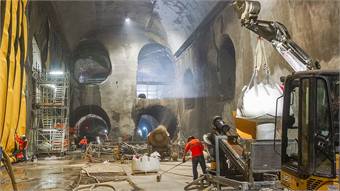
Terminal Western Cavern waterproofing work. Photos: MTA Capital Construction / Rehema Trimiew
A contract worth $333.59 million, with options leading to a total of $550.4 million, has been awarded to Tutor Perini Corp. to complete communications systems that will be used by the public and employees in the future LIRR concourse and infrastructure support systems needed to make the space usable by the public.
The communications systems including telephone, two-way radio, public address, digital signage and fire detection. The infrastructure support systems include tunnel ventilation, tunnel drainage, tunnel lighting, plumbing and fire protection.
A contract valued at $294.2 million has been awarded to Frontier-Kemper Constructors to build permanent structural concrete lining, including embedded mechanical, electrical and plumbing systems, on the newly excavated tunnels north of Grand Central Terminal, running from 50th Street and Park Avenue to 63rd Street and Second Avenue.
The company will also rehabilitate the segment of the 63rd Street Tunnel under the East River that will be used by LIRR trains, which was completed in the early 1970s. And the firm will complete work on the underground portions of two facilities, located at 50th Street and 55th Street, that will ventilate the tunnels and Cavern which will house the new LIRR station at Grand Central. The above-ground portion of the 50th Street ventilation facility has recently been completed.
Blasting has recently been completed underneath the 55th Street ventilation facility, as shown in this MTA video, here.
The East Side Access project will bring trains from all 11 branches of the Long Island Rail Road into a new concourse being built beneath Grand Central Terminal. The new connection will increase the LIRR’s capacity into Manhattan, and dramatically shorten travel time for Long Island and eastern Queens commuters traveling to the east side of Manhattan. Each cavern will contain four tracks, an upper and lower level platform, and a mezzanine.
A time-lapse video released today showing recent work on the Queens side of the project:
More Management

METRO Opens Submissions for 2026 Motorcoach Awards
Nominations are now being accepted for METRO Magazine’s Operator of the Year and Innovative Operator of the Year awards.
Read More →
New York MTA Advances Final Contract for Second Avenue Subway Expansion
Contract Four is the largest in the Second Avenue Subway Phase 2 project and includes construction of station infrastructure, tracks, and signals for the subway expansion, MTA officials said. Work on Contract Four will begin in 2027.
Read More →
Transit Agencies Highlight Safety Gains at National Summit
Leaders from 15 major transit systems shared crime-reduction results and safety initiatives while discussing the role of continued federal support.
Read More →

NITA Names New Leadership, Expands Reduced-Fare Program at First Board Meeting
The new regional transit authority appointed its first board chair and interim executive director while extending reduced fares across CTA, Metra, and Pace for eligible riders.
Read More →
Beyond the Checklist: A Structured Approach to Transit Maintenance
Reliability-Centered Maintenance helps transit agencies move beyond routine checklists to focus limited resources on the assets and failures that have the greatest impact on safety, reliability, and service.
Read More →
APTA 2026 Nominating Committee Selects Leadership Slate, Names Chair and Vice Chair Nominees
Leadership changes will help shape the association’s priorities and its representation of the transportation industry during the 2026–2027 term.
Read More →
DART Launches Major Security, Fare Enforcement Initiative
The 90-day demonstration will deploy coordinated security teams at five light rail stations while testing controlled access and gathering data to guide future investments.
Read More →
Advancing Fare Collection Through Technology and Innovation
Learn about delivering 1300 gates at 91 stations while managing fare evasion. Explore the large scale deployment, solution customization and real-world results that affect the region. Prepare for deployment in your region now.
Read More →
Game Day in Motion: Moving Millions During the 2026 World Cup
Between packed transit stations and team motorcoaches, see how agencies and operators across North America tackled the transportation demands of the 2026 FIFA World Cup.
Read More →
Surface Transportation Extension Averts Shutdown, Leaves Transit Funding Gap
The stopgap keeps federal transportation programs moving, but missing advance funding could complicate the transit and rail projects agencies are planning next.
Read More →