



N.C. university receives honors for transportation options
With choices ranging from on-campus car sharing services to fare-free public transportation, more and more Spartans are choosing to try alternative means of getting to and from campus.

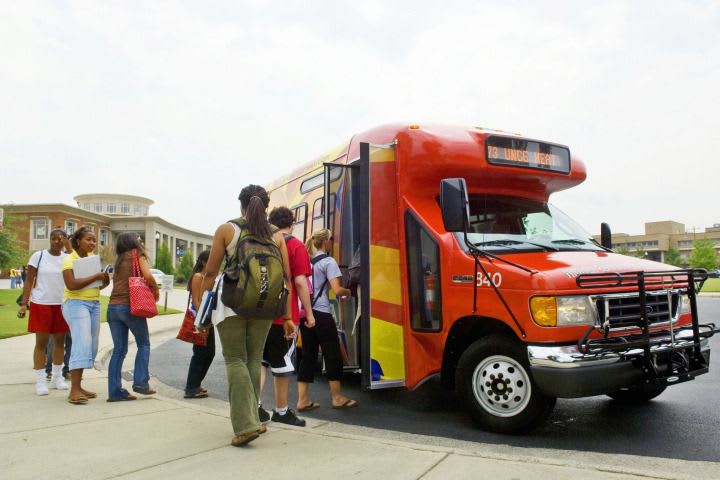
Students getting on a HEAT (Higher Education Area Transit) bus, a college and university transit service serving the students of six area colleges and universities. UNCG Photo by David Wilson.
[IMAGE]UNCG-HEAT-shuttle-full-2.jpg[/IMAGE]GREENSBORO, N.C. — Personal vehicles are increasingly optional at The University of North Carolina at Greensboro (UNCG) as the campus makes strides to be more sustainable and offer students, faculty and staff greater transportation options.
That work is gaining attention. The university was recently named one of the Best Workplaces for Commuters by the National Center for Transit Research. UNCG is the first employer in the Triad to earn the national recognition.
“We have been working on changing a culture at UNCG so people no longer feel they have to come to school with a car,” said Scott Milman, UNCG’s director of auxiliary services, who oversees the university’s parking and transportation operations.
[IMAGE]UNCG-campus-and-logo-full-2.jpg[/IMAGE]
With choices ranging from on-campus car sharing services to fare-free public transportation, more and more Spartans are choosing to try alternative means of getting to and from campus. UNCG participants made up half of the more than 4,000 pledges collected during the Piedmont Authority for Regional Transportation (PART) annual Commuter Challenge. Those making pledges promised to try a sustainable form of transportation: a bus system, carpooling, walking, biking or telecommuting.
UNCG’s ridership numbers on Greensboro Transit Authority (GTA) buses, especially the Higher Education Area Transit (HEAT) service, continue to grow. For the 2009-10 academic year, Spartans took 197,061 rides on HEAT buses, a 44 percent increase over the previous year. UNCG has the second highest participation in the HEAT network, slightly behind N.C. A&T, which had 202,169 riders.
UNCG also introduced two new services this fall — Zipcar and Zimride — designed to reduce the need for individually-owned cars on campus. Zipcar is a car-sharing service that allows members to reserve cars by the hour or the day, easing congestion on campus and reducing the need for additional parking. It’s estimated that every Zipcar takes 15-20 personal cars off the road. UNCG has four, on-campus Zipcars available for members. Additional information can be found at www.zipcar.com.
Zimride is a free rideshare matching network that helps connect drivers and riders interested in carpooling. Open to the UNCG community through a private network, Zimride helps registered users offer or request rides for occasional road trips as well as daily commutes. More information can be found at http://zimride.uncg.edu.
Spartan Cycles is another initiative launching this fall. Once fully implemented, the program will allow UNCG students and employees to check out bicycles from the Housing & Residence Life FIXT office. Bikes in the program were provided by the non-profit bike advocacy group Bicycling in Greensboro with support from UNCG campus police.
“UNCG has been working hard to expand Campus Access Management programs like our partnerships with HEAT, GTA, PART, UNCG bi-ped programs and Zimride ridesharing,” Milman said. “Zipcar provides the missing link for our faculty, staff and students — access to a car on campus.”
Provisions have also been made for commuters who may need a ride in case of an emergency. PART now offers an Emergency Ride Home Program, giving a free ride to UNCG students and employees in the PART coverage area who commuted to work using a sustainable form of transportation and have an emergency. Covered emergencies include an illness or severe crisis for the commuter or an immediate family member, or abandonment caused if a ridesharing driver has to stay late or leave early, leaving their passenger without a way home. For more information, visit http://www.partnc.org/uncgemergency.html.
UNCG’s focus on alternative transportation expands the university’s sustainability efforts and allows students and employees to save more of their hard earned money, Milman said.
“Sending a car to school adds to the cost of attendance. We want students and parents to know they can save money by coming to UNCG without a car, and Campus Access Management will be there to help with their transportation needs.”
More Bus

New York MTA Plans Largest Bus Fleet Upgrade in More Than a Decade
The agency is seeking manufacturers for 650 new CNG buses to replace aging vehicles, improve reliability, and advance its broader fleet modernization strategy.
Read More →
Building a Flexible Path to Transit Electrification
John Hroncich discusses BAE Systems’ modular and scalable approach, lessons learned from decades of real-world operations, and how agencies can identify electrification strategies that fit their fleets.
Read More →
Bus Tech Talk: Keeping Transit Technicians Ahead of the Technology Curve
LA Metro’s Obed Mejia discusses technician training, evolving maintenance technology, fleet replacement, and strategies for getting the most out of today’s transit fleets.
Read More →
Biz Briefs: RIPTA Unveils New Frontrunners, Clevland RTA Adds New Siemens, and More
In METRO's latest installment, we take a look at recent news from Siemens, Prevost, Dodge, and more partnerships making headlines across the transportation sector.
Read More →
People Movement: Holly Arnold Joins Transdev and More
In this edition, we also cover recent appointments and announcements at Pace, CamTran, MCI, and more, showcasing the individuals helping to shape the future of transportation.
Read More →
The High Cost of Transit Buses: Industry Leaders Look to Procurement Reform
Transit leaders and policymakers examine how standardized bus designs, streamlined procurement, and predictable funding could help agencies stretch budgets and deliver better service.
Read More →
The Business Voice Behind Public Transportation
As chair of APTA’s Business Members Board of Governors, Ray Melleady explains how more than 850 business members are partnering with transit agencies to advance funding, innovation, and industry-wide collaboration.
Read More →
From Surviving to Thriving: Building Stronger Transportation Organizations
Bus Business Consultants founder Brian Dickson shares lessons on leadership, organizational health, and creating options for long-term success in a changing transportation industry.
Read More →
Finding the ‘Happy Medium’: Optimizing Maintenance Without Sacrificing Reliability
The key to maintenance optimization isn’t doing less work—it’s doing the right work at the right time on the right assets.
Read More →
LA Metro, City of West Hollywood, and Partners Advance Smarter Bus Lane Enforcement
The award-winning partnership combines AI-powered detection with human oversight to improve bus reliability, accessibility, and enforcement efficiency.
Read More →