



N.Y. MTA revises advertising standards
The modification was prompted by a recent federal court decision that determined that MTA's "no demeaning standard" — a standard that had prohibited ads containing "images or information that demean an individual or group of individuals on account of race, color, religion, national origin, ancestry, gender, age, disability or sexual orientation" — was unconstitutional.

At a regularly scheduled meeting, the New York Metropolitan Transportation Authority (MTA) board modified the MTA's Advertising Standards, which were last addressed in 1997.
The modification was prompted by a recent federal court decision that determined that MTA's "no demeaning standard" — a standard that had prohibited ads containing "images or information that demean an individual or group of individuals on account of race, color, religion, national origin, ancestry, gender, age, disability or sexual orientation" — was unconstitutional.
In determining how best to respond to the court's decision, the MTA considered limiting the use of ad spaces in and on buses, subways, trains and stations across the board to ads of a commercial nature. However, many board members believed that ad space on the transportation system, in addition to serving as a very important source of supplemental revenues to support transportation, should continue to serve as a vehicle for a wide variety of communications, including ads of a non-commercial nature that express viewpoints on matters of public concern.
Accordingly, the MTA board decided to continue its policy of permitting both commercial and noncommercial advertisements, including ads expressing viewpoints on issues of the day. Of course, paid viewpoint ads contain the views of their sponsors, and the agency wants to make sure that its customers do not confuse them with expression of MTA's views.
To underscore the point, MTA’s revised advertising policy will require sponsors who submit viewpoint ads on political, religious, or moral issues or related matters to include a disclaimer on each such ad that makes this clear. Each such ad will be required to prominently include this disclaimer:
“This is a paid advertisement sponsored by [Sponsor]. The display of this advertisement does not imply MTA's endorsement of any views expressed.”
To be clear, the MTA said it does not believe the First Amendment compels the MTA to open up its ad spaces in this way to a wide range of expressive communications. MTA could, for example, adopt a narrower commercially oriented ad policy, one that limited the range of ads it will display to those selling a product or service, and by doing so, avoid having to run demeaning or divisive ads such as the AFDI ad that resulted in litigation. But, the MTA, for decades, has permitted its ad spaces to serve a broader communicative function than mere commercial advertising, and the board, reaffirms that tradition of tolerating a wide spectrum of types of ads, including ads that express views on a wide range of public matters.
More Bus

Finding the ‘Happy Medium’: Optimizing Maintenance Without Sacrificing Reliability
The key to maintenance optimization isn’t doing less work—it’s doing the right work at the right time on the right assets.
Read More →
LA Metro, City of West Hollywood, and Partners Advance Smarter Bus Lane Enforcement
The award-winning partnership combines AI-powered detection with human oversight to improve bus reliability, accessibility, and enforcement efficiency.
Read More →
PSTA Modernizes Workforce Management with Digital Bidding System
The award-winning Workforce Transit Modernization project replaced paper bidding with a transparent digital platform, cutting administrative effort while improving access for operators.
Read More →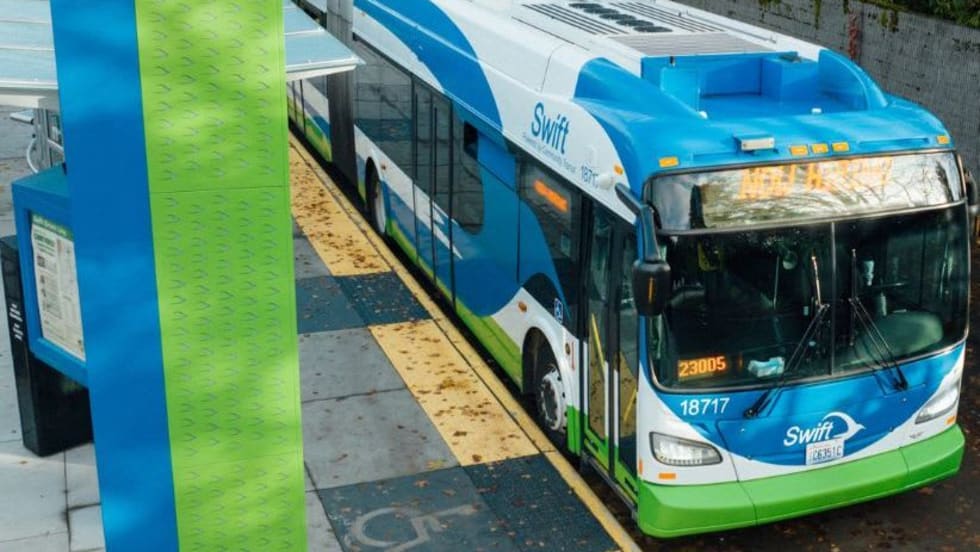
Washington's Community Transit Sets Six-Year Roadmap for Growth, Expansion
Approved TDP targets more bus service, new mobility options, Swift BRT expansion, and a potential Everett Transit annexation.
Read More →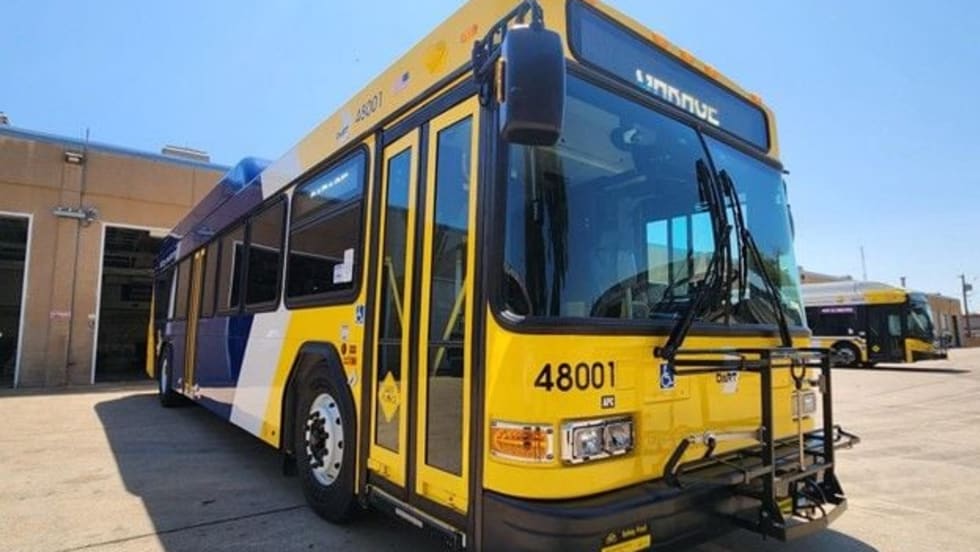
DART Customer Satisfaction Reaches Six-Year High
Overall satisfaction rose to 74.9%, while the agency’s Net Promoter Score reached a record 33.7.
Read More →
How DART's GoPass Is Redefining Regional Mobility
Serving 14 transit agencies, GoPass simplifies multimodal travel by allowing riders to plan, pay for, and manage an entire trip through one app.
Read More →
Biz Briefs: OCTA Taps Clean Energy for Hydrogen Station, Stadler to Supply Via Rail Vehicles, and More
From manufacturers and suppliers to transit agencies and motorcoach operators, these updates offer a snapshot of the projects, partnerships and business moves driving the industry forward.
Read More →
METRO Magazine Announces 2026 Innovative Solutions Awards Winners
Projects Recognized for Advancing Mobility Through Technology, Accessibility, Workforce Innovation, and Operational Excellence
Read More →
Biz Briefs: STV teams with Amtrak, Motorcoach Operators Boost Fleet and Land Contracts, and More
From manufacturers and suppliers to transit agencies and motorcoach operators, these updates offer a snapshot of the projects, partnerships and business moves driving the industry forward.
Read More →
LA Metro Marks Banner Year, Sets Ambitious Goals for New Fiscal Year
Incoming LA Metro Board Chair and Los Angeles Mayor Karen Bass joined outgoing Board Chair Fernando Dutra and LA Metro CEO Stephanie Wiggins to review accomplishments from fiscal year 2026, which included the opening of new rail extensions, advancement of major transit projects, expanded safety programs, and new rider amenities.
Read More →