



NABI production now entirely in U.S.
Company’s previous two-step business approach, with heavy manufacturing relegated to its plants in Hungary, and with final assembly accomplished at its Anniston, Ala., has now been entirely discontinued.


NABI's bus body manufacturing in Anniston, Ala.
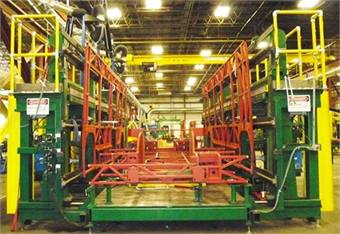
NABI's bus body manufacturing in Anniston, Ala.
NABI President/CEO Jim Marcotuli announced the shipment of the company’s final unfinished bus from Hungary, marking the shift of all NABI buses being produced entirely in the U.S.
Since its incorporation in Alabama in late 1992, NABI utilized a two-step production process with heavy manufacturing relegated to its plants in Hungary, and with final assembly accomplished at its Anniston, Ala., headquarters. However, Marcotuli confirms that the bus maker’s previous two-step business approach has now been entirely discontinued.
Marcotuli elaborated that this final unfinished bus marks the culmination of a progressive shift of manufacturing from Hungary to the U.S. that began with a single, multi-year order for 1,145 standard-floor buses by New Jersey Transit back in 2007.
“The size and multi-year stability of the New Jersey order provided the logical starting point for the progressive shifting of our manufacturing to the USA. We started the change by focusing only on standard-floor buses while leaving our normal low-floor production undisturbed in Hungary. Then in 2011, using lessons learned with the standard-floor production, we began shifting our metal-structured low-floor bus production from Hungary to Alabama. This began incrementally, beginning with structural sub-assemblies being shipped from Hungary rather than unfinished buses, and was completed late last year with all manufacturing now done entirely in Alabama on all new production tooling and with state-of-the-art laser-cutting equipment.”
With all of NABI’s standard-floor and low-floor metal-structured buses produced in Alabama since late last year, this left only the NABI’s composite-structured CompoBus still in production in Hungary. The last of these unique 45-foot buses was completed on April 30th and shipped to Alabama for final assembly. With production of over 700 CompoBuses now completed, and with no plans to resume production of this model, the final unfinished CompoBus that departed Hungary on April 30th marks the end of NABI bus manufacturing in Hungary. The last production CompoBus is expected to be shipped this month.
Bill Coryell who now works in NABI’s sales department was instrumental in the company’s startup in 1992. Coryell explains that the original two-step manufacturing arrangement was a logical approach for a start-up enterprise.
“At the time, Hungary’s bus manufacturing infrastructure was huge, capable and grossly underutilized due to political and economic conditions in Central Europe” notes Coryell. “Using it provided critical facilities, tooling, trained labor as well as deep engineering resources.”
Marcotuli and Coryell both concur that in today’s business climate, the progressive shift in manufacturing to the USA was not only logical, but is a powerful tool to improve business efficiencies and product quality. They echo that this change eliminates substantial transportation cost and simultaneously reduces inventory; reduces in-process time; and shortens delivery time. It also reduces the delivery time on replacement body parts that were previously produced abroad.
An additional and interesting aspect of this change is NABI’s compliance with industry Buy America requirements. Brian Dewsnup, NABI’s CFO, points out, “While the purpose of the shift in production was to secure the previously mentioned improvements in efficiency…as a positive side-effect of the change NABI’s typical U.S. component value has climbed from its previous 60 – 70 percent to typically over 90 percent under the new, all domestic manufacturing scenario.“
Marcotuli is justifiably proud of NABI’s current business operations, noting, “Given today’s concern over foreign goods and heightened consciousness regarding American jobs, we are indeed proud. NABI has simultaneously improved efficiencies, quality and increased American employment. Not only is NABI domestically owned and managed, but it currently produces its products entirely within the USA.”
More Bus

New York MTA Plans Largest Bus Fleet Upgrade in More Than a Decade
The agency is seeking manufacturers for 650 new CNG buses to replace aging vehicles, improve reliability, and advance its broader fleet modernization strategy.
Read More →
Building a Flexible Path to Transit Electrification
John Hroncich discusses BAE Systems’ modular and scalable approach, lessons learned from decades of real-world operations, and how agencies can identify electrification strategies that fit their fleets.
Read More →
Bus Tech Talk: Keeping Transit Technicians Ahead of the Technology Curve
LA Metro’s Obed Mejia discusses technician training, evolving maintenance technology, fleet replacement, and strategies for getting the most out of today’s transit fleets.
Read More →
Biz Briefs: RIPTA Unveils New Frontrunners, Clevland RTA Adds New Siemens, and More
In METRO's latest installment, we take a look at recent news from Siemens, Prevost, Dodge, and more partnerships making headlines across the transportation sector.
Read More →
People Movement: Holly Arnold Joins Transdev and More
In this edition, we also cover recent appointments and announcements at Pace, CamTran, MCI, and more, showcasing the individuals helping to shape the future of transportation.
Read More →
The High Cost of Transit Buses: Industry Leaders Look to Procurement Reform
Transit leaders and policymakers examine how standardized bus designs, streamlined procurement, and predictable funding could help agencies stretch budgets and deliver better service.
Read More →
The Business Voice Behind Public Transportation
As chair of APTA’s Business Members Board of Governors, Ray Melleady explains how more than 850 business members are partnering with transit agencies to advance funding, innovation, and industry-wide collaboration.
Read More →
From Surviving to Thriving: Building Stronger Transportation Organizations
Bus Business Consultants founder Brian Dickson shares lessons on leadership, organizational health, and creating options for long-term success in a changing transportation industry.
Read More →
Finding the ‘Happy Medium’: Optimizing Maintenance Without Sacrificing Reliability
The key to maintenance optimization isn’t doing less work—it’s doing the right work at the right time on the right assets.
Read More →
LA Metro, City of West Hollywood, and Partners Advance Smarter Bus Lane Enforcement
The award-winning partnership combines AI-powered detection with human oversight to improve bus reliability, accessibility, and enforcement efficiency.
Read More →