New Report Examines Racial/Ethnic, Gender Diversity in Transit
The Mineta Transportation Institute's study concludes that the transit workforce is not representative of the U.S. labor force in terms of either sex or race/ethnicity.
Public transit agencies function best when the diversity of their workforce represents the communities they serve, however, previous research shows an underrepresentation of women and racial and ethnic minorities in leadership roles.
Photo: fauxels
2 min to read
New Mineta Transportation Institute (MTI) research, “Understanding Workforce Diversity in the Transit Industry: Establishing a Baseline of Diversity Demographics,” provides updated statistics on the status of the racial/ethnic and gender diversity of the transit agency workforce in the U.S. from 2018 to 2022 and identifies potential barriers and promising practices for diversifying this workforce.
Public transit agencies function best when the diversity of their workforce represents the communities they serve, however, previous research shows an underrepresentation of women and racial and ethnic minorities in leadership roles, and an overconcentration of workers of color in operational roles.
Ad Loading...
Study Findings
The study concludes that the transit workforce is not representative of the U.S. labor force in terms of either sex or race/ethnicity. Key findings include:
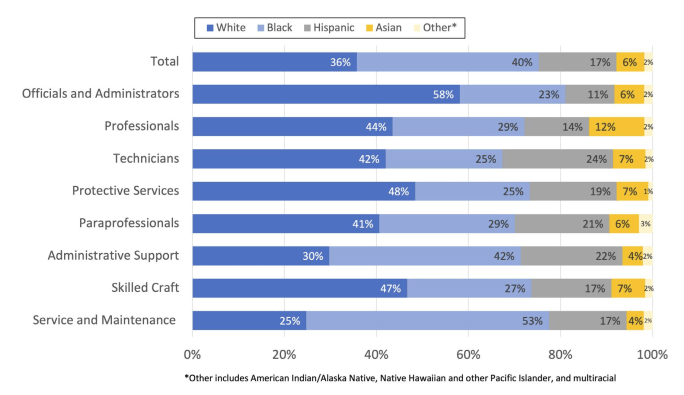
Almost two-thirds (64%) of the workers in the data are non-White, with Black workers making up the largest group of workers (40%), even though they are only 12% of the U.S. labor force.
Hispanic workers are underrepresented relative to their percentage in both the U.S. labor force and relative to their transit use.
White employees are overrepresented in leadership positions, and both White and Asian employees are overrepresented in the more-highly paid professional and skill-craft occupations.
“The extreme staffing shortages within the transit industry have created an unusually good opportunity for operators to successfully improve their workforce diversity,” explains Dr. Asha Weinstein Agrawal, the study’s principal investigator. “Important strategies for recruiting and retaining a diverse workforce include marketing strategies that promote the diverse careers available in public transit, revising job descriptions to be more inclusive, family-friendly work schedules for operations staff, ongoing professional development opportunities that target employees in every job classification, and fostering strong executive-level support for diversity programs.”
Race/Ethnicity of the Transit Workforce, by Job Classification (2018 – 2020 Equal Employment Opportunity data)
Photo: Mineta Transportation Institute
Improving Workforce Diversity
Improving workforce diversity data collection and analysis is also crucial to measure long-term progress.
Although the challenges of tracking and planning for a diverse workforce are daunting to many transit operators, a variety of strategies exist to share resources and help meet individual needs.
Ad Loading...
The findings of this study emphasize the need to do things differently, to make sure the people who work in the transit industry accurately represent the rich diversity of their communities.
Contract Four is the largest in the Second Avenue Subway Phase 2 project and includes construction of station infrastructure, tracks, and signals for the subway expansion, MTA officials said. Work on Contract Four will begin in 2027.
The new regional transit authority appointed its first board chair and interim executive director while extending reduced fares across CTA, Metra, and Pace for eligible riders.
Reliability-Centered Maintenance helps transit agencies move beyond routine checklists to focus limited resources on the assets and failures that have the greatest impact on safety, reliability, and service.
The 90-day demonstration will deploy coordinated security teams at five light rail stations while testing controlled access and gathering data to guide future investments.
Learn about delivering 1300 gates at 91 stations while managing fare evasion. Explore the large scale deployment, solution customization and real-world results that affect the region. Prepare for deployment in your region now.
Between packed transit stations and team motorcoaches, see how agencies and operators across North America tackled the transportation demands of the 2026 FIFA World Cup.
The stopgap keeps federal transportation programs moving, but missing advance funding could complicate the transit and rail projects agencies are planning next.