




RELATED: Portland St. U. transportation center earns $15M grant
New research center to test boundaries of smart transportation in NYC
Other universities will join NYU to study challenging transportation problems and field-test novel solutions in close collaboration with transportation users, government agencies, policy makers, private companies, and entrepreneurs.
January 5, 2017
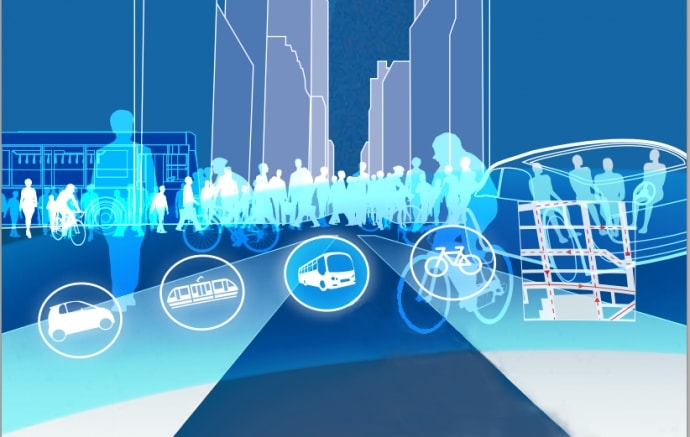
Image via NYU Tandon School of Engineering
4 min to read
Image via NYU Tandon School of Engineering
The U.S. Department of Transportation has selected a research consortium led by the New York University Tandon School of Engineering to become the first Tier 1 University Transportation Center (UTC) in New York City, charged with taking on some of the most pressing mobility challenges facing urban areas of all sizes.
The consortium proposal, led by Kaan Ozbay, a professor in the NYU Tandon Department of Civil and Urban Engineering, won the prestigious UTC designation from among 212 applications to the Fixing America's Surface Transportation (FAST) Act competition. The new research and education center will receive a five-year, $7 million U.S. Department of Transportation grant that will be supplemented with matching funds that will bring its budget to $10.5 million for the five years.
University of Washington at Seattle, University of Texas El Paso, Rutgers University, and City University of New York will join NYU to use their home cities as living laboratories in which to study challenging transportation problems and field-test novel solutions in close collaboration with transportation users, government agencies, policy makers, private companies, and entrepreneurs.
The new center, called Connected Cities for Smart Mobility toward Accessible and Resilient Transportation (C2SMART), aims to accelerate transportation opportunities arising from unprecedented recent advances in communication and smart technologies. University researchers will work with public and private partners in New York City; Seattle; New Brunswick, New Jersey; and El Paso, Texas.
In addition to research aimed at finding solutions to transportation issues through the use of data and technology, C2SMART will focus on education, workforce development, and accelerating technology from the research phase to the real world.
C2SMART brings together a highly respected group of academics with specialized transportation expertise from across the country — many of whom have collaborated for years — at an opportune time, explained C2SMART Director Ozbay. The availability of data and technology has escalated exponentially even within the last two years, creating opportunities to change the transportation paradigm.
"Rather than just focusing on developing technologies that make a city smarter, we are dedicated to the critical step of connecting disparate technologies for cities of different populations, infrastructure scales, and systems," he said.
C2SMART will:
Make it possible to safely share data from field tests and non-traditional sensing technologies so that decision-makers can address a wide range of urban mobility problems involving people and goods using multiple modes of transportation.
Develop innovative solutions that focus on disruptive technologies such as connected travelers (vehicles and people), autonomous vehicles, shared mobility (such as a bike or car-sharing programs), and the Internet of Things.
Work closely with city and state stakeholders, including government agencies, policy makers, the private sector, non-profit organizations, and entrepreneurs, to overcome institutional barriers to innovations.
Train the workforce of tomorrow to deal with these new problems in ways that are not covered in existing transportation curricula. This new educational approach will also attract a new generation of engineers, app developers, data scientists, and sensor builders to the transportation field.
Although the UTC process requires systematic vetting of projects to determine which get funded, NYU Tandon researchers are already involved in a number of exciting, cutting-edge projects they hope will be advanced by C2SMART.
Examples include:
Smart-parking apps that go beyond San Francisco's popular smart-parking app SFpark by integrating information to make truck deliveries easier and reduce double-parking. The first step will be a computer simulation.
Improving the resiliency of every mode of transportation in New York City using data generated during extreme events such as Superstorm Sandy. Working with Rutgers University, NYU Tandon researchers want to integrate separate data on flooding, vehicle routing and speed during an extreme event with other sensor-generated information to develop safety measures that could identify vulnerabilities and harden transportation systems, then share their findings with other cities. Their findings could also inform reactions to terrorism or hazardous material emergencies.
Explore how drones can fill in the information gaps left by stationary sensors, perhaps sending them into construction zones to report on unexpected traffic jams. Privacy, no-fly zones, and limited range are just a few of the issues that would be explored as simulations and field tests are developed.
More New Mobility

From Hardware to Digital Partner: Luminator Charts Its Next Chapter
CEO Magnus Friberg discusses Luminator’s shift toward becoming a digital partner, the growing importance of software and interoperability, and how AI can help agencies improve operations and passenger experience.
Read More →
Biz Briefs: Alstom Lands Canadian Contract, LYT to Supply California TSP, and More
In METRO's latest installment, we take a look at recent news from Complete Coach Works, Beep, FlixBus, and more partnerships making headlines across the transportation sector.
Read More →
CharterUP’s Armir Harris on Technology, AI, and the Future of Group Mobility
In a recent episode of METROspectives, CharterUP Founder/CEO Armir Harris discussed the company’s evolution from an online charter bus marketplace into a technology platform supporting public- and private-sector mobility and much more.
Read More →
Jacksonville’s NAVI Project Charts a New Course for Autonomous Public Transportation
Through its NAVI program, JTA is showing how autonomous vehicles, intelligent infrastructure, and coordinated operations can work together to deliver everyday public transportation.
Read More →
Biz Briefs: Luminator Marks Milestone and More
From manufacturers and suppliers to transit agencies and motorcoach operators, these updates offer a snapshot of the projects, partnerships and business moves driving the industry forward.
Read More →
New Tricks for Old Bureaucracies: Joshua Schank on Making Transit Innovation Stick
Former LA Metro Chief Innovation Officer Joshua Schank discusses why good ideas aren't enough, how transit agencies can overcome resistance to change, and why today's challenges demand more innovation.
Read More →
How DART's GoPass Is Redefining Regional Mobility
Serving 14 transit agencies, GoPass simplifies multimodal travel by allowing riders to plan, pay for, and manage an entire trip through one app.
Read More →
Biz Briefs: OCTA Taps Clean Energy for Hydrogen Station, Stadler to Supply Via Rail Vehicles, and More
From manufacturers and suppliers to transit agencies and motorcoach operators, these updates offer a snapshot of the projects, partnerships and business moves driving the industry forward.
Read More →CharterUP Expands Into New Mobility and Autonomous Transportation
Vice President of New Mobility Stephen Joos discusses how CharterUP is leveraging its nationwide transportation network, technology platform, and autonomous vehicle partnerships to expand into workforce mobility, campus shuttles, and transit solutions.
Read More →
METRO Magazine Announces 2026 Innovative Solutions Awards Winners
Projects Recognized for Advancing Mobility Through Technology, Accessibility, Workforce Innovation, and Operational Excellence
Read More →