



New research could potentially lead to turnstile-free mass transit
Ultra-wideband tech. could lead to better tracking of trains and buses, and potentially eliminate the need for turnstiles, tickets or cards.

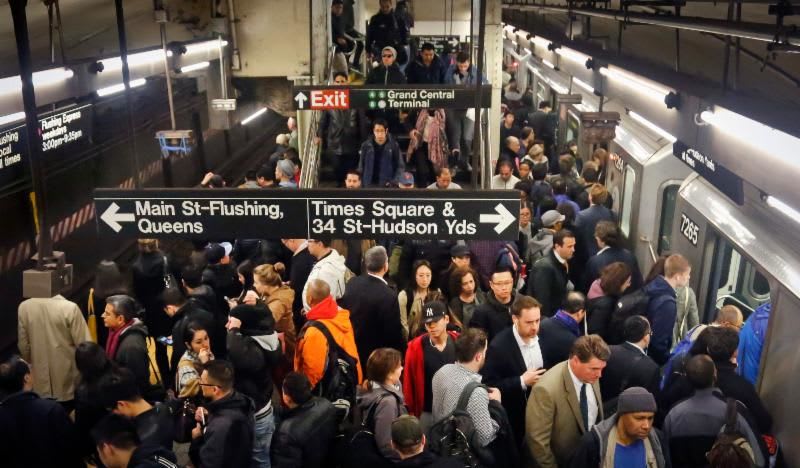
Ultra-wideband tech. could lead to better tracking of trains and buses, and potentially eliminate the need for turnstiles, tickets or cards. Photo: University at Albany
Ultra-wideband tech. could lead to better tracking of trains and buses, and potentially eliminate the need for turnstiles, tickets or cards. Photo: University at Albany
Researchers with the University at Albany have taken the first steps toward possibly making turnstile-free subways a reality.
Led by Assistant Professor Hany Elgala, Ph.D., working with partners at the university's Parking and Mass Transit Services and Office of Facilities Management, the scientists studied the feasibility of applying ultra-wideband (UWB) technology to public transportation systems.
The group included those from: the Center for Technology in Government at the University at Albany (CTG at UAlbany) and the Signals & Networks Lab (SINE) within the College of Engineering and Applied Sciences.
Their methods and results are available in the recently published report, "Intelligent Transportation based UWB Positioning and Connectivity: A Proof of Concept for Improving Public Transportation."
"UWB is a wireless radio system that uses a small amount of energy for simultaneous ranging, location tracking, andtransmission of large amounts of data over a wide range of frequency bandwidths," explained G. Brian Burke, managing director of CTG at UAlbany in the report. "For public transportation, UWB could lead to better tracking of trains and buses, and potentially eliminate the need for turnstiles, tickets or cards to deposit money or swipe for payment."
"Based on the obtained results, more investigations are needed to study how the technology performs in more real-world scenario and associated conditions," Elgala said. "We believe that the UWB technology has much more to offer for metropolitan public transportation including train-to-wayside communication and obstacle detection in front of trains."
This technology, if successfully implemented, could be a boon for the millions of Americans who rely on buses, trains, and subways. In 2017 alone, the American Public Transportation Association reported 10.1 billion trips were taken on public transportation.
According to the report, the team wanted to see if UWB could hit specific levels of accuracy, consistency, and resiliency required by public transportation authorities to ensure service quality, effectiveness, and safety. Specifically, they wanted to test determining the location of a train or bus ("ranging") and to see if they could find a sensor within a "crowd" ("localization") which would be used to pay for rides without traditional turnstiles.
Working with their on-campus partners, and with commercially available ultra-wideband devices, the researchers ran tests in UAlbany's tunnels and on outdoor campus roadways to evaluate environmental and other effects on the systems. Their experiments measured reliability and precision.
For ranging, the scientists tracked a bus, between two UWB nodes about a tenth of a mile apart and in line-of-sight of each other. In that scenario, researchers could track a bus within about four inches of the vehicle's actual location. For non-line-of-sight situations, with two UWB nodes about 28 yards apart, the precision was within 20 inches.
Inside the tunnel, with six UWB nodes, scientists could locate a sensor within two inches of its actual location during localization testing.
"The best way to think of it," Burke said of the report, "is as if you had a payment card in your pocket, but just walked right onto a bus and were charged automatically, instead of stopping to swipe the payment card."
"These are just the early steps toward a turnstile-less world," said Burke. "There are levels of consistency and precision that need to be met, not to mention the policies needed to manage this kind of technology — but the impact could be felt by millions of Americans who rely on public transportation."
To learn more about UWB technology as it pertains to public transportation, visit https://www.ctg.albany.edu/projects/ultrawideband.
More Technology

From Hardware to Digital Partner: Luminator Charts Its Next Chapter
CEO Magnus Friberg discusses Luminator’s shift toward becoming a digital partner, the growing importance of software and interoperability, and how AI can help agencies improve operations and passenger experience.
Read More →
Beyond the Checklist: A Structured Approach to Transit Maintenance
Reliability-Centered Maintenance helps transit agencies move beyond routine checklists to focus limited resources on the assets and failures that have the greatest impact on safety, reliability, and service.
Read More →
NJ TRANSIT Advances Bus Technology Upgrades Across Statewide Fleet
More than 1,500 buses now feature upgraded technology designed to improve arrival predictions and provide free Wi-Fi, with deployment expected to reach nearly 2,000 buses by the end of 2026.
Read More →

Building a Flexible Path to Transit Electrification
John Hroncich discusses BAE Systems’ modular and scalable approach, lessons learned from decades of real-world operations, and how agencies can identify electrification strategies that fit their fleets.
Read More →
Biz Briefs: Alstom Lands Canadian Contract, LYT to Supply California TSP, and More
In METRO's latest installment, we take a look at recent news from Complete Coach Works, Beep, FlixBus, and more partnerships making headlines across the transportation sector.
Read More →
From Legacy Silos to Conversational Intelligence
What if transit leaders could ask any operational question and get a trusted answer in seconds? Conversational AI is transforming how agencies use their data.
Read More →
USDOT Announces Rail Vehicle Replacement Grants, Chattanooga AV Shuttle Funding
More than $191 million in federal funding will help three transit agencies replace aging rail vehicles and support a new autonomous shuttle service in Chattanooga.
Read More →
Bus Tech Talk: Keeping Transit Technicians Ahead of the Technology Curve
LA Metro’s Obed Mejia discusses technician training, evolving maintenance technology, fleet replacement, and strategies for getting the most out of today’s transit fleets.
Read More →
Biz Briefs: RIPTA Unveils New Frontrunners, Clevland RTA Adds New Siemens, and More
In METRO's latest installment, we take a look at recent news from Siemens, Prevost, Dodge, and more partnerships making headlines across the transportation sector.
Read More →
Why Simulating Pedestrian Movement Has Become Essential for Modern Rail Stations
Pedestrian microsimulation is helping rail planners identify bottlenecks, test station designs, and prepare complex transit hubs for growing passenger volumes.
Read More →