



New Yorkers have longest workweek with commute, study says
The study found that lower-wage workers often endure the most brutal commutes, and the findings suggest a need for workplace policies that help to balance work and family life, in addition to better investment in our mass transit system.


NYC subway.
Photo: frankieleon/Flickr

NYC subway.
Photo: frankieleon/Flickr
Full-time workers in New York City have longer workweeks than those in 29 other major U.S. cities when commuting times are taken into account, according to a first-of-its-kind analysis of workplace trends released by New York City Comptroller Scott M. Stringer. The study found that lower-wage workers often endure the most brutal commutes, and the findings suggest a need for workplace policies that help to balance work and family life, in addition to better investment in our mass transit system.
“New York is America’s hardest working city, but it’s a one-two punch for lower wage workers, who get paid less and travel longer to get to work,” Comptroller Stringer said. “This means employees in the Big Apple get paid less than it appears on an hourly basis, because their commutes are significantly greater than anyone else in the country. New Yorkers are dedicated, ambitious and tough, but to compete in the 21st century we need to expand our transit networks and advance policies like flexible work arrangements and predictable scheduling.”
Photo: Luke Redmond/Flickr
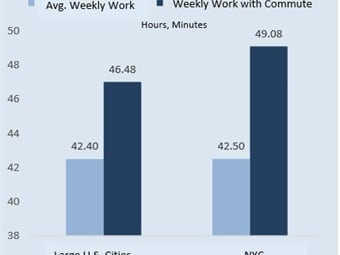
Comptroller Stringer’s study examined microdata from the 1990 and 2000 census and the 2013 American Community Survey to evaluate trends in work and commuting hours. The analysis found that full-time workers in New York City spend slightly more time at work than do workers in the next 29 largest cities, but they also spend about two hours more per week commuting — an average of 6 hours and 18 minutes per week. The combined work and commuting workweeks of New York City workers averages over 49 hours – three to four hours longer than in some other large cities.
Further findings of the study include:
In almost all common occupations, full-time New York City workers have longer combined work-commuting weeks than their counterparts in other large cities. Finance sector workers in New York City top off at 53 hours per week, almost four more hours per week than their counterparts in other cities. Longer work hours, relative to other cities, are characteristic of the majority of New York’s industries, including advertising, media, computer, and legal services. Accountants and auditors, financial managers, cashiers, and janitors and building cleaners also have unusually long workweeks.
Occupations like security guards and home health care workers are heavily burdened by longer work weeks and commutes. While employees in higher paid sectors can afford to live closer to the City’s core in areas well-served by mass transit, lower-wage workers increasingly live in neighborhoods outside the city’s job core–forcing them to spend more time commuting and less time with family. For instance, security guards have the longest commutes, spending more than eight hours per week commuting on average. Nursing and home health aides and maids and housekeepers also report long commutes, while chief executives, physicians and surgeons report some of the shortest commutes.
Significantly fewer women with children work in New York City than in other cities across the country. The Labor Force Participation Rate for New York City women with children is 3 percentage points lower than the average of the other 29 cities in the study and well below that of Boston, Philadelphia and San Francisco. Fewer working mothers in New York City work part time than in other large cities, and the rate of working from home is about the same. Despite the long workweeks and commutes, there is no evidence that workers in New York City have greater scheduling or telecommuting flexibility than workers elsewhere.
On average, New York City’s full-time workers earned about 16% more than workers did in other large cities in 2013. However, when New Yorkers’ longer work hours and commutes are factored in, that wage advantage plays out in dramatically different ways. Some higher-income groups, like lawyers and judges, retained an effective wage premium of 15% , while others, such as cooks (8%) and waiters and waitresses (4%) did not benefit as much from their lengthy workweeks. The situation is reversed at the lower end of the spectrum: Due to long commutes and lower pay, nursing and home health care aides earned an effective wage premium that was 11% less than their counterparts in other large cities even before adjusting for the higher cost of living.
“If New York City is going to symbolize the American Dream, we can’t be a nightmare when it comes to long work hours and commuting. Our residents deserve better. We need to give New Yorkers a 21st century transit system and better utilize women’s skills so that they don’t have to choose between work and family,” Stringer concluded.
- See more at: http://comptroller.nyc.gov/newsroom/comptroller-stringer-report-finds-new-york-is-americas-hardest-working-city/#sthash.cE791Kex.dpuf
More Management

METRO Opens Submissions for 2026 Motorcoach Awards
Nominations are now being accepted for METRO Magazine’s Operator of the Year and Innovative Operator of the Year awards.
Read More →
New York MTA Advances Final Contract for Second Avenue Subway Expansion
Contract Four is the largest in the Second Avenue Subway Phase 2 project and includes construction of station infrastructure, tracks, and signals for the subway expansion, MTA officials said. Work on Contract Four will begin in 2027.
Read More →
Transit Agencies Highlight Safety Gains at National Summit
Leaders from 15 major transit systems shared crime-reduction results and safety initiatives while discussing the role of continued federal support.
Read More →

NITA Names New Leadership, Expands Reduced-Fare Program at First Board Meeting
The new regional transit authority appointed its first board chair and interim executive director while extending reduced fares across CTA, Metra, and Pace for eligible riders.
Read More →
Beyond the Checklist: A Structured Approach to Transit Maintenance
Reliability-Centered Maintenance helps transit agencies move beyond routine checklists to focus limited resources on the assets and failures that have the greatest impact on safety, reliability, and service.
Read More →
APTA 2026 Nominating Committee Selects Leadership Slate, Names Chair and Vice Chair Nominees
Leadership changes will help shape the association’s priorities and its representation of the transportation industry during the 2026–2027 term.
Read More →
DART Launches Major Security, Fare Enforcement Initiative
The 90-day demonstration will deploy coordinated security teams at five light rail stations while testing controlled access and gathering data to guide future investments.
Read More →
Advancing Fare Collection Through Technology and Innovation
Learn about delivering 1300 gates at 91 stations while managing fare evasion. Explore the large scale deployment, solution customization and real-world results that affect the region. Prepare for deployment in your region now.
Read More →
Game Day in Motion: Moving Millions During the 2026 World Cup
Between packed transit stations and team motorcoaches, see how agencies and operators across North America tackled the transportation demands of the 2026 FIFA World Cup.
Read More →
Surface Transportation Extension Averts Shutdown, Leaves Transit Funding Gap
The stopgap keeps federal transportation programs moving, but missing advance funding could complicate the transit and rail projects agencies are planning next.
Read More →