




Related: Making trains safer through advanced communications
NTSB: Amtrak engineer’s loss of situational awareness led to derailment
The Washington-to-New York City passenger train, Amtrak 188, was traveling at 106 mph around a curve in Philadelphia when it derailed May 12, 2015. Eight passengers were killed and more than 180 others were sent to area hospitals, some with critical injuries.
May 18, 2016
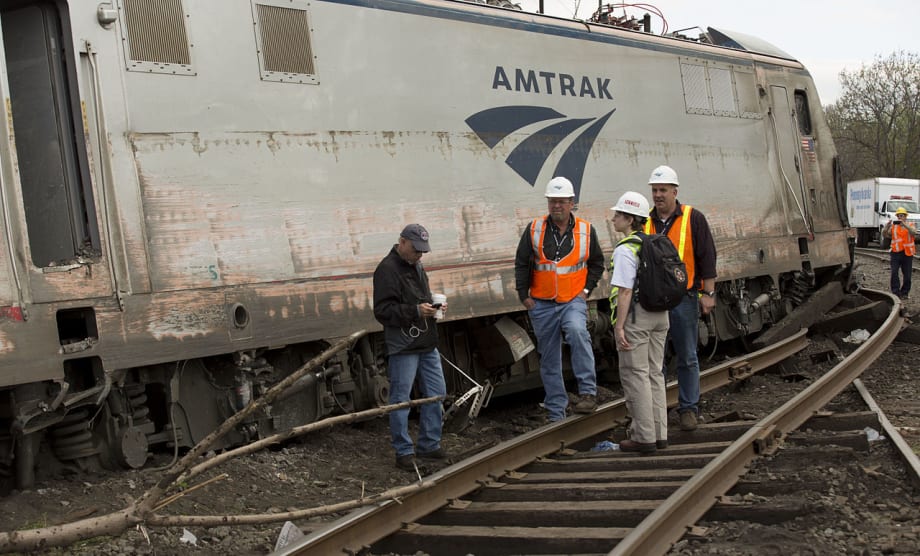
NTSB
3 min to read
NTSB
The May 2015 derailment of an Amtrak train in Philadelphia was the result of a loss of situational awareness by the train’s engineer after his attention was diverted to an emergency involving another train, the National Transportation Safety Board announced in a public meeting on Tuesday.
The Washington-to-New York City passenger train, Amtrak 188, was traveling at 106 mph around a curve in Philadelphia — more than twice the authorized speed of 50 mph — when it derailed May 12, 2015. Eight passengers were killed and more than 180 others were sent to area hospitals, some with critical injuries.
“It’s widely understood that every person, no matter how conscientious and skilled, is fallible, which is why technology was developed to backstop human vulnerabilities,” said NTSB Chairman Christopher A. Hart. “Had positive train control been in place on that stretch of track, this entirely preventable tragedy would not have happened.”
NTSB investigators who interviewed the Amtrak engineer described him as “very cooperative.” At the time of the accident he was not impaired by any substance and was not using his cell phone. There was no evidence that he was fatigued or suffering from any pre-existing medical condition while operating the train on the night of the accident.
In interviews the Amtrak engineer indicated that he was concerned for the well-being of a commuter train engineer, whose locomotive had just been struck by an object, spraying that engineer with glass from the windshield. The radio communications about that emergency, in which the Amtrak engineer participated and listened, lasted six minutes and, preceded the derailment by less than one minute.
Investigators determined the Amtrak engineer became distracted by the emergency involving the commuter train and lost situational awareness as to where his train was located in relation to the curve with the 50 mph speed restriction. The acceleration past 100 mph before entering the curve where the derailment occurred was consistent with a belief that his train had already passed the curve into an area of relatively straight track where the authorized speed was 110 mph.
The survival factors aspect of the investigation revealed some of the windows failed to remain intact throughout the accident sequence. Investigators said if the windows had not failed, some passengers who were ejected from the train and killed would likely have remained inside the train and survived.
In 1970 the NTSB recommended that then-available technology — that could prevent collisions, overspeed accidents and protect track workers — be implemented on the nation’s railroads; the NTSB has advocated for it ever since. At Tuesday’s meeting, NTSB members expressed frustration with the slow progress of positive train control implementation, which for passenger trains was previously required to be completed by the end of 2015 before Congress extended the deadline until 2018 and delayed enforcement of the regulation for two years beyond that.
“Unless positive train control is implemented soon, I’m very concerned that we’re going to be back in this room again, hearing investigators detail how technology that we have recommended for more than 45 years could have prevented yet another fatal rail accident,” Hart said.
The opening and closing statements, presentations, accident synopsis, findings, probable cause and safety recommendations are available here.
More Rail

New York MTA Advances Final Contract for Second Avenue Subway Expansion
Contract Four is the largest in the Second Avenue Subway Phase 2 project and includes construction of station infrastructure, tracks, and signals for the subway expansion, MTA officials said. Work on Contract Four will begin in 2027.
Read More →
San Diego MTS Breaks Monthly Trolley Ridership Record
Agency officials said July’s ridership indicates MTS’s continued recovery from the pandemic.
Read More →
Report Examines NJ TRANSIT Reliability, Funding Challenges
The Garden State Initiative analysis examines the roles of Amtrak infrastructure, fleet management, and agency operations while recommending a more performance-based approach to improving reliability.
Read More →
Stadler, CapMetro Sign Long-Term Rail Fleet Support Agreement
Beginning in 2027, Stadler will provide on-site technical expertise, spare parts support, training, and obsolescence management to help extend the reliability and longevity of CapMetro’s GTW fleet.
Read More →
Biz Briefs: Alstom Lands Canadian Contract, LYT to Supply California TSP, and More
In METRO's latest installment, we take a look at recent news from Complete Coach Works, Beep, FlixBus, and more partnerships making headlines across the transportation sector.
Read More →
CATS Gold Line Marks 5 Years of Service, 2.8M Passenger Trips
With a six-mile expansion planned, the Charlotte streetcar is positioned to connect more neighborhoods and major transit hubs across the region.
Read More →
Why Simulating Pedestrian Movement Has Become Essential for Modern Rail Stations
Pedestrian microsimulation is helping rail planners identify bottlenecks, test station designs, and prepare complex transit hubs for growing passenger volumes.
Read More →
Amtrak Begins Major Construction at New York’s Sunnyside Yard
The new maintenance facility will support Amtrak’s Airo trainsets while improving maintenance efficiency and turnaround times in New York.
Read More →
Chicago Leaders Unveil Plans for O’Hare Airport Express Train
The privately developed project would offer a 15-minute trip between downtown and O’Hare’s Terminal 2, with trains operating every 15 minutes on a dedicated track. The service would use battery-electric trains and three existing freight rail rights-of-way.
Read More →
OCTA Maps Out 30-Year Strategy to Protect Coastal Rail Corridor
The draft feasibility report identifies strategies to protect the coastal rail line for decades as the agency continues near-term stabilization and sand placement efforts.
Read More →