



NTSB briefs Congress on limited investigation of WMATA derailment
The train derailed at an interlocking about 50 feet from the East Falls Church station platform. Approximately 75 passengers were evacuated to the wayside and onto the station platform. The trailing truck of the fourth railcar and the leading truck from the fifth railcar derailed.

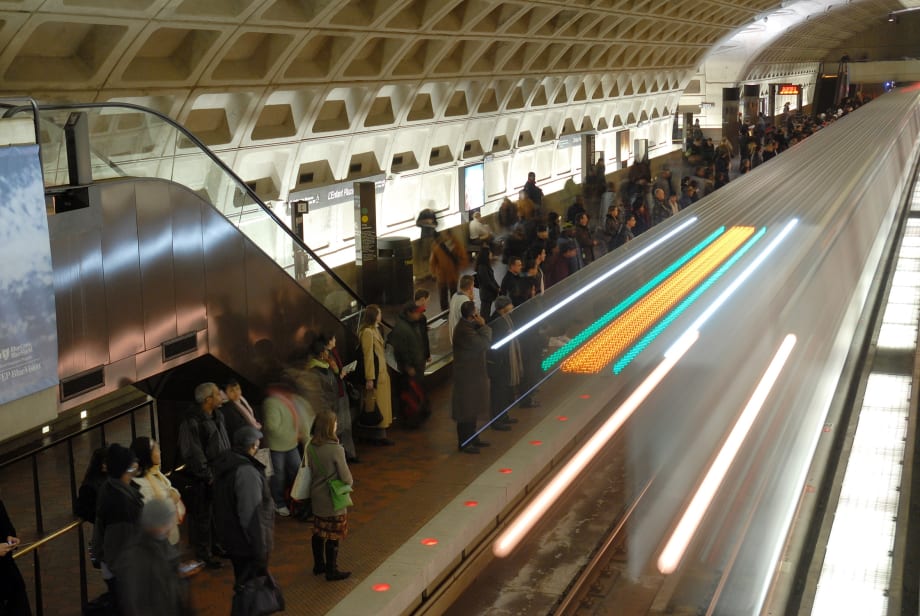
WMATA/Larry Levine
WMATA/Larry Levine
The National Transportation Safety Board (NTSB) presented to Congressional staff for members of Congress from the region, as well as committee staff with oversight for transportation safety, the agency’s findings from a limited investigation of the July 29, 2016, derailment of a Washington Metropolitan Area Transit Authority (WMATA) train.
The NTSB dispatched two investigators to the scene of the Orange Line train 602 derailment near East Falls Church, Va., to assess the accident and to determine if a broader investigation was necessary.
The train derailed at an interlocking about 50 feet from the East Falls Church station platform. Approximately 75 passengers were evacuated to the wayside and onto the station platform. The trailing truck of the fourth railcar and the leading truck from the fifth railcar derailed. There were three reported injuries; one resulted in the passenger being transported to and subsequently released by, Arlington hospital. The other two passengers were evaluated and refused further medical attention. Service was suspended on the track after the derailment and resumed on Monday.
In this limited investigation the NTSB did not state probable cause, but did convey findings of fact, including:
NTSB investigators noted a 59-inch gage (the distance between the rails of the track) in the location of the derailment. WMATA standards require that track gage greater than 57-1/4 inches be removed from service.
Investigators noted a severe defective tie condition in the accident area. WMATA standards call for 12 non-defective crossties in this area. Further WMATA standards require no more than 10 feet between non-defective ties. In the subject location investigators found more than 30 feet of track with no effective crossties.
In response to the findings of the NTSB investigators and WMATA’s own investigation, the transit agency told the NTSB it is taking the following actions:
Conduct a Stand Down Wednesday, to clarify the expectations for remedial actions following track inspections.
WMATA supervisors will accompany track inspectors during crossover inspections in advance of safe tracks.
Crossovers will now be included in main line track automated inspections.
Crossovers will now be inspected twice weekly as required by WMATA standards.
The NTSB’s briefing to Congressional staff for Members of Congress from the region, as well as committee staff with oversight for transportation safety, is the agency’s last update on its investigation of the derailment.
More Rail

New York MTA Advances Final Contract for Second Avenue Subway Expansion
Contract Four is the largest in the Second Avenue Subway Phase 2 project and includes construction of station infrastructure, tracks, and signals for the subway expansion, MTA officials said. Work on Contract Four will begin in 2027.
Read More →
San Diego MTS Breaks Monthly Trolley Ridership Record
Agency officials said July’s ridership indicates MTS’s continued recovery from the pandemic.
Read More →
Report Examines NJ TRANSIT Reliability, Funding Challenges
The Garden State Initiative analysis examines the roles of Amtrak infrastructure, fleet management, and agency operations while recommending a more performance-based approach to improving reliability.
Read More →
Stadler, CapMetro Sign Long-Term Rail Fleet Support Agreement
Beginning in 2027, Stadler will provide on-site technical expertise, spare parts support, training, and obsolescence management to help extend the reliability and longevity of CapMetro’s GTW fleet.
Read More →
Biz Briefs: Alstom Lands Canadian Contract, LYT to Supply California TSP, and More
In METRO's latest installment, we take a look at recent news from Complete Coach Works, Beep, FlixBus, and more partnerships making headlines across the transportation sector.
Read More →
CATS Gold Line Marks 5 Years of Service, 2.8M Passenger Trips
With a six-mile expansion planned, the Charlotte streetcar is positioned to connect more neighborhoods and major transit hubs across the region.
Read More →
Why Simulating Pedestrian Movement Has Become Essential for Modern Rail Stations
Pedestrian microsimulation is helping rail planners identify bottlenecks, test station designs, and prepare complex transit hubs for growing passenger volumes.
Read More →
Amtrak Begins Major Construction at New York’s Sunnyside Yard
The new maintenance facility will support Amtrak’s Airo trainsets while improving maintenance efficiency and turnaround times in New York.
Read More →
Chicago Leaders Unveil Plans for O’Hare Airport Express Train
The privately developed project would offer a 15-minute trip between downtown and O’Hare’s Terminal 2, with trains operating every 15 minutes on a dedicated track. The service would use battery-electric trains and three existing freight rail rights-of-way.
Read More →
OCTA Maps Out 30-Year Strategy to Protect Coastal Rail Corridor
The draft feasibility report identifies strategies to protect the coastal rail line for decades as the agency continues near-term stabilization and sand placement efforts.
Read More →