



NTSB: Mechanical failure caused fatal Seattle crash
Improper manufacturing by Ride the Ducks International, the vehicle manufacturer, and inadequate maintenance by Ride the Ducks of Seattle, the vehicle owner and operator, resulted in the axle failure that subsequently led to the loss of vehicle control.

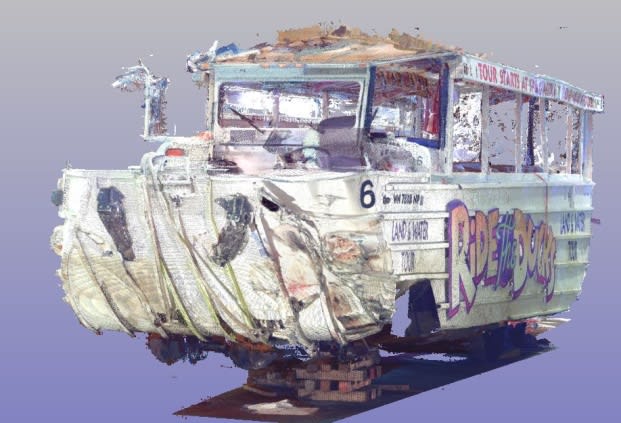
Linked 3D laser scans depicting frontal damage on the accident DUKW vehicle. Courtesy NTSB
Linked 3D laser scans depicting frontal damage on the accident DUKW vehicle. Courtesy NTSB
The National Transportation Safety Board (NTSB) determined that the mechanical failure of the left front axle of an amphibious passenger vehicle is the probable cause of a fatal 2015 collision involving the amphibious passenger vehicle, a motorcoach, and three passenger vehicles on the Aurora Bridge, in Seattle.
Improper manufacturing by Ride the Ducks International, the vehicle manufacturer, and inadequate maintenance by Ride the Ducks of Seattle, the vehicle owner and operator, resulted in the axle failure that subsequently led to the loss of vehicle control, according to the NTSB’s final report.
The lane crossover crash occurred when the driver of the DUCK 6 amphibious passenger vehicle lost control while traveling northbound across the Aurora Bridge and veered into the southbound center lane, where the motorcoach was traveling. The DUCK 6 struck the motorcoach, killing five motorcoach passengers, and injuring 71 others on both vehicles. Three other vehicles were damaged during the crash sequence.
Contributing to the passenger injuries were the lack of occupant crash protections for the amphibious passenger vehicle and the high impact forces of the crash. Occupant protection is an issue area on the NTSB Most Wanted List of safety improvements.
“This was not a case of an impaired, fatigued, or distracted driver or of any inappropriate actions by either driver. Rather, the crash was due to a mechanical failure on the amphibious passenger vehicle that should have been addressed,” said NTSB Chairman Christopher A. Hart. “This crash is a cautionary tale of what can happen when a manufacturer does not follow established rules about fixing safety defects.”
The docket material for the Seattle crash investigation — which contains interview summaries, investigative group factual reports, relevant photos, maintenance records, and a video study from a surveillance camera that captured the final crash sequence — is available here.
More Motorcoach

METRO Opens Submissions for 2026 Motorcoach Awards
Nominations are now being accepted for METRO Magazine’s Operator of the Year and Innovative Operator of the Year awards.
Read More →
Biz Briefs: Alstom Lands Canadian Contract, LYT to Supply California TSP, and More
In METRO's latest installment, we take a look at recent news from Complete Coach Works, Beep, FlixBus, and more partnerships making headlines across the transportation sector.
Read More →
Biz Briefs: RIPTA Unveils New Frontrunners, Clevland RTA Adds New Siemens, and More
In METRO's latest installment, we take a look at recent news from Siemens, Prevost, Dodge, and more partnerships making headlines across the transportation sector.
Read More →
People Movement: Holly Arnold Joins Transdev and More
In this edition, we also cover recent appointments and announcements at Pace, CamTran, MCI, and more, showcasing the individuals helping to shape the future of transportation.
Read More →
ABA Report: Motorcoach Travel Generates $161.6B Economic Impact
The 2025 analysis finds motorcoach travel supported nearly 900,000 jobs and generated $28 billion in federal, state, and local taxes.
Read More →
CharterUP’s Armir Harris on Technology, AI, and the Future of Group Mobility
In a recent episode of METROspectives, CharterUP Founder/CEO Armir Harris discussed the company’s evolution from an online charter bus marketplace into a technology platform supporting public- and private-sector mobility and much more.
Read More →
People Movement: ABC Names John Walsh as Chief Commercial Officer
In this edition, METRO also covers recent appointments and announcements at the DART, STV, and more, showcasing the individuals helping to shape the future of transportation.
Read More →
From Surviving to Thriving: Building Stronger Transportation Organizations
Bus Business Consultants founder Brian Dickson shares lessons on leadership, organizational health, and creating options for long-term success in a changing transportation industry.
Read More →
Biz Briefs: Luminator Marks Milestone and More
From manufacturers and suppliers to transit agencies and motorcoach operators, these updates offer a snapshot of the projects, partnerships and business moves driving the industry forward.
Read More →
ABAF Study Reveals Growing Insurance Crisis for Motorcoach Operators
Preliminary findings show 98% of operators faced premium increases over the past five years, while shrinking insurer participation is putting added pressure on businesses and customers.
Read More →