



NY MTA testing new system-wide app, launches responsive website
Includes real-time arrival info for trains and buses, and a unified trip-planning function for travel across the network.

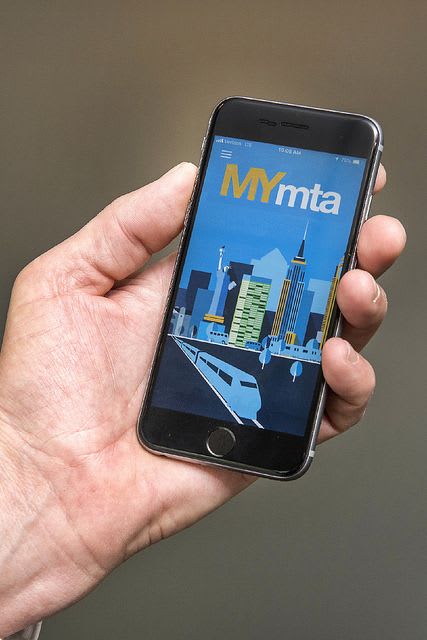
The Metropolitan Transportation Authority launched a test version of “MYmta,” a comprehensive new app. Photo: PatrickCashin-MTA

The Metropolitan Transportation Authority launched a test version of “MYmta,” a comprehensive new app. Photo: PatrickCashin-MTA
The Metropolitan Transportation Authority (MTA) launched a test version of “MYmta,” a comprehensive new app, along with new.mta.info, its new mobile-optimized website. The MTA is asking its customers to use the feedback functions on the app and the website to provide feedback on what features they like, what can be improved, and what should be added.
Both the app and the website bring wayfinding for all of the MTA’s mass transit properties under one roof, providing:
Real-time arrival information for trains, subways and buses.
Service status, including information on planned work and updates on the causes of delays.
The ability to find nearby stations and stops with the click of a button.
A unified trip-planning function for travel across the MTA’s regional transportation network including trains, subways and buses, as well as non-MTA entities such as Staten Island Ferry, NYC Ferry Service, PATH, and New Jersey Transit.
The ability for customers with mobility challenges to plan accessible trips across trains, subways and buses.
The ability to personalize the app by saving favorite lines, stations, stops and trips.
The MTA plans to add functionality related to the bridges and tunnels it operates in a subsequent version of the app.
The new app is currently available in the Apple and Google Play app stores.
The MYmta app and website were developed based on outreach with more than 2,000 customers through surveys, one-on-one interviews and conversations with riders in the subways, buses and rail roads, according to MTA officials.
As part of developing the MYmta app, the MTA has begun a process of data improvement and modernization, building an improved data infrastructure that includes new trip planning engines, enhanced monitoring, and more.
Updating the MTA’s digital infrastructure also improves the quality of the information the authority provides to the third-party developers who take advantage of its open data policy.
MY Access-A-Ride/MYAAR
Within the MYmta app, the MTA is also building in special functionality for Paratransit customers, in a part of the app that is going to be known as MY Access-A-Ride [or MYAAR]. It will enable Paratransit users to plan and manage their trips, book rides, track the real-time location of their driver, and give us feedback on what’s working and what isn’t, all from their mobile phone, tablet, laptop or desktop computer. MYAAR is currently being tested by Paratransit customers, and is slated to launch this summer.
Research & Outreach
To hone in on the most important features required for the MYmta and the MYAAR experience, the MTA performed extensive customer outreach in order to understand their specific needs.
The six-month development cycle included surveys, and over 180 hours of one-on-one interviews and in-system ‘intercepts’ in which the MTA approached customers in the system, showed them features on the app, and recorded their feedback.
As part of its research, the MTA also spoke with Paratransit users, joined them on rides, and held several workshops through which customers helped design potential solutions and prioritized the app features most important to them.
Going forward, the MTA is committed to further developing the app and website in direct response to customer feedback.
Upcoming Features
Based on customer feedback the MTA has developed a series of features that will be added to the app and website in the months ahead, including the ability to track buses in real time; a feature that will enable customers to report issues in the system; and customized alerts in the app.
All of these features are currently slated to roll out later this summer, but customers can visit the MTA’s test website at new.mta.info and help decide what features are most important by giving them a ‘thumbs up’ or ‘thumbs down.’ The page listing the upcoming features is here: https://new.mta.info/whats-next
Existing MTA Apps
Existing MTA apps, including Subway Time, Bus Time, LIRR Train Time and Metro-North Train Time, and The Weekender will all continue to live on serving our customers until the MTA receives enough customer feedback indicating that their needs are better served through the new app and website.
More Technology

From Hardware to Digital Partner: Luminator Charts Its Next Chapter
CEO Magnus Friberg discusses Luminator’s shift toward becoming a digital partner, the growing importance of software and interoperability, and how AI can help agencies improve operations and passenger experience.
Read More →
Beyond the Checklist: A Structured Approach to Transit Maintenance
Reliability-Centered Maintenance helps transit agencies move beyond routine checklists to focus limited resources on the assets and failures that have the greatest impact on safety, reliability, and service.
Read More →
NJ TRANSIT Advances Bus Technology Upgrades Across Statewide Fleet
More than 1,500 buses now feature upgraded technology designed to improve arrival predictions and provide free Wi-Fi, with deployment expected to reach nearly 2,000 buses by the end of 2026.
Read More →

Building a Flexible Path to Transit Electrification
John Hroncich discusses BAE Systems’ modular and scalable approach, lessons learned from decades of real-world operations, and how agencies can identify electrification strategies that fit their fleets.
Read More →
Biz Briefs: Alstom Lands Canadian Contract, LYT to Supply California TSP, and More
In METRO's latest installment, we take a look at recent news from Complete Coach Works, Beep, FlixBus, and more partnerships making headlines across the transportation sector.
Read More →
From Legacy Silos to Conversational Intelligence
What if transit leaders could ask any operational question and get a trusted answer in seconds? Conversational AI is transforming how agencies use their data.
Read More →
USDOT Announces Rail Vehicle Replacement Grants, Chattanooga AV Shuttle Funding
More than $191 million in federal funding will help three transit agencies replace aging rail vehicles and support a new autonomous shuttle service in Chattanooga.
Read More →
Bus Tech Talk: Keeping Transit Technicians Ahead of the Technology Curve
LA Metro’s Obed Mejia discusses technician training, evolving maintenance technology, fleet replacement, and strategies for getting the most out of today’s transit fleets.
Read More →
Biz Briefs: RIPTA Unveils New Frontrunners, Clevland RTA Adds New Siemens, and More
In METRO's latest installment, we take a look at recent news from Siemens, Prevost, Dodge, and more partnerships making headlines across the transportation sector.
Read More →
Why Simulating Pedestrian Movement Has Become Essential for Modern Rail Stations
Pedestrian microsimulation is helping rail planners identify bottlenecks, test station designs, and prepare complex transit hubs for growing passenger volumes.
Read More →