



Public-private partnership formed to test Metra reverse-commute
Metra to work with businesses and governments to add Milwaukee North trains


Metra and Lake County Partners agreed to a public-private partnership that would work together to investigate the viability of increased service. Photo: Metra
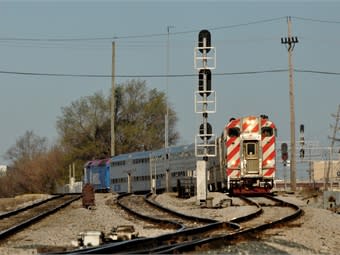
Metra and Lake County Partners agreed to a public-private partnership that would work together to investigate the viability of increased service. Photo: Metra
Metra has reached an agreement with business and civic groups in Lake County to share the costs of a potential two-year pilot project for two new reverse-commute trains on the Milwaukee District North Line and to work on a definitive agreement to share the cost of installing a universal crossover near Lake Forest, which would create additional opportunities for enhanced service.
The public-private partnership agreement, which must be approved by the Metra Board of Directors, is the culmination of a process that began with an appearance by Lake County officials at a Metra Board meeting in April. The officials asked Metra to explore ways to improve reverse-commute service to Lake County in order for them to effectively recruit and retain employees living in Chicago. They also argued that better train service would reduce pollution and roadway congestion and improve employee productivity and satisfaction.
After several months of discussion, Metra and Lake County Partners, an economic development corporation affiliated with Lake County businesses and government, agreed to a public-private partnership that would work together to investigate the viability of increased service. The groups will evenly split the $1.4 million cost of operating one new reverse-commute train in each rush period as part of a two-year demonstration project and work on a definitive agreement to divide the $4.75 million cost of installing a crossover near Lake Forest, with the partners contributing $2.75 million, Metra contributing $1 million and local governments contributing $1 million.
“At a time when Metra is pinched for operating and capital funding, this partnership is an innovative way to test the demand for service to Lake County and potentially improve our infrastructure,” said Metra CEO/Executive Director Jim Derwinski. “We are hopeful that this initiative will build our ridership, help local businesses to recruit top talent and have a positive impact on economic activity in Lake County.”
Metra’s current schedule is not ideal for reverse-commute riders to and from Lake Forest, the station closest to several major employers including AbbVie, Horizon Pharma and others. There are no morning outbound express trains, and the afternoon trains are either too early or too late for most workers.
Changes to the current schedule were not possible until recently, when Metra upgraded the signal system on the line, creating more flexibility.
If the pilot project shows that there is a strong market for reverse-commute service and that the service is self-sustaining, the partners agree to enter into an agreement to fund the construction of a new crossover near the Lake Forest Station. A crossover allows trains to switch between tracks. Constructing a crossover at Lake Forest would allow Metra to turn trains around at that location, which would create an opportunity for better service in the morning and evening rush periods if demand supported it.
More Rail

New York MTA Advances Final Contract for Second Avenue Subway Expansion
Contract Four is the largest in the Second Avenue Subway Phase 2 project and includes construction of station infrastructure, tracks, and signals for the subway expansion, MTA officials said. Work on Contract Four will begin in 2027.
Read More →
San Diego MTS Breaks Monthly Trolley Ridership Record
Agency officials said July’s ridership indicates MTS’s continued recovery from the pandemic.
Read More →
Report Examines NJ TRANSIT Reliability, Funding Challenges
The Garden State Initiative analysis examines the roles of Amtrak infrastructure, fleet management, and agency operations while recommending a more performance-based approach to improving reliability.
Read More →
Stadler, CapMetro Sign Long-Term Rail Fleet Support Agreement
Beginning in 2027, Stadler will provide on-site technical expertise, spare parts support, training, and obsolescence management to help extend the reliability and longevity of CapMetro’s GTW fleet.
Read More →
Biz Briefs: Alstom Lands Canadian Contract, LYT to Supply California TSP, and More
In METRO's latest installment, we take a look at recent news from Complete Coach Works, Beep, FlixBus, and more partnerships making headlines across the transportation sector.
Read More →
CATS Gold Line Marks 5 Years of Service, 2.8M Passenger Trips
With a six-mile expansion planned, the Charlotte streetcar is positioned to connect more neighborhoods and major transit hubs across the region.
Read More →
Why Simulating Pedestrian Movement Has Become Essential for Modern Rail Stations
Pedestrian microsimulation is helping rail planners identify bottlenecks, test station designs, and prepare complex transit hubs for growing passenger volumes.
Read More →
Amtrak Begins Major Construction at New York’s Sunnyside Yard
The new maintenance facility will support Amtrak’s Airo trainsets while improving maintenance efficiency and turnaround times in New York.
Read More →
Chicago Leaders Unveil Plans for O’Hare Airport Express Train
The privately developed project would offer a 15-minute trip between downtown and O’Hare’s Terminal 2, with trains operating every 15 minutes on a dedicated track. The service would use battery-electric trains and three existing freight rail rights-of-way.
Read More →
OCTA Maps Out 30-Year Strategy to Protect Coastal Rail Corridor
The draft feasibility report identifies strategies to protect the coastal rail line for decades as the agency continues near-term stabilization and sand placement efforts.
Read More →