



QLINE aims to popularize streetcars in Detroit
The $144 million QLINE, built as a local catalyst project, began rolling May 12, 2017 on a 3.3-mile segment of Woodward Avenue.
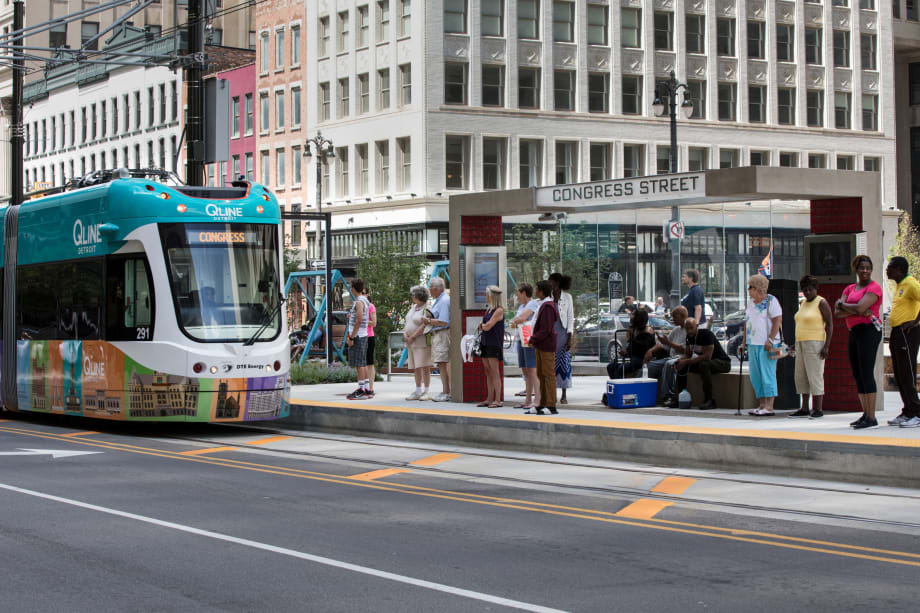
M-1 RAIL, the QLINE's nonprofit owner and operator, projects that the QLINE will average 5,000 rides in its first year and up to 8,000 rides within five years. Photo: HNTB
M-1 RAIL, the QLINE's nonprofit owner and operator, projects that the QLINE will average 5,000 rides in its first year and up to 8,000 rides within five years. Photo: HNTB
Streetcar transportation has returned to Detroit, to the benefit of mobility and economic development.
The $144 million QLINE, built as a local catalyst project, began rolling May 12, 2017 on a 3.3-mile segment of Woodward Avenue. The six QLINE vehicles provide efficient, convenient transportation to the city's most important destinations for business, medical care, education, art, sports, and entertainment.
M-1 RAIL, the QLINE's nonprofit owner and operator, projects that the QLINE will average 5,000 rides in its first year and up to 8,000 rides within five years.
The QLINE represents a big step forward for Detroit, which went through municipal bankruptcy in 2013 and 2014. About 10 years ago, city business and educational leaders agreed that mass transit in the region needed a jump start, and that Woodward Avenue was the place to begin.
"It would connect all of our key assets up and down the corridor," said Paul Childs, chief operating officer of M-1 RAIL. "The achievement of getting this done in Detroit at that time is very important, because nothing like that had happened in a very long time."
How the plan came together
The group that planned the streetcar established owner-operator M-1 RAIL and M-2 RAIL, the developer-builder, as nonprofit 501(c)(3) organizations. The combination of the two entities enabled the streetcar to receive New Market Tax funding and via the Michigan Department of Transportation, two federal grants totaling $37.2 million. In addition, more than $100 million in business and philanthropic donations was raised by private entities.
The nonprofit structure of the key organizations made it essential that the streetcar project not go over budget.
"We looked for project delivery methods that would deliver the project on time and within budget while minimizing risk," said Matt Webb, sr. project manager for HNTB, which served as the owner's representative and on the QLINE project.
Utilities, visuals and vehicles
One of the strategies that carried M-1 over the finish line was working cooperatively with utility companies, Childs said.
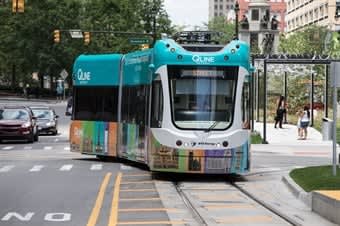
Six QLINE vehicles provide efficient, convenient transportation to Detroit's most important destinations for business, medical care, education, art, sports, and entertainment. Photo: HNTB
A 3-D model of underground utility infrastructure in the corridor, created by HNTB, demonstrated to the utility companies that not all of their assets would have to be relocated.
M-1 also sought to minimize visual disruptions along the route. To attain that goal, off-wire technology (using lithium-ion batteries) was deployed on approximately 60% of the line.
American-headquartered Brookville Equipment Corp., based in Brookville, Pennsylvania, was selected to provide the modern streetcar. Their Liberty Streetcar was selected to carry passengers based on its ability to meet the off-wire demands and goals Detroit and M-1 RAIL were looking to achieve.
Revving up the economy
The QLINE has juiced economic development up and down its route. "Once the project put a shovel in the ground (in 2013), that's when it became real for everybody," Childs said. "That's when the economic development story took root. Over that time frame until now, there's been a little north of $7 billion of finished, under-construction or committed projects along the corridor."
How to replicate the QLINE's success
The QLINE was built on partnerships. "It's all about the business community, the philanthropic community, local, state and federal governments, all getting together," Childs said. "If everybody gets together, there are a lot of things you can do."
More Rail

New York MTA Advances Final Contract for Second Avenue Subway Expansion
Contract Four is the largest in the Second Avenue Subway Phase 2 project and includes construction of station infrastructure, tracks, and signals for the subway expansion, MTA officials said. Work on Contract Four will begin in 2027.
Read More →
San Diego MTS Breaks Monthly Trolley Ridership Record
Agency officials said July’s ridership indicates MTS’s continued recovery from the pandemic.
Read More →
Report Examines NJ TRANSIT Reliability, Funding Challenges
The Garden State Initiative analysis examines the roles of Amtrak infrastructure, fleet management, and agency operations while recommending a more performance-based approach to improving reliability.
Read More →
Stadler, CapMetro Sign Long-Term Rail Fleet Support Agreement
Beginning in 2027, Stadler will provide on-site technical expertise, spare parts support, training, and obsolescence management to help extend the reliability and longevity of CapMetro’s GTW fleet.
Read More →
Biz Briefs: Alstom Lands Canadian Contract, LYT to Supply California TSP, and More
In METRO's latest installment, we take a look at recent news from Complete Coach Works, Beep, FlixBus, and more partnerships making headlines across the transportation sector.
Read More →
CATS Gold Line Marks 5 Years of Service, 2.8M Passenger Trips
With a six-mile expansion planned, the Charlotte streetcar is positioned to connect more neighborhoods and major transit hubs across the region.
Read More →
Why Simulating Pedestrian Movement Has Become Essential for Modern Rail Stations
Pedestrian microsimulation is helping rail planners identify bottlenecks, test station designs, and prepare complex transit hubs for growing passenger volumes.
Read More →
Amtrak Begins Major Construction at New York’s Sunnyside Yard
The new maintenance facility will support Amtrak’s Airo trainsets while improving maintenance efficiency and turnaround times in New York.
Read More →
Chicago Leaders Unveil Plans for O’Hare Airport Express Train
The privately developed project would offer a 15-minute trip between downtown and O’Hare’s Terminal 2, with trains operating every 15 minutes on a dedicated track. The service would use battery-electric trains and three existing freight rail rights-of-way.
Read More →
OCTA Maps Out 30-Year Strategy to Protect Coastal Rail Corridor
The draft feasibility report identifies strategies to protect the coastal rail line for decades as the agency continues near-term stabilization and sand placement efforts.
Read More →