



Question of the Day: Uber, Lyft - Friend or Foe?
We asked top public transit officials, including Brad Miller, Matthew Tucker, Carm Basile, Karl Gnadt, Kevin Kane, Rob Gannon and Nathaniel Ford Sr. if they see services like Uber and Lyft as a threat to public transit or as potential partners?

Basile
We asked top public transit officials, including Brad Miller, Matthew Tucker, Carm Basile, Karl Gnadt, Kevin Kane, Rob Gannon and Nathaniel Ford Sr. if they see services like Uber and Lyft as a threat to public transit or as potential partners?

Tucker
Matthew Tucker, CEO
North County Transit District
Oceanside, Calif.
I believe that service providers such as Uber and Lyft are assets to public transportation — specifically in support of first and last mile service, demand-response service and other service models that are not cost-effective with our traditional ‘mass’ transit business model. From my perspective, we have to take a toolbox approach to meeting transportation needs and recognize that different business models may provide a more cost-effective approach to meeting a market demand, which creates the opportunity for us as transit providers to focus our resources on where we can achieve the highest return on investment.

Miller
Brad Miller, CEO
Pinellas Suncoast Transit Authority
St. Petersburg, Fla.
Partners, definitely. At PSTA, we are proud to be the first transit system in the nation to partner with Uber to get riders to and from the bus stop — helping solve that first mile/last mile issue that all transit faces. Our partnership with Uber is expanding further with a new deal [that will allow] late-night transit riders, who work past our last bus, to get a free Uber home. I’m proud of my agency team for seeing this new technology, not as a threat, but as a complement to the mobility we provide for our customers.
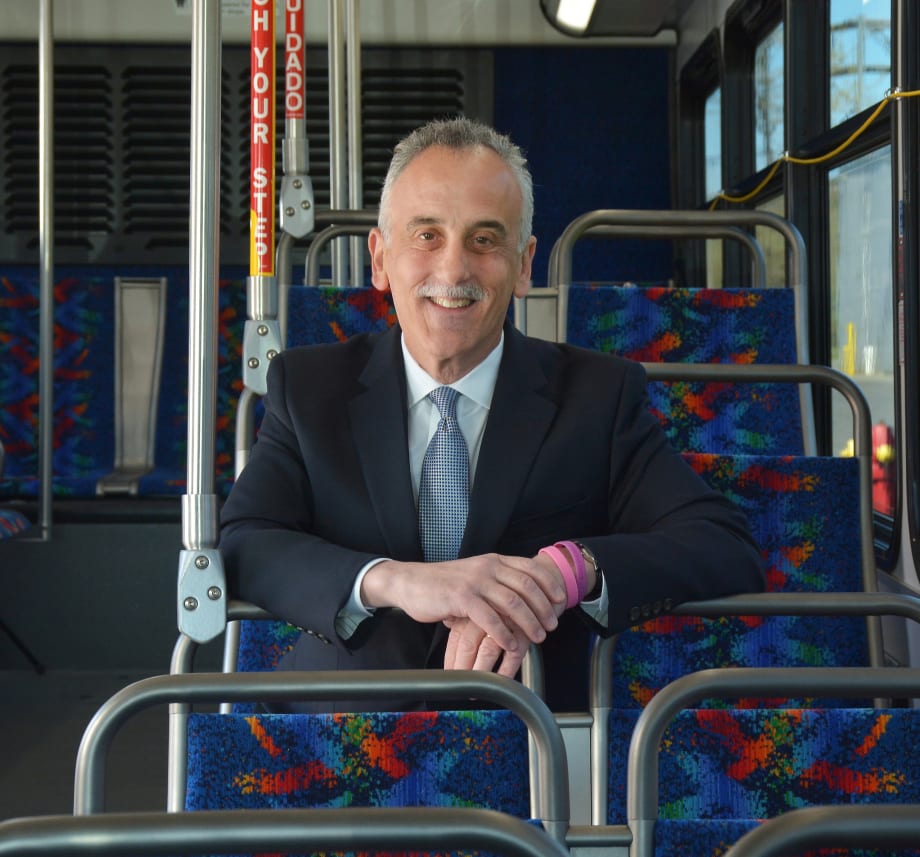
Basile
Carm Basile, CEO
Capital District Transportation Authority
Albany, N.Y.
We don’t view ridesharing services like Uber and Lyft as a threat to public transit, in fact, we see them providing an opportunity for innovative partnerships and collaboration. In many cities where Uber and Lyft are established, transit systems are working with them to address things like the last mile of travel, which has always posed a challenge for transit systems — big and small. In the Capital Region, we want to work with ridehailing and local taxi companies to address mobility issues. We want to use our mobile application and payment systems to develop seamless entry into the mobility universe. Technology is a great thing, and we want to use it to give customers a menu of options that will allow them to move throughout our region easily and conveniently.

Gnadt
Karl Gnadt, CEO/Managing Director
Champaign-Urbana Mass Transit District
Urbana, Ill.
The Champaign-Urbana Mass Transit District (MTD) prefers to think of alternative mobility providers, such as ridershare, carshare and bicyclists, as mobility partners. Our mission is to lead the way to greater mobility and oftentimes that means that public transportation is only one important rung on the ladder of travel. In our community, which includes a highly-educated, environmentally-conscious, and technologically-savvy constituency, facilitating ease of travel through whatever means possible will only benefit MTD. Ultimately, it’s about getting people where they need to go, and ridershare services can help reach that goal.
Kane
Kevin Kane, Executive Director
Victor Valley Transit Authority
Hesperia, Calif.
VVTA is a small agency approximately 90 miles northeast of LA. As such, we currently have little to no Uber or Lyft available in our service area. Still, VVTA views them as potential partners. In fact, through our Mobility Management department we are actually reaching out to Uber and Lyft to develop services that can meet the mobility needs for our local hospital/medical center friends. Since our service area is so spread out (approximately 950 mi.²) we see these services, just as many larger agencies do, as a resource for first/last mile options. If Uber, Lyft, autonomous vehicles, or other yet to be identified transportation innovations can assist transit and save taxpayers’ dollars, VVTA is all for that.

Gannon
Rob Gannon, Interim GM
King County Metro Transit
Seattle
I believe strongly in the concept that you can compete to claim value, but when you collaborate, you create value. If we view TNCs only as competitors, then we aren’t paying enough attention to our shared interest: efficient mobility. The transit industry can move more people more efficiently, but in some situations TNCs can provide service with greater agility, such as last mile, and evening or night service. If we find innovative ways to partner with Uber and Lyft to expand access for all, we create better outcomes for customers — more choices, more access and more convenience. Then, communities as a whole benefit with less frustration, less congestion and less pollution. That makes more sense than having TNCs compete for our customers and make inefficient use of roadway space and limited energy resources.

Ford
Nathaniel P. Ford Sr., CEO
Jacksonville Transportation Authority
Jacksonville, Fla.
The JTA believes ride-sharing or transportation network companies, along with traditional taxi services, can be potential partners that can provide the “first and last mile” connectivity. With more than 90 percent of JTA customers walking or biking to a bus stop, the path to and from the bus is critical. As mobility managers, we recognize that holistic transportation solutions are important for the industry and for APTA. Transit providers must understand the impacts of the sharing economy as well as emerging autonomous vehicles technology and be prepared to adapt to how people want to approach mobility. It will fundamentally change transportation and JTA has committed resources to research and develop strategies to make sure we can respond to the changing marketplace and be a leader in developing mobility solutions. In addition, infrastructure such as bike lanes, parking facilities and pedestrian friendly enhancements such as sidewalk and ADA ramps complement traffic management to create a seamless and robust transportation network.
More Management

METRO Opens Submissions for 2026 Motorcoach Awards
Nominations are now being accepted for METRO Magazine’s Operator of the Year and Innovative Operator of the Year awards.
Read More →
New York MTA Advances Final Contract for Second Avenue Subway Expansion
Contract Four is the largest in the Second Avenue Subway Phase 2 project and includes construction of station infrastructure, tracks, and signals for the subway expansion, MTA officials said. Work on Contract Four will begin in 2027.
Read More →
Transit Agencies Highlight Safety Gains at National Summit
Leaders from 15 major transit systems shared crime-reduction results and safety initiatives while discussing the role of continued federal support.
Read More →

NITA Names New Leadership, Expands Reduced-Fare Program at First Board Meeting
The new regional transit authority appointed its first board chair and interim executive director while extending reduced fares across CTA, Metra, and Pace for eligible riders.
Read More →
Beyond the Checklist: A Structured Approach to Transit Maintenance
Reliability-Centered Maintenance helps transit agencies move beyond routine checklists to focus limited resources on the assets and failures that have the greatest impact on safety, reliability, and service.
Read More →
APTA 2026 Nominating Committee Selects Leadership Slate, Names Chair and Vice Chair Nominees
Leadership changes will help shape the association’s priorities and its representation of the transportation industry during the 2026–2027 term.
Read More →
DART Launches Major Security, Fare Enforcement Initiative
The 90-day demonstration will deploy coordinated security teams at five light rail stations while testing controlled access and gathering data to guide future investments.
Read More →
Advancing Fare Collection Through Technology and Innovation
Learn about delivering 1300 gates at 91 stations while managing fare evasion. Explore the large scale deployment, solution customization and real-world results that affect the region. Prepare for deployment in your region now.
Read More →
Game Day in Motion: Moving Millions During the 2026 World Cup
Between packed transit stations and team motorcoaches, see how agencies and operators across North America tackled the transportation demands of the 2026 FIFA World Cup.
Read More →
Surface Transportation Extension Averts Shutdown, Leaves Transit Funding Gap
The stopgap keeps federal transportation programs moving, but missing advance funding could complicate the transit and rail projects agencies are planning next.
Read More →