




RELATED: NY MTA plans to pilot smart batteries at subway power substation
Rail tunnel heat could be captured to warm homes, research says
Heat from the tunnel would cover up to 80% of the heating needs of local apartments in Lausanne, Switzerland throughout winter.
July 3, 2019
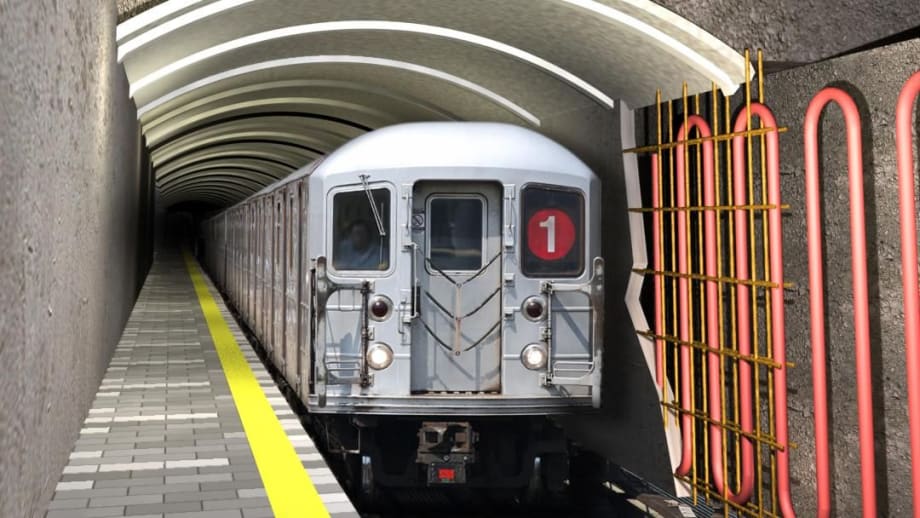
Researchers at Lausanne, Switzerland-based EPFL’s Soil Mechanics Laboratory are studying uses for heat captured in rail tunnels.
© LMS-2019 EPFL
3 min to read
Researchers at Lausanne, Switzerland-based EPFL’s Soil Mechanics Laboratory are studying uses for heat captured in rail tunnels.
© LMS-2019 EPFL
Heat transfer happens in various ways in rail tunnels. For instance, when trains brake or accelerate, they produce heat that warms the surrounding air. That hot air mixes with other air in the tunnel and with heat radiating from the ground.
Until now, engineers have been unable to accurately calculate the amount of heat that tunnel air contains. Researchers at Lausanne, Switzerland-based EPFL’s Soil Mechanics Laboratory (LMS) have overcome that problem by precisely estimating the convection heat transfer coefficient. Their findings have been published in Applied Thermal Engineering.
This breakthrough paves the way for innovative applications involving so-called energy tunnels that can supply energy to built environments. The team also tested its model on Lausanne’s future M3 metro line which, once complete, will carry passengers between the city’s train station and the Blécherette district to the north.
Enough heat for 1,500 apartments
“Our research shows that fitting the heat-recovery system along 50 – 60% of the planned route — or 60,000 square meters of tunnel surface area — would cover the heating needs of 1,500 standard 80m2 apartments, or as many as 4,000 Minergie-certified energy-efficient units,” explains Margaux Peltier, a scientific assistant at the LMS, whose Master’s research forms the basis of the article. The system also allows heat to be stored so it can be supplied to homes when needed. “Switching from gas-fired heating would cut the city’s CO2 emissions by two million tons per year,” adds Peltier.
As the temperature naturally stabilizes in underground tunnels, excess heat or cold is evacuated to the surface. The resulting warm airflow can often be felt at metro tunnel entrances. The idea behind the innovation is to harness this surplus warmth in addition to heat naturally present in the ground.
The system works in a similar way to a refrigerator, with plastic pipes containing heat-transfer fluid, or simply water, placed at regular intervals inside the concrete tunnel walls and connected to a heat pump. In winter, cold water will be pumped into the pipes, emerging hot at the surface. The opposite will happen in summer. According to the researchers, the system would be cheap and energy-efficient to install and would have a lifespan of between 50 and 100 years, with only the heat pumps having to be replaced every 25 years.
Heating and air-conditioning
Once equipped, heat from the tunnel would cover up to 80% of the heating needs of local apartments throughout winter, with the shortfall preferably coming from other renewable sources. But what makes geothermal systems like these unique is that they work in summer too. “The tunnel would act like a highly reliable, year-round heating and air-conditioning system,” says Peltier, adding that it would make a real difference to keeping Lausanne’s homes cool during hot weather. The system could even chill the ice rink set to be built in the city.
More Rail

New York MTA Advances Final Contract for Second Avenue Subway Expansion
Contract Four is the largest in the Second Avenue Subway Phase 2 project and includes construction of station infrastructure, tracks, and signals for the subway expansion, MTA officials said. Work on Contract Four will begin in 2027.
Read More →
San Diego MTS Breaks Monthly Trolley Ridership Record
Agency officials said July’s ridership indicates MTS’s continued recovery from the pandemic.
Read More →
Report Examines NJ TRANSIT Reliability, Funding Challenges
The Garden State Initiative analysis examines the roles of Amtrak infrastructure, fleet management, and agency operations while recommending a more performance-based approach to improving reliability.
Read More →
Stadler, CapMetro Sign Long-Term Rail Fleet Support Agreement
Beginning in 2027, Stadler will provide on-site technical expertise, spare parts support, training, and obsolescence management to help extend the reliability and longevity of CapMetro’s GTW fleet.
Read More →
Biz Briefs: Alstom Lands Canadian Contract, LYT to Supply California TSP, and More
In METRO's latest installment, we take a look at recent news from Complete Coach Works, Beep, FlixBus, and more partnerships making headlines across the transportation sector.
Read More →
CATS Gold Line Marks 5 Years of Service, 2.8M Passenger Trips
With a six-mile expansion planned, the Charlotte streetcar is positioned to connect more neighborhoods and major transit hubs across the region.
Read More →
Why Simulating Pedestrian Movement Has Become Essential for Modern Rail Stations
Pedestrian microsimulation is helping rail planners identify bottlenecks, test station designs, and prepare complex transit hubs for growing passenger volumes.
Read More →
Amtrak Begins Major Construction at New York’s Sunnyside Yard
The new maintenance facility will support Amtrak’s Airo trainsets while improving maintenance efficiency and turnaround times in New York.
Read More →
Chicago Leaders Unveil Plans for O’Hare Airport Express Train
The privately developed project would offer a 15-minute trip between downtown and O’Hare’s Terminal 2, with trains operating every 15 minutes on a dedicated track. The service would use battery-electric trains and three existing freight rail rights-of-way.
Read More →
OCTA Maps Out 30-Year Strategy to Protect Coastal Rail Corridor
The draft feasibility report identifies strategies to protect the coastal rail line for decades as the agency continues near-term stabilization and sand placement efforts.
Read More →