



Rebrand, Tech Upgrades Link Connect Transit with Community
Connect Transit's efforts have resulted in a 40% increase in ridership over the last three years and the honor of being named APTA's 2015 Outstanding Public Transportation System for agencies providing fewer than four million passenger trips annually.

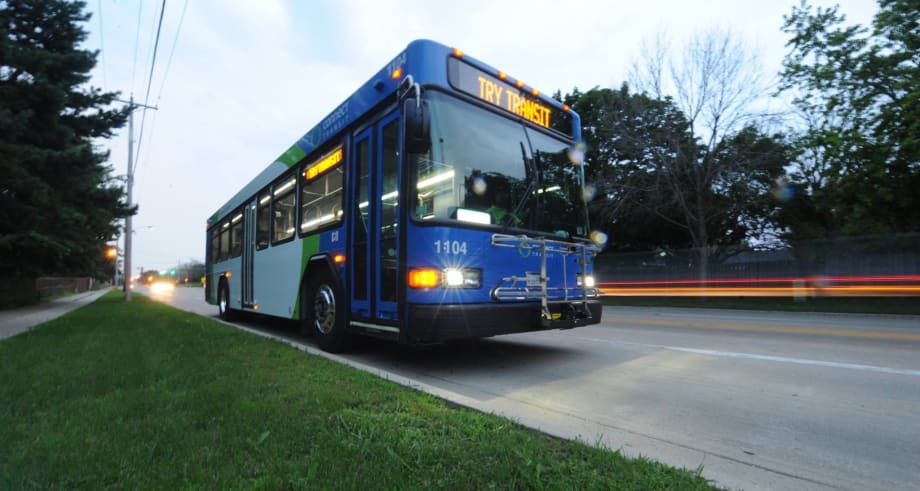
Along with the brand reboot, Connect Transit also focused heavily on the addition of technology.
Photo: Connect Transit
The Bloomington-Normal Public Transit System was formed in 1972, effectively providing fixed-route bus and paratransit for several years; however, it was not necessarily well-known in the two Central Illinois communities it served.
“The system really just chugged along for a number of decades without changing very much,” explained GM Andrew Johnson, who joined the agency in 2011. “The system liked to stay under the radar and didn’t really get out in the community to show them the gem they had in public transportation. One of the main things was the buses were nondescript, to the point where people didn’t even notice them.”
To remedy that, the agency rebranded itself as Connect Transit, with a new blue/green/white color scheme.
“In Bloomington-Normal they have separate everything — separate police and fire departments, water, you name it. The one thing they work together on is transit,” Johnson explained. “It’s a joint effort for the city and the town, so we seized upon that because not only do we connect people with all the places they want to go, we actually connect the two communities on more than just a transportation level.”
Implementing New Tech
Along with the brand reboot, the agency also focused heavily on the addition of technology. To that end, Connect Transit launched a redesigned website with a user-friendly trip planner, up-to-date detour information and an interactive experience with social media. The agency also launched a mobile bus tracking, accessible online or via a mobile phone app, which allows riders to see their buses in real time down to the minute it will be arriving at its next stop.
“We really did not have much technology in place, so we had to start from scratch on a lot of stuff,” said Johnson. “The bus tracking app has proved to be very popular, and we were able to get it done using fairly inexpensive wireless tablet-based technology.”
Connect also implemented paratransit scheduling software, fleet maintenance software, accounting software and a narrowband radio system.
Additionally, the agency began re-establishing its relationship with the city of Bloomington and the town of Normal by focusing on both internal and external customer service.
“We saw there was really a lot of untapped potential for ridership in our community and that was simply because we weren’t reaching out to the customer. We weren’t trying to go above and beyond their expectations,” Johnson said. “For transit-dependent individuals, it was what it was, and they rode the system, but for choice riders and the like, it wasn’t on their radar, so we upped the bar quite a bit on customer service.”
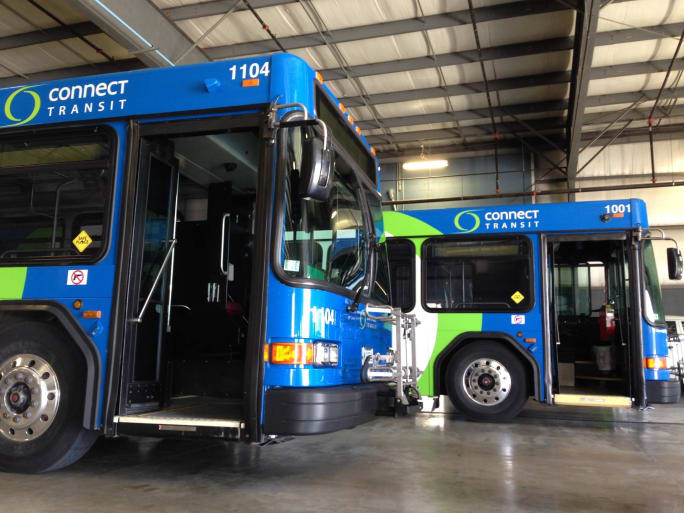
Connect Transit’s efforts have resulted in a 40% increase in ridership over the last three years and the honor of being named APTA’s 2015 Outstanding Public Transportation System for agencies providing fewer than four million passenger trips annually.
Photo: Connect Transit
Investing in Workforce and More
Connect made significant investments in workforce development, enabling participation in numerous external training opportunities offered by APTA, the National Transit Institute and the Transit Safety Institute, among others. ASE transit certification is encouraged for maintenance personnel and is paid for by the transit system. Vendors are also regularly invited to perform cost-effective on-site training for larger groups of staff members.
The agency also created a supervisor development program to ensure proper training of the next generation of Connect Transit leaders and a tuition reimbursement program was implemented to advance employee education.
Connect Transit’s efforts have resulted in a 40% increase in ridership over the last three years and the honor of being named APTA’s 2015 Outstanding Public Transportation System for agencies providing fewer than four million passenger trips annually.
“It’s one of those things where no one person can really take credit for the whole thing,” said Johnson of the honor. “You have to have the right board in place. You have to have the right sentiment in the community that they want transit to succeed. And, you have to have the right team of employees in place to make it happen, and that we were able to have that all come together at the same time, has just been a wonderful thing.”
More Management

METRO Opens Submissions for 2026 Motorcoach Awards
Nominations are now being accepted for METRO Magazine’s Operator of the Year and Innovative Operator of the Year awards.
Read More →
New York MTA Advances Final Contract for Second Avenue Subway Expansion
Contract Four is the largest in the Second Avenue Subway Phase 2 project and includes construction of station infrastructure, tracks, and signals for the subway expansion, MTA officials said. Work on Contract Four will begin in 2027.
Read More →
Transit Agencies Highlight Safety Gains at National Summit
Leaders from 15 major transit systems shared crime-reduction results and safety initiatives while discussing the role of continued federal support.
Read More →

NITA Names New Leadership, Expands Reduced-Fare Program at First Board Meeting
The new regional transit authority appointed its first board chair and interim executive director while extending reduced fares across CTA, Metra, and Pace for eligible riders.
Read More →
Beyond the Checklist: A Structured Approach to Transit Maintenance
Reliability-Centered Maintenance helps transit agencies move beyond routine checklists to focus limited resources on the assets and failures that have the greatest impact on safety, reliability, and service.
Read More →
APTA 2026 Nominating Committee Selects Leadership Slate, Names Chair and Vice Chair Nominees
Leadership changes will help shape the association’s priorities and its representation of the transportation industry during the 2026–2027 term.
Read More →
DART Launches Major Security, Fare Enforcement Initiative
The 90-day demonstration will deploy coordinated security teams at five light rail stations while testing controlled access and gathering data to guide future investments.
Read More →
Advancing Fare Collection Through Technology and Innovation
Learn about delivering 1300 gates at 91 stations while managing fare evasion. Explore the large scale deployment, solution customization and real-world results that affect the region. Prepare for deployment in your region now.
Read More →
Game Day in Motion: Moving Millions During the 2026 World Cup
Between packed transit stations and team motorcoaches, see how agencies and operators across North America tackled the transportation demands of the 2026 FIFA World Cup.
Read More →
Surface Transportation Extension Averts Shutdown, Leaves Transit Funding Gap
The stopgap keeps federal transportation programs moving, but missing advance funding could complicate the transit and rail projects agencies are planning next.
Read More →