




RELATED: AV Deployments Gaining in Popularity
Report finds 'Transit Leaps' needed to properly integrate with AVs
Ideal scenario for public transit planners would be an optimized, dense, and always available transit network that is also affordable.
February 19, 2019

How ownership will settle out if vehicle fleets become fully robotic is unknown. Some scenarios predict wide utilization of highly optimized robotaxi fleets.
LAVTA
2 min to read
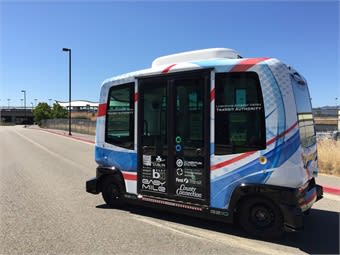
How ownership will settle out if vehicle fleets become fully robotic is unknown. Some scenarios predict wide utilization of highly optimized robotaxi fleets.
LAVTA
Mineta Transportation Institute’s (MTI) latest perspective, “Automated Vehicles have Arrived: What’s a Transit Agency to Do?” analyzes the ongoing innovations in automated and connected vehicles, commonly referred to as AVs, and how proactive transit agencies can maintain their existing mission while responding to changes on the horizon.
How ownership will settle out if vehicle fleets become fully robotic is unknown. Some scenarios predict wide utilization of highly optimized robotaxi fleets. Other scenarios start from the current state of primarily private vehicle ownership and consider a wide array of possibilities — ranging from massive sharing to just a slight increase.
While there is a celebrated upside to having driverless robotaxis provide all imagined passenger trips, it is unclear how to ensure transportation equity and access regardless of one’s ability to pay or mobility level. The ideal scenario for public transit planners would be an optimized, dense, and always available transit network that is also affordable for the rider.
Regardless, the mixture of varying levels of automated vehicles will create a complex planning environment. “We should expect at least 30 years of mixed fleets of varying levels of semi-automation,” said MTI Research Associate and author John Niles. He goes on to address the issues that will be faced in the coming years, including, distracted driving, complex and shifting transit infrastructure planning, and street re-organization among others.
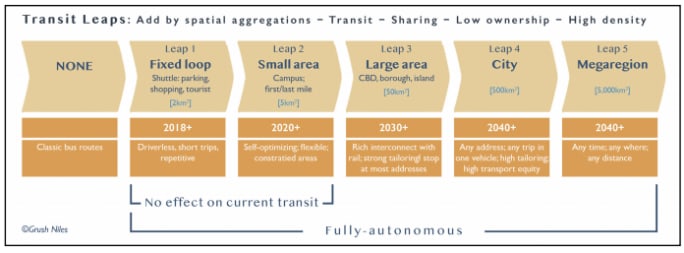
Figure. Transit Leap levels are described spatially rather than by level of autonomous operations.
For the public transit to remain a viable option, the industry must undergo a series of AV adaptations Niles refers to as “Transit Leaps.”
Transit Leap implementations occur at the highest level of autonomous operations and allow public transportation to evolve with the AV technology. Each “leap” coincides with evolving AV technology while still maintaining the essential functions of the transit system, including accessibility and affordability for riders. Beginning with first-and-last mile applications, Transit Leaps could progress through larger and more capable roll-outs toward a long-run scenario of massive shared fleets that span urban regions. Adhering to an evolutionary model, transit agencies will be able to better manage the rapid growth of AVs as transportation drives into the future.
More Technology

From Hardware to Digital Partner: Luminator Charts Its Next Chapter
CEO Magnus Friberg discusses Luminator’s shift toward becoming a digital partner, the growing importance of software and interoperability, and how AI can help agencies improve operations and passenger experience.
Read More →
Beyond the Checklist: A Structured Approach to Transit Maintenance
Reliability-Centered Maintenance helps transit agencies move beyond routine checklists to focus limited resources on the assets and failures that have the greatest impact on safety, reliability, and service.
Read More →
NJ TRANSIT Advances Bus Technology Upgrades Across Statewide Fleet
More than 1,500 buses now feature upgraded technology designed to improve arrival predictions and provide free Wi-Fi, with deployment expected to reach nearly 2,000 buses by the end of 2026.
Read More →

Building a Flexible Path to Transit Electrification
John Hroncich discusses BAE Systems’ modular and scalable approach, lessons learned from decades of real-world operations, and how agencies can identify electrification strategies that fit their fleets.
Read More →
Biz Briefs: Alstom Lands Canadian Contract, LYT to Supply California TSP, and More
In METRO's latest installment, we take a look at recent news from Complete Coach Works, Beep, FlixBus, and more partnerships making headlines across the transportation sector.
Read More →
Sponsored•September 8, 2026
From Legacy Silos to Conversational Intelligence
What if transit leaders could ask any operational question and get a trusted answer in seconds? Conversational AI is transforming how agencies use their data.
Read More →
USDOT Announces Rail Vehicle Replacement Grants, Chattanooga AV Shuttle Funding
More than $191 million in federal funding will help three transit agencies replace aging rail vehicles and support a new autonomous shuttle service in Chattanooga.
Read More →
Bus Tech Talk: Keeping Transit Technicians Ahead of the Technology Curve
LA Metro’s Obed Mejia discusses technician training, evolving maintenance technology, fleet replacement, and strategies for getting the most out of today’s transit fleets.
Read More →
Biz Briefs: RIPTA Unveils New Frontrunners, Clevland RTA Adds New Siemens, and More
In METRO's latest installment, we take a look at recent news from Siemens, Prevost, Dodge, and more partnerships making headlines across the transportation sector.
Read More →
Why Simulating Pedestrian Movement Has Become Essential for Modern Rail Stations
Pedestrian microsimulation is helping rail planners identify bottlenecks, test station designs, and prepare complex transit hubs for growing passenger volumes.
Read More →