



RTA, Calabrese agree to accelerate leadership transition
After Sept. 1, 2018, Calabrese will serve RTA in a new senior advisory role as the board begins a national search for next GM.

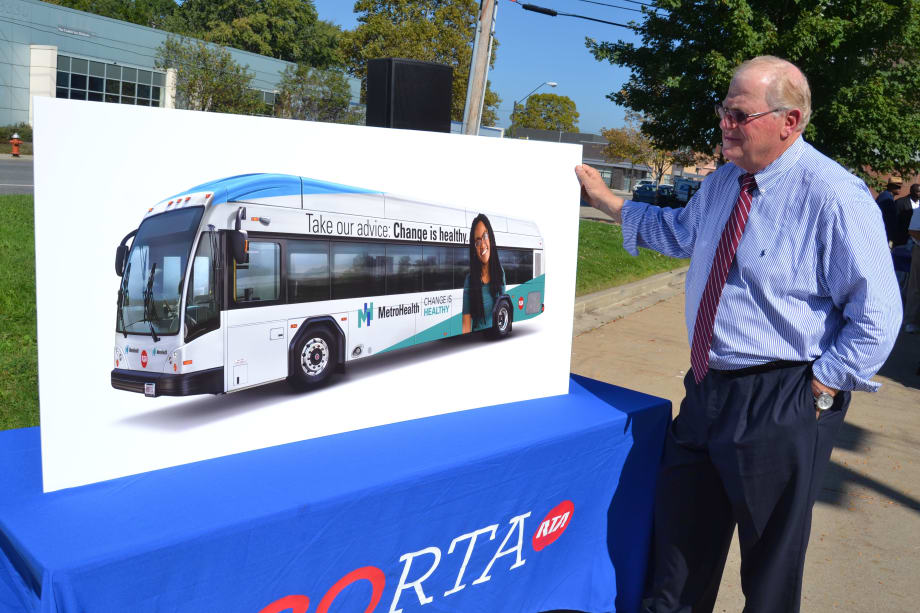
Greater Cleveland Regional Transit Authority CEO/GM Joseph Calabrese (shown) at a 2017 rebranding event. Photo: GCRTA
Greater Cleveland Regional Transit Authority CEO/GM Joseph Calabrese (shown) at a 2017 rebranding event. Photo: GCRTA
The Greater Cleveland Regional Transit Authority (RTA) Board of Trustees and CEO/GM Joseph A. Calabrese have reached an agreement to accelerate RTA’s executive leadership transition. After Sept. 1, 2018, Calabrese will serve RTA in a new senior advisory role as the board begins a national search for the agency’s next GM. Specifically:
Calabrese will continue serving as CEO/GM until Sept. 1
He will serve as Senior Advisor for Special Projects and Strategic Innovation in a full-time capacity between September 1, 2018 – February 28, 2019
He will advise RTA in this position on a part-time basis from March 1, 2019 – February 29, 2020
Board President Dennis Clough stressed that the decision was mutual and was not prompted by any single event.
“It’s the board’s responsibility to keep RTA’s big picture in focus. Joe announced his intention to retire in 2020, and we decided it would be best to speed up the transition to a new leader,” Clough said. “From an organizational standpoint, the board believes that this is the best strategy to ensure an orderly transition to new leadership, and Joe agreed. This decision will better position RTA for the future.”
Freed from the day-to-day responsibilities of running the large RTA operation, Calabrese will play a key role in important initiatives that are now launching or underway, Clough said, including:
The Cleveland State University study of RTA’s economic impact in the region
The Greater Cleveland Partnership’s operational audit, designed to help RTA learn both how it can save money and improve how it serves customers
Ongoing efforts to identify strategies and methods that lead to a well-funded public transit system, helping drive business and wealth in the region
In addition, Clough said the agency’s day-to-day operations will benefit from Calabrese’s deep transit industry experience as the search for a new GM unfolds. Calabrese has more than 43 years of experience in both the public and private sectors of the transit industry. He is the longest-serving GM in RTA history, and the longest-serving GM of any multi-modal transit system in the nation.
“Joe Calabrese has served RTA well. He led the agency through some tough times and won major awards and wide recognition for his efforts.” Clough said. “We thank him for his leadership and we look forward to working with him in his new advisory capacity.”
Trustees will name an interim GM to lead RTA when Calabrese assumes his new position in September. In his advisory role, Calabrese will report to the interim, and ultimately, to the next RTA GM.
More Management

METRO Opens Submissions for 2026 Motorcoach Awards
Nominations are now being accepted for METRO Magazine’s Operator of the Year and Innovative Operator of the Year awards.
Read More →
New York MTA Advances Final Contract for Second Avenue Subway Expansion
Contract Four is the largest in the Second Avenue Subway Phase 2 project and includes construction of station infrastructure, tracks, and signals for the subway expansion, MTA officials said. Work on Contract Four will begin in 2027.
Read More →
Transit Agencies Highlight Safety Gains at National Summit
Leaders from 15 major transit systems shared crime-reduction results and safety initiatives while discussing the role of continued federal support.
Read More →

NITA Names New Leadership, Expands Reduced-Fare Program at First Board Meeting
The new regional transit authority appointed its first board chair and interim executive director while extending reduced fares across CTA, Metra, and Pace for eligible riders.
Read More →
Beyond the Checklist: A Structured Approach to Transit Maintenance
Reliability-Centered Maintenance helps transit agencies move beyond routine checklists to focus limited resources on the assets and failures that have the greatest impact on safety, reliability, and service.
Read More →
APTA 2026 Nominating Committee Selects Leadership Slate, Names Chair and Vice Chair Nominees
Leadership changes will help shape the association’s priorities and its representation of the transportation industry during the 2026–2027 term.
Read More →
DART Launches Major Security, Fare Enforcement Initiative
The 90-day demonstration will deploy coordinated security teams at five light rail stations while testing controlled access and gathering data to guide future investments.
Read More →
Advancing Fare Collection Through Technology and Innovation
Learn about delivering 1300 gates at 91 stations while managing fare evasion. Explore the large scale deployment, solution customization and real-world results that affect the region. Prepare for deployment in your region now.
Read More →
Game Day in Motion: Moving Millions During the 2026 World Cup
Between packed transit stations and team motorcoaches, see how agencies and operators across North America tackled the transportation demands of the 2026 FIFA World Cup.
Read More →
Surface Transportation Extension Averts Shutdown, Leaves Transit Funding Gap
The stopgap keeps federal transportation programs moving, but missing advance funding could complicate the transit and rail projects agencies are planning next.
Read More →