



RTC of Southern Nevada Finds Initiatives Matching Findings of Heat Report
The “Urban Heat Island Mapping Campaign” study found that neighborhoods with the hottest temperatures are largely located in and around downtown Las Vegas, downtown North Las Vegas, the Historic Westside, and the eastern area of the valley.

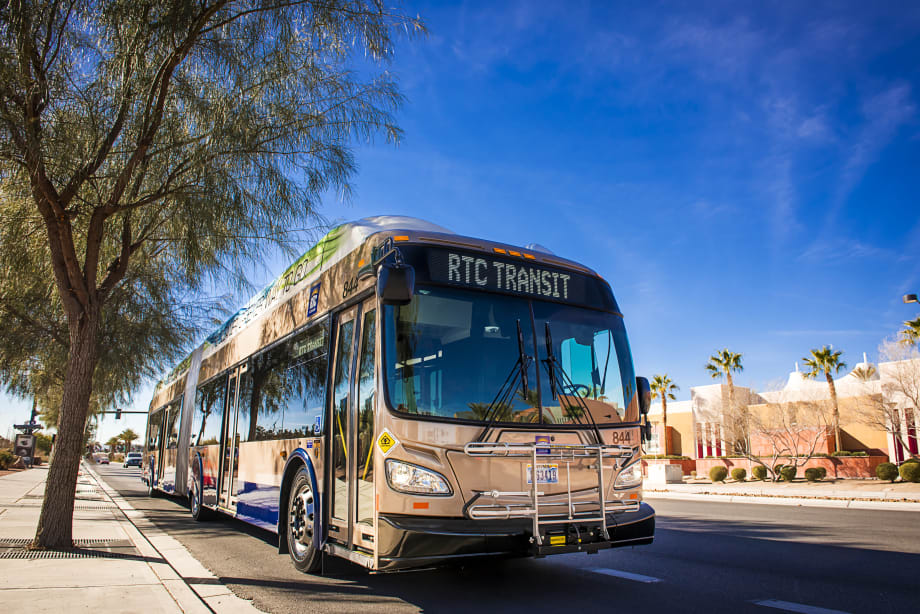
In August 2022 and January 2023, the RTC implemented service changes to improve frequencies and schedules on several routes to reduce wait times for riders, a significant enhancement particularly during the summer months.
RTC of Southern Nevada
Results from the Heat Island Mapping campaign conducted by the Regional Transportation Commission of Southern Nevada (RTC), Get Outdoors Nevada, and more than 60 community volunteers support recent transit improvements, including more frequent service and innovative new shade structures in some of the hottest areas of the Nevada valley.
In August 2022 and January 2023, the RTC implemented service changes to improve frequencies and schedules on several routes to reduce wait times for riders, a significant enhancement particularly during the summer months. And just last month, the RTC began installing a new type of “slimline” transit shelter to help mitigate the effects of heat.
Slimline shelters, funded by a $4 million federal grant, include shading to protect waiting passengers from the sun and provide more lighting at night, creating greater visibility, and added security benefits. These shelters have a smaller footprint to accommodate stops that are less than five feet from the roadway while continuing to enable access under the Americans with Disabilities Act. More than 100 slimline shelters will be installed in the valley over the coming year, with more than 80% located in and around locations that comprise the hottest 30% of the valley. The RTC will also add more than 50 traditional transit shelters throughout the same areas.
“Safety and comfort for passengers and vulnerable road users are top priorities for the RTC, and the results we gathered from the heat mapping project will help us more responsibly plan for the future,” said RTC CEO M.J. Maynard. “By better understanding which neighborhoods experience higher temperatures, we can continue to work with local jurisdictions to create initiatives that mitigate heat impacts and reduce the risks of heat-related dangers across our community.”
The “Urban Heat Island Mapping Campaign” study found that neighborhoods with the hottest temperatures are largely located in and around downtown Las Vegas, downtown North Las Vegas, the Historic Westside, and the eastern area of the valley. Most of these locations feature large proportions of pavement and buildings but lack dense concentrations of trees. Their lower elevations also result in naturally warmer temperatures than higher elevations elsewhere in the region. While hotter temperatures are generally concentrated in the central and eastern valley, all areas of the region had “hotspots.”
Equipped with special sensors mounted to their cars, more than 30 volunteer teams drove pre-mapped routes throughout the valley last summer to collect data. The teams gathered 138,000 temperature and humidity measurements that were used to create detailed maps of the distribution of heat across the valley. The interactive maps, complete project summary, and more can be found on the RTC’s website.
Southern Nevada, which has one of the fastest-warming climates in the country, was one of 14 locations in the U.S. chosen to participate in the heat mapping campaign, which was supported by the National Oceanic and Atmospheric Administration (NOAA). Local project partners included the Clark County Department of Environment and Sustainability, UNLV School of Public Health, and Get Outdoors Nevada.
More Management

METRO Opens Submissions for 2026 Motorcoach Awards
Nominations are now being accepted for METRO Magazine’s Operator of the Year and Innovative Operator of the Year awards.
Read More →
New York MTA Advances Final Contract for Second Avenue Subway Expansion
Contract Four is the largest in the Second Avenue Subway Phase 2 project and includes construction of station infrastructure, tracks, and signals for the subway expansion, MTA officials said. Work on Contract Four will begin in 2027.
Read More →
Transit Agencies Highlight Safety Gains at National Summit
Leaders from 15 major transit systems shared crime-reduction results and safety initiatives while discussing the role of continued federal support.
Read More →

NITA Names New Leadership, Expands Reduced-Fare Program at First Board Meeting
The new regional transit authority appointed its first board chair and interim executive director while extending reduced fares across CTA, Metra, and Pace for eligible riders.
Read More →
Beyond the Checklist: A Structured Approach to Transit Maintenance
Reliability-Centered Maintenance helps transit agencies move beyond routine checklists to focus limited resources on the assets and failures that have the greatest impact on safety, reliability, and service.
Read More →
APTA 2026 Nominating Committee Selects Leadership Slate, Names Chair and Vice Chair Nominees
Leadership changes will help shape the association’s priorities and its representation of the transportation industry during the 2026–2027 term.
Read More →
DART Launches Major Security, Fare Enforcement Initiative
The 90-day demonstration will deploy coordinated security teams at five light rail stations while testing controlled access and gathering data to guide future investments.
Read More →
Advancing Fare Collection Through Technology and Innovation
Learn about delivering 1300 gates at 91 stations while managing fare evasion. Explore the large scale deployment, solution customization and real-world results that affect the region. Prepare for deployment in your region now.
Read More →
Game Day in Motion: Moving Millions During the 2026 World Cup
Between packed transit stations and team motorcoaches, see how agencies and operators across North America tackled the transportation demands of the 2026 FIFA World Cup.
Read More →
Surface Transportation Extension Averts Shutdown, Leaves Transit Funding Gap
The stopgap keeps federal transportation programs moving, but missing advance funding could complicate the transit and rail projects agencies are planning next.
Read More →