



San Antonio's VIA Names New President/CEO
Jon Gary Herrera will succeed Jeffrey C. Arndt as president and CEO at VIA, beginning Jan. 4, 2025.

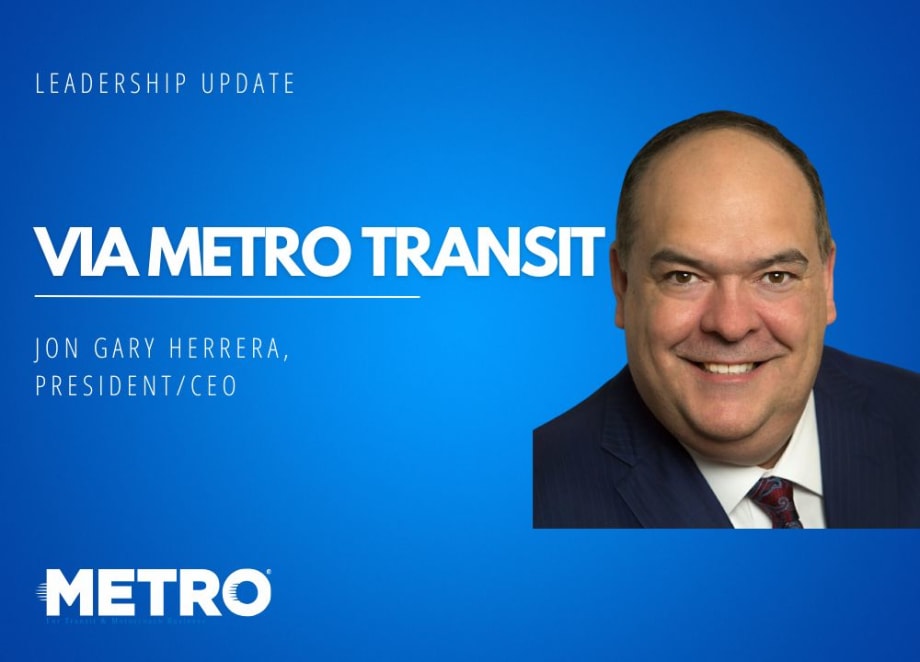
Jon Gary Herrera, a San Antonio native, has served as VIA’s sr. VP, public engagement, since 2017, overseeing efforts to deliver major milestones, including the historic 2020 initiative to secure additional funding for VIA’s Keep SA Moving plan.
Photo: VIA Metropolitan Transit
San Antonio, Texas’ VIA Metropolitan Transit board voted unanimously to appoint a new president and CEO to lead the region’s mobility provider.
Jon Gary Herrera will succeed Jeffrey C. Arndt as president and CEO at VIA, beginning Jan. 4, 2025.
Arndt’s Impact and Successor
During his tenure, Arndt and his team ushered in a time of transformation for the agency that first rolled out service in 1978 and has grown as an industry leader in safety, innovation, and customer satisfaction.
The much-decorated CEO is retiring after 40 years in the transportation industry and 13 years behind the wheel at VIA, leaving the agency as the “Most Outstanding Metropolitan Transit Authority in Texas,” a distinction earned three times under Arndt’s leadership.
Herrera, a San Antonio native, has served as VIA’s sr. VP, public engagement, since 2017, overseeing efforts to deliver major milestones, including the historic 2020 initiative to secure additional funding for VIA’s Keep SA Moving plan.
He was selected as the lone finalist for VIA’s top job at a special-called board meeting in October, where trustees approved Board Chair Fernando Reyes to negotiate a contract with Herrera.
“The board chose from among three impressive and capable internal candidates, who have each demonstrated a passion for their work and a commitment to carry us forward to the future,” said Reyes. “Every member of the team is part of Jeff’s legacy here. He will leave VIA stronger than he found it, and with the Board’s sincere thanks for a job done well, and always done with heart.”
Impact of Herrera’s Appointment
Herrera will be VIA’s first Latino president and CEO to lead the state’s second-largest transit service area in the agency’s 46 years.
“I applaud the board’s selection and congratulate Jon Gary, who will be a strong and visionary leader for the agency and the people at VIA who keep San Antonio moving, every day,” Arndt said. “Choosing from within the VIA family speaks to the strength of our leadership and the entire team, who together will continue to accomplish great things for the community we serve.”
State of the Agency
VIA has long been the least-funded major transit agency in Texas but continues to innovate to deliver more and better service for San Antonio and Bexar County.
In 2025, the agency will break ground on the region’s first Advanced Rapid Transit corridor, the VIA Rapid Green Line, connecting major job centers and neighborhoods from the San Antonio International Airport area, through Downtown and to the neighborhood near San Antonio’s historic missions.
A second VIA Rapid line, designed to connect the East and West sides, is set to begin construction in 2027.
A fifth VIA Link zone opened Downtown this fall, offering new and affordable on-demand options in the city center. And a Better Bus Plan to improve frequency and reliability on VIA’s core service routes will roll out next year.
“I’m honored to be chosen to lead VIA at a time of great progress and change for the city I was born and raised in, and where I have worked to support its continued growth and prosperity,” Herrera said. “Our board and longtime CEO have charted a path toward a more mobile future for our region. I’m proud to be part of that mission and vision, and introduce new, innovative ways we can get there, together.”
More Management

METRO Opens Submissions for 2026 Motorcoach Awards
Nominations are now being accepted for METRO Magazine’s Operator of the Year and Innovative Operator of the Year awards.
Read More →
New York MTA Advances Final Contract for Second Avenue Subway Expansion
Contract Four is the largest in the Second Avenue Subway Phase 2 project and includes construction of station infrastructure, tracks, and signals for the subway expansion, MTA officials said. Work on Contract Four will begin in 2027.
Read More →
Transit Agencies Highlight Safety Gains at National Summit
Leaders from 15 major transit systems shared crime-reduction results and safety initiatives while discussing the role of continued federal support.
Read More →

NITA Names New Leadership, Expands Reduced-Fare Program at First Board Meeting
The new regional transit authority appointed its first board chair and interim executive director while extending reduced fares across CTA, Metra, and Pace for eligible riders.
Read More →
Beyond the Checklist: A Structured Approach to Transit Maintenance
Reliability-Centered Maintenance helps transit agencies move beyond routine checklists to focus limited resources on the assets and failures that have the greatest impact on safety, reliability, and service.
Read More →
APTA 2026 Nominating Committee Selects Leadership Slate, Names Chair and Vice Chair Nominees
Leadership changes will help shape the association’s priorities and its representation of the transportation industry during the 2026–2027 term.
Read More →
DART Launches Major Security, Fare Enforcement Initiative
The 90-day demonstration will deploy coordinated security teams at five light rail stations while testing controlled access and gathering data to guide future investments.
Read More →
Advancing Fare Collection Through Technology and Innovation
Learn about delivering 1300 gates at 91 stations while managing fare evasion. Explore the large scale deployment, solution customization and real-world results that affect the region. Prepare for deployment in your region now.
Read More →
Game Day in Motion: Moving Millions During the 2026 World Cup
Between packed transit stations and team motorcoaches, see how agencies and operators across North America tackled the transportation demands of the 2026 FIFA World Cup.
Read More →
Surface Transportation Extension Averts Shutdown, Leaves Transit Funding Gap
The stopgap keeps federal transportation programs moving, but missing advance funding could complicate the transit and rail projects agencies are planning next.
Read More →