



San Antonio's VIA Ridership Up in 2023
VIA attributed the increase in ridership primarily to its frequency on key routes. The agency's ridership data confirm that there is a correlation between bus frequency and ridership.

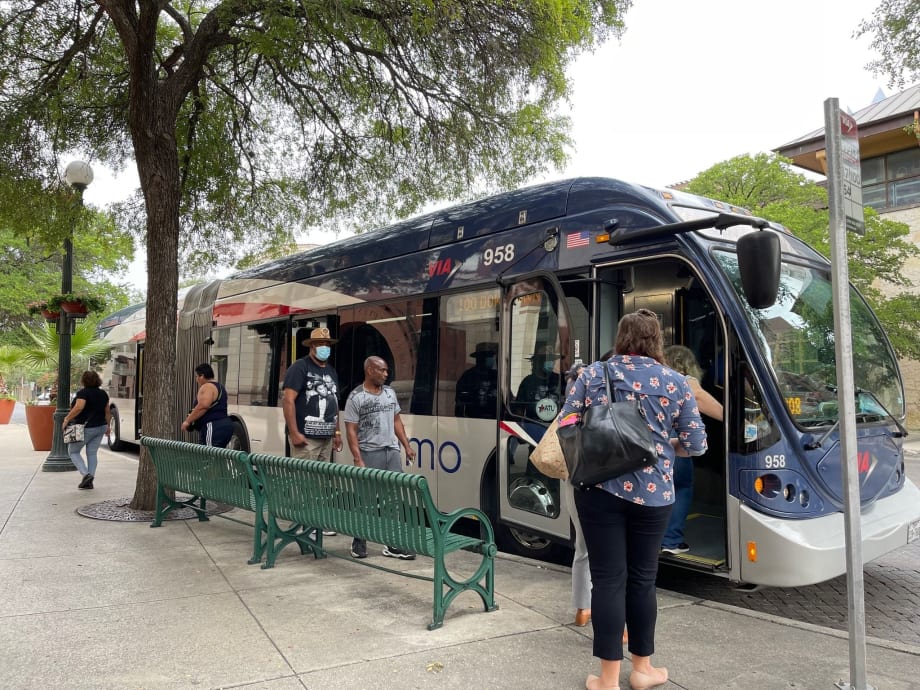
VIA found that 10 routes make up approximately half of the growth between 2022 and 2023, all of which are frequent routes that have peak service of 20 minutes or better.
Photo: VIA Metropolitan Transit
VIA Metropolitan Transit is tracking steady gains in bus ridership, signaling an upward trend for transit in San Antonio, which mirrors growth in transit ridership post-pandemic in cities across the U.S., such as Los Angeles and Chicago.
VIA attributed the increase in ridership primarily to its frequency on key routes. VIA ridership data confirm that there is a correlation between bus frequency and ridership.
VIA found that 10 routes make up approximately half of the growth between 2022 and 2023, all of which are frequent routes that have peak service of 20 minutes or better.
Areas of Boosted Ridership
The high-frequency VIA Route 552 has seen an increase of 28% year-over-year and accounts for 14% of annual growth in 2023. Additionally, VIA Prímo routes 100, 102, and 103 saw an increase of 13% to 20%, and they account for 18% of growth in 2023.
“Over the past few years, we have endured extraordinary circumstances as a community but have maintained our focus on keeping San Antonio moving forward, safely,” said VIA President/CEO Jeffrey C. Arndt. “Today, more than ever, affordable, reliable public transit is essential, and we are seeing more people use VIA to stay connected to work, school, health care, grocers and each other.”
Underpinning VIA’s ridership increase is its consistently high Net Promoter Score, or NPS. The NPS, which can range from -100 to 100, is a metric that measures customer satisfaction and loyalty, and frequency is measured as the number of buses that stop at a bus stop per hour divided by 60 minutes.
The NPS is an indicator of how likely customers are to recommend a product or service to friends and family. For VIA, the NPS applies to VIA fixed-route bus service. It’s designed to capture loyalty and helps in gauging potential growth.
The NPS scores for VIA remain high at 57 compared to the industry average of 29, as of Fall 2023, indicating that VIA customers are likely to recommend VIA as a transportation alternative.
COVID restrictions and health concerns hit every major U.S. transit agency with steep declines beginning in 2020 and some cities experienced up to an 80% drop in ridership. VIA maintained over 50% of its ridership throughout the height of the pandemic, offering safe, reliable transportation options that included increased safety protocols and essential service models.
More Management

METRO Opens Submissions for 2026 Motorcoach Awards
Nominations are now being accepted for METRO Magazine’s Operator of the Year and Innovative Operator of the Year awards.
Read More →
New York MTA Advances Final Contract for Second Avenue Subway Expansion
Contract Four is the largest in the Second Avenue Subway Phase 2 project and includes construction of station infrastructure, tracks, and signals for the subway expansion, MTA officials said. Work on Contract Four will begin in 2027.
Read More →
Transit Agencies Highlight Safety Gains at National Summit
Leaders from 15 major transit systems shared crime-reduction results and safety initiatives while discussing the role of continued federal support.
Read More →

NITA Names New Leadership, Expands Reduced-Fare Program at First Board Meeting
The new regional transit authority appointed its first board chair and interim executive director while extending reduced fares across CTA, Metra, and Pace for eligible riders.
Read More →
Beyond the Checklist: A Structured Approach to Transit Maintenance
Reliability-Centered Maintenance helps transit agencies move beyond routine checklists to focus limited resources on the assets and failures that have the greatest impact on safety, reliability, and service.
Read More →
APTA 2026 Nominating Committee Selects Leadership Slate, Names Chair and Vice Chair Nominees
Leadership changes will help shape the association’s priorities and its representation of the transportation industry during the 2026–2027 term.
Read More →
DART Launches Major Security, Fare Enforcement Initiative
The 90-day demonstration will deploy coordinated security teams at five light rail stations while testing controlled access and gathering data to guide future investments.
Read More →
Advancing Fare Collection Through Technology and Innovation
Learn about delivering 1300 gates at 91 stations while managing fare evasion. Explore the large scale deployment, solution customization and real-world results that affect the region. Prepare for deployment in your region now.
Read More →
Game Day in Motion: Moving Millions During the 2026 World Cup
Between packed transit stations and team motorcoaches, see how agencies and operators across North America tackled the transportation demands of the 2026 FIFA World Cup.
Read More →
Surface Transportation Extension Averts Shutdown, Leaves Transit Funding Gap
The stopgap keeps federal transportation programs moving, but missing advance funding could complicate the transit and rail projects agencies are planning next.
Read More →