




RELATED: SDMTS wins APTA award for pedestrian safety campaign
San Diego MTS' rail unit adopts LiDAR tech to enhance track data
The new image-enhancing technology provides pinpoint accuracy of the agency’s 106 miles of track.
May 10, 2017
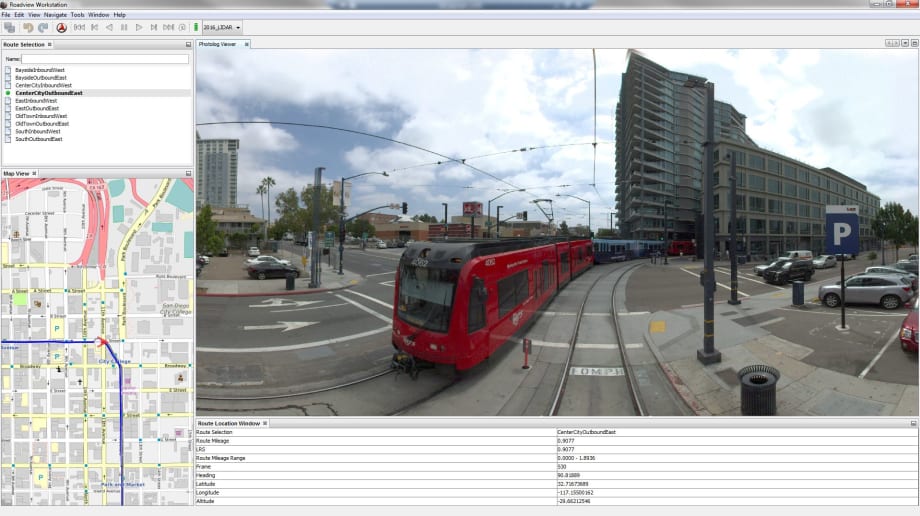
Roadview is a technology-driven software solution developed through a laser-guided mapping and detection technology called LiDAR.
3 min to read
Roadview is a technology-driven software solution developed through a laser-guided mapping and detection technology called LiDAR.
A new image-enhancing technology has been adopted by the San Diego Metropolitan Transit System’s (MTS) rail division that provides pinpoint accuracy of the agency’s 106 miles of track, and more clarity about the work ahead even before employees step foot on the right-of-way. The word is now spreading to other departments that are finding it useful as well, according to agency officials.
It’s called Roadview — a technology-driven software solution developed through a laser-guided mapping and detection technology called LiDAR.
“Roadview allows MTS to find, map, and categorize everything along the right-of-way. It’s helped our track team analyze work that needs to be done faster and more efficiently,” said Paul Jablonski, MTS CEO.
It’s similar to Google’s Street View system that offers users panoramic views from on-the-ground positions along many streets and neighborhoods in the world.
MTS hired Mandli Communications to take the Google Street View idea from the streets to the rails. Using a front-mounted camera on a Trolley that traveled on all three lines, a panorama of stitched images consisting of the entire MTS right-of-way was created.
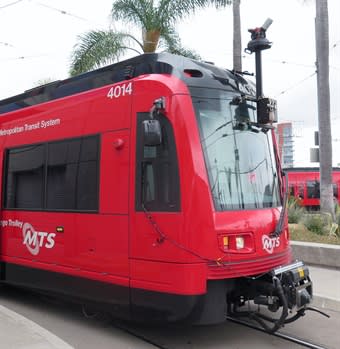
Using a front-mounted camera on a light rail vehicle that traveled on all three lines, a panorama of stitched images consisting of the entire San Diego MTS right-of-way was created.
Big proponents and users of Roadview are the MTS Track and Wayside departments. There’s a lot of ground to cover on three light rail lines operating through seven different cities. And it’s a challenge to keep up with inventory (i.e. 87 crossing gates, 115 miles of catenary wire, 63 traction substations to thousands of fasteners, nearly 300,000 cross ties, insulated joints, switches, and much more).
Track condition is primarily monitored by visual inspections. And it’s important to have these eyes and ears on the ground. But its also time consuming and cumbersome. Recording specific locations through Roadview’s GPS feature speeds up the visual inspections, maintains a strict accounting of assets and understand when and where items need to be replaced.
“It really comes in handy to pin down locations using GPS coordinates with contract work,” said Fred Byle, MTS Superintendent of Wayside Maintenance. “If a contractor pins a GPS location where we need to do repairs like cut a rail, change out a rail tie, or replace insulated joints, we can see the exact spot through Roadview. It saves a lot of time.”
And while Track and Maintenance of Wayside have found substantial benefit from Roadview, other departments are finding ways to use it as well — particularly in the classroom.
“Roadview is a perfect element for the train operator training program,” said Dave Jensen. “We are just getting into the process of using it. It shows news students all the intricacies of the system through a new lens. We can visually show students about defensive driving, what to look for in tough intersections, speed limits through certain areas and much more. And do it all from the classroom setting.”
MTS Right-of-Way Engineer Monica Coria said Roadview has helped her when analyzing permit requests for applicants who want to enter MTS property. “Google Earth or Google Street View help, but sometimes you hit gaps in coverage. Roadview fills in the gaps and also provides more details about existing conditions in a particular location on our tracks. It allows me to get multiple perspectives on a right-of-way permit request.”
Adopting new technology is commonplace across many MTS departments. But when one item, such as Roadview, can help multiple departments in different ways, it’s a win-win situation for employees and passengers.
More Rail

New York MTA Advances Final Contract for Second Avenue Subway Expansion
Contract Four is the largest in the Second Avenue Subway Phase 2 project and includes construction of station infrastructure, tracks, and signals for the subway expansion, MTA officials said. Work on Contract Four will begin in 2027.
Read More →
San Diego MTS Breaks Monthly Trolley Ridership Record
Agency officials said July’s ridership indicates MTS’s continued recovery from the pandemic.
Read More →
Report Examines NJ TRANSIT Reliability, Funding Challenges
The Garden State Initiative analysis examines the roles of Amtrak infrastructure, fleet management, and agency operations while recommending a more performance-based approach to improving reliability.
Read More →
Stadler, CapMetro Sign Long-Term Rail Fleet Support Agreement
Beginning in 2027, Stadler will provide on-site technical expertise, spare parts support, training, and obsolescence management to help extend the reliability and longevity of CapMetro’s GTW fleet.
Read More →
Biz Briefs: Alstom Lands Canadian Contract, LYT to Supply California TSP, and More
In METRO's latest installment, we take a look at recent news from Complete Coach Works, Beep, FlixBus, and more partnerships making headlines across the transportation sector.
Read More →
CATS Gold Line Marks 5 Years of Service, 2.8M Passenger Trips
With a six-mile expansion planned, the Charlotte streetcar is positioned to connect more neighborhoods and major transit hubs across the region.
Read More →
Why Simulating Pedestrian Movement Has Become Essential for Modern Rail Stations
Pedestrian microsimulation is helping rail planners identify bottlenecks, test station designs, and prepare complex transit hubs for growing passenger volumes.
Read More →
Amtrak Begins Major Construction at New York’s Sunnyside Yard
The new maintenance facility will support Amtrak’s Airo trainsets while improving maintenance efficiency and turnaround times in New York.
Read More →
Chicago Leaders Unveil Plans for O’Hare Airport Express Train
The privately developed project would offer a 15-minute trip between downtown and O’Hare’s Terminal 2, with trains operating every 15 minutes on a dedicated track. The service would use battery-electric trains and three existing freight rail rights-of-way.
Read More →
OCTA Maps Out 30-Year Strategy to Protect Coastal Rail Corridor
The draft feasibility report identifies strategies to protect the coastal rail line for decades as the agency continues near-term stabilization and sand placement efforts.
Read More →