



San Francisco completes Central Subway tunnel portal entrance
The identical twin TBMs weighed-in at 750 tons each and were affectionately named Mom Chung — for Dr. Margaret “Mom” Chung, the nation’s first Chinese-American physician — and Big Alma — for San Francisco philanthropist and socialist “Big Alma” de Bretteville Spreckles.

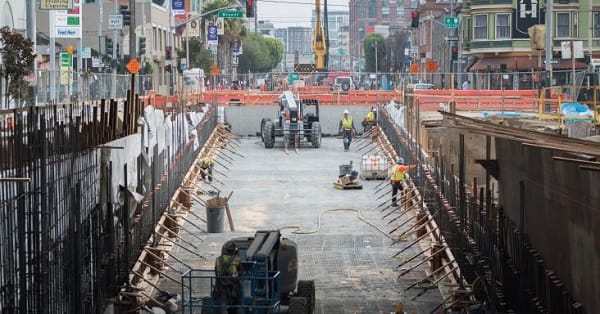
Construction on the now-completed Central Subway Portal on 4th Street
Construction on the now-completed Central Subway Portal on 4th Street
The San Francisco Municipal Transportation Agency (SFMTA), which manages all transportation in the city, including the Municipal Railway (Muni), completed the Central Subway tunnel portal entrance, which was the final element to the overall tunneling contract. This portion of the Central Subway Project was completed on-time and on-budget.
The portal, at 4th and Harrison streets, was initially called the “launch box” because it served as the entrance site of two 350-foot-long boring machines (TBMs). Each TBM tunneled 8,500 feet beneath SoMa, Union Square and Chinatown creating the Central Subway tunnels. The identical twin TBMs weighed-in at 750 tons each and were affectionately named Mom Chung — for Dr. Margaret “Mom” Chung, the nation’s first Chinese-American physician — and Big Alma — for San Francisco philanthropist and socialist “Big Alma” de Bretteville Spreckles.
Now that the TBMs have completed their 1.5-mile journeys, the launch box has been seismically and structurally reinforced creating the portal where the Muni Metro T Third Line Light Rail Vehicles (LRVs) will enter and exit the Central Subway.
The tunnel portal structure contract called for a final completion date of May 15. However, the crews met expectations by substantially completing the portal structure, constructing the twin tunnels and five cross passages a month earlier.
“It was not only imperative that the portal structure create San Francisco’s next generation of public transit,” said Ed Reiskin, SFMTA Director of Transportation. “It was crucial that we adhered to our commitment to the public. We promised to deliver on-time and on-budget, and the completion of this portion of the project is another milestone that demonstrates we deliver as promised.”
The project was complete within budget estimates of $241 million. The U.S. Department of Transportation announced approval of the Full Funding Grant Agreement of $942.2 million to fund nearly half of the Central Subway Project. The remaining budget is balanced by existing state and local grant funds.
The Central Subway is expected to open to the public in 2019 and will directly serve some of San Francisco’s most densely populated communities including: the Visitacion Valley in the Southeast, east to the Bayview/Dogpatch, and west to the city’s center.
More Rail

New York MTA Advances Final Contract for Second Avenue Subway Expansion
Contract Four is the largest in the Second Avenue Subway Phase 2 project and includes construction of station infrastructure, tracks, and signals for the subway expansion, MTA officials said. Work on Contract Four will begin in 2027.
Read More →
San Diego MTS Breaks Monthly Trolley Ridership Record
Agency officials said July’s ridership indicates MTS’s continued recovery from the pandemic.
Read More →
Report Examines NJ TRANSIT Reliability, Funding Challenges
The Garden State Initiative analysis examines the roles of Amtrak infrastructure, fleet management, and agency operations while recommending a more performance-based approach to improving reliability.
Read More →
Stadler, CapMetro Sign Long-Term Rail Fleet Support Agreement
Beginning in 2027, Stadler will provide on-site technical expertise, spare parts support, training, and obsolescence management to help extend the reliability and longevity of CapMetro’s GTW fleet.
Read More →
Biz Briefs: Alstom Lands Canadian Contract, LYT to Supply California TSP, and More
In METRO's latest installment, we take a look at recent news from Complete Coach Works, Beep, FlixBus, and more partnerships making headlines across the transportation sector.
Read More →
CATS Gold Line Marks 5 Years of Service, 2.8M Passenger Trips
With a six-mile expansion planned, the Charlotte streetcar is positioned to connect more neighborhoods and major transit hubs across the region.
Read More →
Why Simulating Pedestrian Movement Has Become Essential for Modern Rail Stations
Pedestrian microsimulation is helping rail planners identify bottlenecks, test station designs, and prepare complex transit hubs for growing passenger volumes.
Read More →
Amtrak Begins Major Construction at New York’s Sunnyside Yard
The new maintenance facility will support Amtrak’s Airo trainsets while improving maintenance efficiency and turnaround times in New York.
Read More →
Chicago Leaders Unveil Plans for O’Hare Airport Express Train
The privately developed project would offer a 15-minute trip between downtown and O’Hare’s Terminal 2, with trains operating every 15 minutes on a dedicated track. The service would use battery-electric trains and three existing freight rail rights-of-way.
Read More →
OCTA Maps Out 30-Year Strategy to Protect Coastal Rail Corridor
The draft feasibility report identifies strategies to protect the coastal rail line for decades as the agency continues near-term stabilization and sand placement efforts.
Read More →