



San Francisco to charge operators of tech buses
The agreement, which had been in the works for months, took on added urgency in recent weeks as protesters blocked Google buses in San Francisco and Oakland, according to the report.

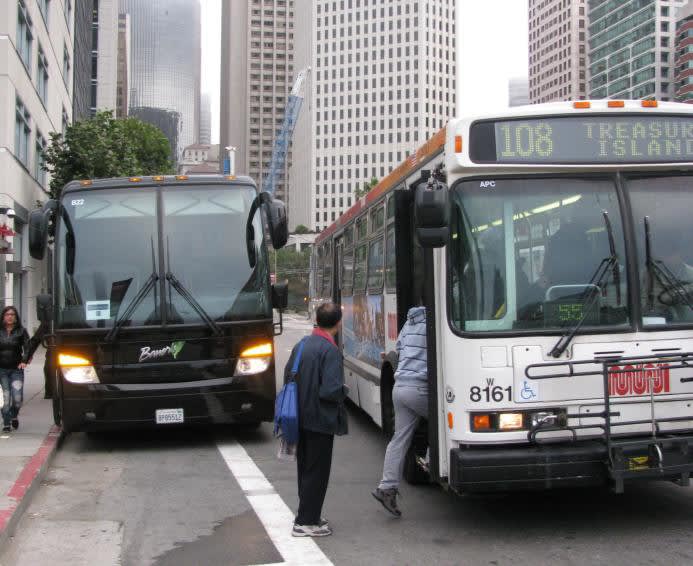
SAN FRANCISCO — Employee shuttle buses for Silicon Valley tech firms, which have become a symbol of income disparity in San Francisco, will soon be charged for using public bus stops, the San Francisco Chronicle reported.
The agreement, which had been in the works for months, took on added urgency in recent weeks as protesters blocked Google buses in San Francisco and Oakland, according to the report.
For the full story, click here.
VIDEO:Life at the Googleplex
(SFMTA announcement of the shuttle program)
The San Francisco Municipal Transportation Agency (SFMTA), Mayor Ed Lee, Genentech, Google, Apple, Facebook, Bauer's Intelligent Transportation and the Bay Area Council announced an agreement to launch a commuter shuttle bus pilot program that will minimize impacts to Muni, while maximizing the traffic and environmental benefits of employer-provided shuttles.
The shuttles provide more than 35,000 boardings per day in San Francisco, eliminating at least 45 million vehicle miles traveled and 761,000 metric tons of carbon every year from the region’s roads and air.
After more than a year of collaborative work, the group came to a broad consensus on a package of policy recommendations allowing commuter shuttles to use a limited network of approved Muni zones, as part of an 18-month pilot program. The Pilot Program includes:
Charging a daily fee based on the number of stops that a shuttle provider or employer makes to fully cover the SFMTA’s cost of administering and enforcing the program and includes private investment to improve select stops. Fees are estimated to raise tens of thousands of dollars monthly to the largest transportation providers.
Approval of 200 bus stops (out of more than 2,500 total in the Muni system) to be used by providers
Private shuttle providers will pay to use Muni bus zones, based on a per stop, per day, cost recovery schedule. Due to Proposition 218, the SFMTA cannot create a fee structure that goes beyond the cost to provide such a service or policy.
Providers would operate in accordance to agreed-upon guidelines, such as yielding to Muni and pulling to the front of the zone making more room for other vehicles, and avoiding steep and narrow streets.
The agency would enforce these rules to ensure only participating companies are using shared zones. It will be illegal to use all other bus zones.
Each commuter shuttle will be issued a unique identification placard so enforcement personnel can easily identify vehicles.
Providers would share data with SFMTA to ensure that location information is available for complaint follow-up, enforcement and to support the agency’s transportation system management.
“The private commuter shuttle sector has been growing very rapidly over the last few years and our policies are now catching up,” said Tom Nolan, Chairman of the MTA Board of Directors. “How we deal with shuttles now is not sustainable and this proposal gives the board an opportunity to vote on a policy that increases safety, reduces impacts on Muni, provides more information, improves the flow of traffic and reduces driving simultaneously.”
Currently, issues are resolved on a case-by-case basis, which is not sustainable or effective in managing this mode of transportation. The private shuttles predominantly use Muni bus zones, without any coordination with Muni and this can lead to delays on the transit system. The city does not have complete information about which shuttles operate where and this makes it difficult and time consuming to follow up on inquiries and complaints.
The commuter shuttle sector includes employers and institutions (medical centers, universities), as well as some buildings that provide commute shuttle transportation within San Francisco and between San Francisco and other cities. This does not include tour buses, airport shuttles, jitneys, charter buses or limousines.
The proposal will be taken to the MTA board on January 21. If the board takes action, the SFMTA will ask shuttle providers to propose stops for inclusion into the bus zone network and will ask San Francisco residents for their input to determine specific bus zones that can be used. Final plans will be approved by public hearing in late spring.
More Management

METRO Opens Submissions for 2026 Motorcoach Awards
Nominations are now being accepted for METRO Magazine’s Operator of the Year and Innovative Operator of the Year awards.
Read More →
New York MTA Advances Final Contract for Second Avenue Subway Expansion
Contract Four is the largest in the Second Avenue Subway Phase 2 project and includes construction of station infrastructure, tracks, and signals for the subway expansion, MTA officials said. Work on Contract Four will begin in 2027.
Read More →
Transit Agencies Highlight Safety Gains at National Summit
Leaders from 15 major transit systems shared crime-reduction results and safety initiatives while discussing the role of continued federal support.
Read More →

NITA Names New Leadership, Expands Reduced-Fare Program at First Board Meeting
The new regional transit authority appointed its first board chair and interim executive director while extending reduced fares across CTA, Metra, and Pace for eligible riders.
Read More →
Beyond the Checklist: A Structured Approach to Transit Maintenance
Reliability-Centered Maintenance helps transit agencies move beyond routine checklists to focus limited resources on the assets and failures that have the greatest impact on safety, reliability, and service.
Read More →
APTA 2026 Nominating Committee Selects Leadership Slate, Names Chair and Vice Chair Nominees
Leadership changes will help shape the association’s priorities and its representation of the transportation industry during the 2026–2027 term.
Read More →
DART Launches Major Security, Fare Enforcement Initiative
The 90-day demonstration will deploy coordinated security teams at five light rail stations while testing controlled access and gathering data to guide future investments.
Read More →
Advancing Fare Collection Through Technology and Innovation
Learn about delivering 1300 gates at 91 stations while managing fare evasion. Explore the large scale deployment, solution customization and real-world results that affect the region. Prepare for deployment in your region now.
Read More →
Game Day in Motion: Moving Millions During the 2026 World Cup
Between packed transit stations and team motorcoaches, see how agencies and operators across North America tackled the transportation demands of the 2026 FIFA World Cup.
Read More →
Surface Transportation Extension Averts Shutdown, Leaves Transit Funding Gap
The stopgap keeps federal transportation programs moving, but missing advance funding could complicate the transit and rail projects agencies are planning next.
Read More →