



Six streetcars to be purchased for Detroit project
Whether the Buy America-compliant streetcars will be on-wire or off-wire is still being explored.

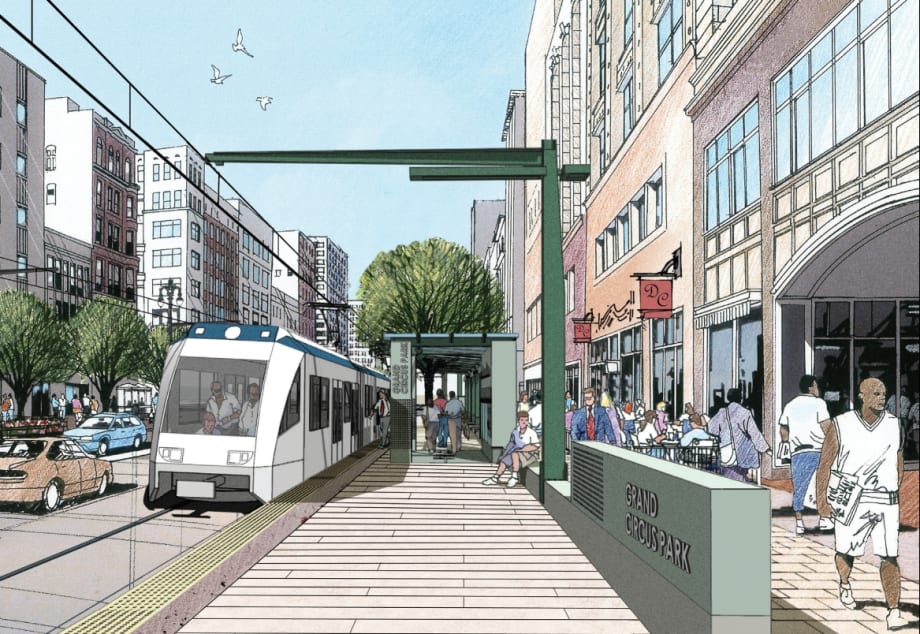
A rendering of Detroit's M-1 Rail streetcar.
A rendering of Detroit's M-1 Rail streetcar.
M-1 Rail officials presented at the Downtown Detroit Partnership’s Summer Stakeholder Meeting, telling the crowd their goal is to minimize the impact the construction of the 3.3-mile streetcar circulator has on businesses, residents, pedestrians and visitors of the Woodward Avenue corridor.
With construction scheduled to begin by late summer/early fall of this year, M-1 Rail’s chief operating officer Paul Childs along with director of governmental and community affairs Sommer Woods presented some of their planning details to the people who attended the meeting at the Compuware Building.
“We have had some very good stakeholder meetings over the last several months, but today’s was very productive,” said Woods. “Our team was able to provide updates on key topics that are important to greater downtown businesses and institutions. Today’s meeting also brought to light some questions we still need to answer as we work to finalize our plans for construction.”
Some highlights:
Maps, Streetcars and Stations
As a part of their 30-minute presentation, officials with M-1 Rail tried to help those in attendance envision Woodward Avenue with a streetcar by showing documentation from the supplemental environmental assessment, illustrative renderings of the stations and a sample rendering of the type of streetcar that likely will be used.
Along with showing a picture of a sample streetcar, M-1 Rail officials said six ADA-compliant streetcars that meet the Buy-America standards are going to be purchased; and they are still exploring whether Detroit’s streetcar will be on-wire or off-wire.
Segment 1 Construction
Construction for the streetcar line will occur in two segments with the first segment — Larned to Adams — scheduled to break ground this year. The presentation helped to begin to set expectations. M-1 Rail team members explained construction includes track construction, utility relocations and station platforms.
They also discussed the tentative construction schedule, the impact it will have on businesses and the traffic management strategy, which includes bus routes, street closures, supply deliveries for businesses and parking.
RELATED:"2013 Top Rail Project Profiles."
More Rail

New York MTA Advances Final Contract for Second Avenue Subway Expansion
Contract Four is the largest in the Second Avenue Subway Phase 2 project and includes construction of station infrastructure, tracks, and signals for the subway expansion, MTA officials said. Work on Contract Four will begin in 2027.
Read More →
San Diego MTS Breaks Monthly Trolley Ridership Record
Agency officials said July’s ridership indicates MTS’s continued recovery from the pandemic.
Read More →
Report Examines NJ TRANSIT Reliability, Funding Challenges
The Garden State Initiative analysis examines the roles of Amtrak infrastructure, fleet management, and agency operations while recommending a more performance-based approach to improving reliability.
Read More →
Stadler, CapMetro Sign Long-Term Rail Fleet Support Agreement
Beginning in 2027, Stadler will provide on-site technical expertise, spare parts support, training, and obsolescence management to help extend the reliability and longevity of CapMetro’s GTW fleet.
Read More →
Biz Briefs: Alstom Lands Canadian Contract, LYT to Supply California TSP, and More
In METRO's latest installment, we take a look at recent news from Complete Coach Works, Beep, FlixBus, and more partnerships making headlines across the transportation sector.
Read More →
CATS Gold Line Marks 5 Years of Service, 2.8M Passenger Trips
With a six-mile expansion planned, the Charlotte streetcar is positioned to connect more neighborhoods and major transit hubs across the region.
Read More →
Why Simulating Pedestrian Movement Has Become Essential for Modern Rail Stations
Pedestrian microsimulation is helping rail planners identify bottlenecks, test station designs, and prepare complex transit hubs for growing passenger volumes.
Read More →
Amtrak Begins Major Construction at New York’s Sunnyside Yard
The new maintenance facility will support Amtrak’s Airo trainsets while improving maintenance efficiency and turnaround times in New York.
Read More →
Chicago Leaders Unveil Plans for O’Hare Airport Express Train
The privately developed project would offer a 15-minute trip between downtown and O’Hare’s Terminal 2, with trains operating every 15 minutes on a dedicated track. The service would use battery-electric trains and three existing freight rail rights-of-way.
Read More →
OCTA Maps Out 30-Year Strategy to Protect Coastal Rail Corridor
The draft feasibility report identifies strategies to protect the coastal rail line for decades as the agency continues near-term stabilization and sand placement efforts.
Read More →