



Stadler breaks ground on railcar manufacturing plant in Salt Lake City
Its 62-acre property boasts 75,000 square feet of production space for the bogie, main, pre- and final assembly of single- and bi-level trains.

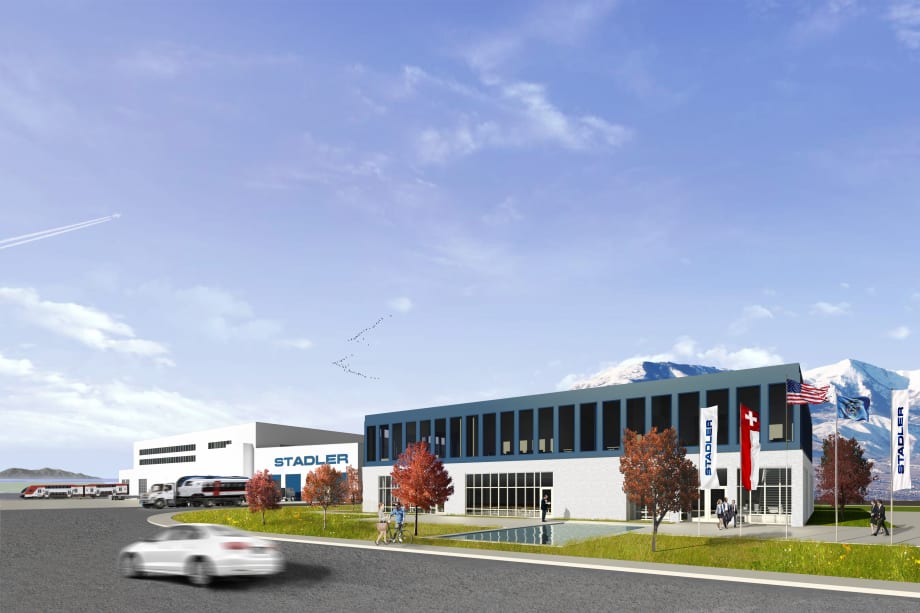
Its 62-acre property boasts 75,000 square feet of production space for the bogie, main, pre- and final assembly of single- and bi-level trains. Photo: Stadler
Its 62-acre property boasts 75,000 square feet of production space for the bogie, main, pre- and final assembly of single- and bi-level trains. Photo: Stadler
Stadler is building a new plant in Salt Lake City. The total amount of the investment stands at around $50 million.
After renting a service plant from the Utah Transit Authority in 2016 to build its TEXRail trains, Stadler has confirmed its commitment to the area by beginning construction of its very own Utah plant, which will be used to assemble efficient, lightweight multiple unit trains for the American market.
In June 2015, Stadler received an order from the Fort Worth Transportation Authority for eight new FLIRT (Fast Light Innovative Regional Train) trains. The fact that federal funds were being used for the order made it subject to the Buy America Act, and for the first time Stadler was required to find a location in the U.S. where the TEXRail trains could be built. The infrastructure of the former Union Pacific plant in Salt Lake City was well suited to the requirements of the TEXRail order. The TEXRail FLIRT is the first to be built in the U.S. The public got its first glimpse of the train on October 9 at the APTA Expo in Atlanta.
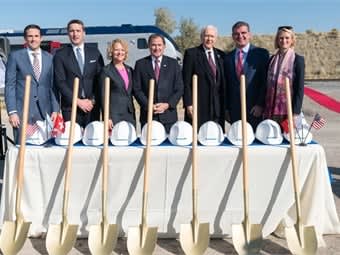
The plant’s ground breaking ceremony was celebrated on October 13 by Peter Spuhler, Group CEO and owner of Stadler, and Martin Ritter, CEO of Stadler US, along with Senator Orrin Hatch, Utah Governor Gary Herbert, Salt Lake City Mayor Jackie Biskupski and other guests from the worlds of politics and business. Photo: Stadler
When Stadler received a major contract from Caltrain for the construction of 16 bi-level trains in August 2016, the company quickly realized it would need a larger production space. The decision to stay in Utah was based on the state’s economic conditions and its political environment, which ensured widespread support from the Governor’s Office and other authorities in Salt Lake City and Clearfield, as well as in Davis and Salt Lake Counties. The decision was also swayed by Utah’s dedication to public transport, the state’s proximity to existing customers on the West Coast, and a workforce of enthusiastic and well-trained workers, who after nine months were already 115 strong.
The new plant lies right off of I-80, five minutes from the international airport and just ten minutes from downtown Salt Lake City. It has its own side track on the main Denver-San Francisco line. The plant has been designed to accommodate around 350 workstations, but can be upgraded on a modular basis at any time. Its 62-acre property boasts 75,000 square feet of production space for the bogie, main, pre- and final assembly of single- and bi-level trains. In addition to storage and handling areas, test tracks will be set up for the commissioning of the trains. Office spaces and an employee cafeteria are also located on the site.
The TEXRail FLIRT trains that are built in Salt Lake City will become part of an entire fleet of rail vehicles in the U.S.: Stadler’s latest U.S. contract involves an order for 16 six-car, electrical, bi-level multiple units for the California construction company Caltrain. The contract includes an option for another 96 double-decker multiple units, and is valued at a total of $551 million. These new, high-performance, double-decker multiple units have been built to seat a maximum number of passengers, and will run between San Francisco and San Jose in Silicon Valley. The first Stadler bi-level train will be delivered to the U.S. in August 2019 and put into commercial use in 2020 after having passed all the necessary tests.
More Rail

New York MTA Advances Final Contract for Second Avenue Subway Expansion
Contract Four is the largest in the Second Avenue Subway Phase 2 project and includes construction of station infrastructure, tracks, and signals for the subway expansion, MTA officials said. Work on Contract Four will begin in 2027.
Read More →
San Diego MTS Breaks Monthly Trolley Ridership Record
Agency officials said July’s ridership indicates MTS’s continued recovery from the pandemic.
Read More →
Report Examines NJ TRANSIT Reliability, Funding Challenges
The Garden State Initiative analysis examines the roles of Amtrak infrastructure, fleet management, and agency operations while recommending a more performance-based approach to improving reliability.
Read More →
Stadler, CapMetro Sign Long-Term Rail Fleet Support Agreement
Beginning in 2027, Stadler will provide on-site technical expertise, spare parts support, training, and obsolescence management to help extend the reliability and longevity of CapMetro’s GTW fleet.
Read More →
Biz Briefs: Alstom Lands Canadian Contract, LYT to Supply California TSP, and More
In METRO's latest installment, we take a look at recent news from Complete Coach Works, Beep, FlixBus, and more partnerships making headlines across the transportation sector.
Read More →
CATS Gold Line Marks 5 Years of Service, 2.8M Passenger Trips
With a six-mile expansion planned, the Charlotte streetcar is positioned to connect more neighborhoods and major transit hubs across the region.
Read More →
Why Simulating Pedestrian Movement Has Become Essential for Modern Rail Stations
Pedestrian microsimulation is helping rail planners identify bottlenecks, test station designs, and prepare complex transit hubs for growing passenger volumes.
Read More →
Amtrak Begins Major Construction at New York’s Sunnyside Yard
The new maintenance facility will support Amtrak’s Airo trainsets while improving maintenance efficiency and turnaround times in New York.
Read More →
Chicago Leaders Unveil Plans for O’Hare Airport Express Train
The privately developed project would offer a 15-minute trip between downtown and O’Hare’s Terminal 2, with trains operating every 15 minutes on a dedicated track. The service would use battery-electric trains and three existing freight rail rights-of-way.
Read More →
OCTA Maps Out 30-Year Strategy to Protect Coastal Rail Corridor
The draft feasibility report identifies strategies to protect the coastal rail line for decades as the agency continues near-term stabilization and sand placement efforts.
Read More →