



Strong local leadership key to successful transportation systems
A new handbook draws on examples from over thirty cities and outlines nearly two dozen policies and strategies that mayors and transportation agency leaders can use to improve urban transportation.


WMATA bus. Photo: JS/METRO Magazine
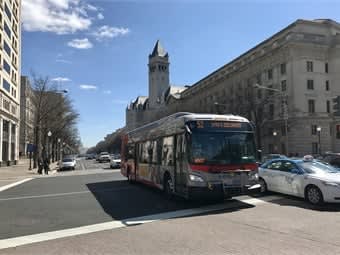
WMATA bus. Photo: JS/METRO Magazine
Despite an onslaught of stories about pending technological revolution and trillion-dollar infrastructure policies, American cities whose transportation systems are performing well are doing so thanks to strong local leadership. On the other hand, a leadership vacuum or institutional disarray frequently mark transportation systems that struggle.
“Mayors whose cities are meeting transportation challenges are putting themselves in the driver’s seat, whether or not they control every facet of transportation" said Steven Higashide, senior program analyst for TransitCenter. "Cities already have a huge array of unheralded tools to shape transportation choices: more and more cities are allocating road space for buses and plazas, rethinking development standards to create more walkable places, and slicing red tape to get projects done fast.”
TransitCenter’s new handbook, “All Transportation is Local” draws on examples from over thirty cities and outlines nearly two dozen policies and strategies that mayors and transportation agency leaders can use to improve urban transportation.
Mayors should:
● Rewrite regulations that force buildings to overcater to the automobile. Many cities have kept obsolete requirements on the books that require that developers overbuild parking and attempt to maintain free-flowing traffic. Dozens of places are doing away with such requirements, making it easier to build walkable, attractive neighborhoods. For example, in 2010 Nashville eliminated rigid standards forcing developers to build parking in downtown, allowing for more pedestrian-friendly construction.
● Get more out of their street infrastructure. As cities grow, they can move many more people by redesigning streets to prioritize transit, walking, and cycling; incentivizing transportation options, and managing curb space to make loading and parking easier. The City of Everett, Mass. recently made national news with a pilot
project that transformed underutilized parking into a bus-only lane, using nothing more than traffic cones and signage. The project was such a hit with both drivers and bus riders that it has been made permanent.
● Hire transportation leaders who are action-oriented and strategic communicators. The most effective city transportation leaders win support for change by connecting transportation to critical city goals like safety, access to opportunity, and economic productivity. They move quickly by embracing new project delivery methods, adopting an experimental mindset, and holding their department accountable to one-year and two-year benchmarks. Seattle has set a goal of having over 70% of city residents within walking distance of frequent transit — and is making it happen by adding signal priority, bus lanes, and other improvements on key routes.
● Form alliances with civic leaders, transit agencies, and employers so that transit improvements happen in tandem with street improvements and that policy changes happen with community backing. Business groups and transportation advocates in Denver were instrumental in supporting a regional transit vision in the early 2000s, and remain highly engaged as the city writes its own transit plan.
“I worked for two strong mayors that wanted innovation at almost all cost. The most important thing they did was to have my back,” said Gabe Klein, the former transportation commissioner of Chicago and Washington, D.C. “That enabled lots of controlled experimentation, where we set the expectation with the public that we were going to try new things and move quickly."
“Cities like Memphis and Boston are currently using quick-build techniques to reconfigure dangerous intersections. Richmond, Seattle and Everett, Mass. are successfully working to get more out of their bus system. These sorts of quick wins establish public confidence and encourage constituents to see urban space as something subject to change."
More Management

METRO Opens Submissions for 2026 Motorcoach Awards
Nominations are now being accepted for METRO Magazine’s Operator of the Year and Innovative Operator of the Year awards.
Read More →
New York MTA Advances Final Contract for Second Avenue Subway Expansion
Contract Four is the largest in the Second Avenue Subway Phase 2 project and includes construction of station infrastructure, tracks, and signals for the subway expansion, MTA officials said. Work on Contract Four will begin in 2027.
Read More →
Transit Agencies Highlight Safety Gains at National Summit
Leaders from 15 major transit systems shared crime-reduction results and safety initiatives while discussing the role of continued federal support.
Read More →

NITA Names New Leadership, Expands Reduced-Fare Program at First Board Meeting
The new regional transit authority appointed its first board chair and interim executive director while extending reduced fares across CTA, Metra, and Pace for eligible riders.
Read More →
Beyond the Checklist: A Structured Approach to Transit Maintenance
Reliability-Centered Maintenance helps transit agencies move beyond routine checklists to focus limited resources on the assets and failures that have the greatest impact on safety, reliability, and service.
Read More →
APTA 2026 Nominating Committee Selects Leadership Slate, Names Chair and Vice Chair Nominees
Leadership changes will help shape the association’s priorities and its representation of the transportation industry during the 2026–2027 term.
Read More →
DART Launches Major Security, Fare Enforcement Initiative
The 90-day demonstration will deploy coordinated security teams at five light rail stations while testing controlled access and gathering data to guide future investments.
Read More →
Advancing Fare Collection Through Technology and Innovation
Learn about delivering 1300 gates at 91 stations while managing fare evasion. Explore the large scale deployment, solution customization and real-world results that affect the region. Prepare for deployment in your region now.
Read More →
Game Day in Motion: Moving Millions During the 2026 World Cup
Between packed transit stations and team motorcoaches, see how agencies and operators across North America tackled the transportation demands of the 2026 FIFA World Cup.
Read More →
Surface Transportation Extension Averts Shutdown, Leaves Transit Funding Gap
The stopgap keeps federal transportation programs moving, but missing advance funding could complicate the transit and rail projects agencies are planning next.
Read More →