



Study: Dependence on devices may be boosting Metra ridership
These findings are part of the Chaddick Institute’s Technology in Travel study, which includes more than 35,000 unique passenger observations since 2009. Passengers are counted once on a given trip. Each year, passengers are observed by trained data collectors to determine how they spend their time while traveling.

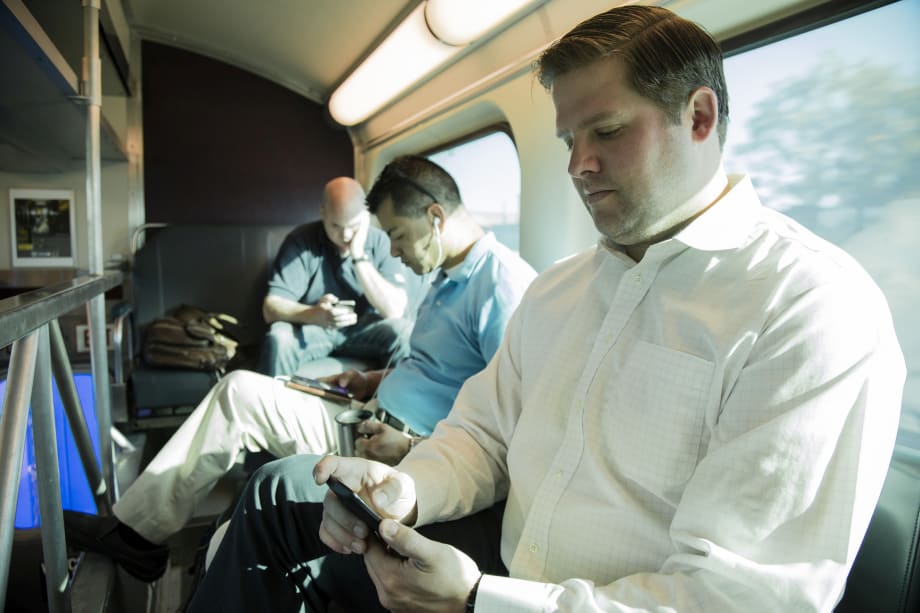
Commuters along Metra's Union Pacific northwest train line spend the majority of their journey glued to their smartphones and tablets. A new study from the Chaddick Institute of Metropolitan Development at DePaul finds technology use is on the rise on Metra. (Photo by Jeff Carrion)
Commuters along Metra's Union Pacific northwest train line spend the majority of their journey glued to their smartphones and tablets. A new study from the Chaddick Institute of Metropolitan Development at DePaul finds technology use is on the rise on Metra. (Photo by Jeff Carrion)
Chicago Metra commuters are increasingly doing things that would be illegal if they were driving — texting, reading email, shopping online or watching a movie — according to research from DePaul University’s Chaddick Institute for Metropolitan Development.
More commuters in the Chicago area are opting to ride the train, in part because of this dependence on electronic devices, researchers found.
“Sophisticated personal electronic devices are changing the way Americans use public transportation,” said Joseph Schwieterman, director of the Chaddick Institute. “Heavy users of mobile technology are finding train travel to be particularly amenable to their digitally oriented lives. Many relish the idea of using their devices from origin to destination, giving this historic mode of travel a new competitive edge.”
The report is based on observation of 4,700 passengers on 53 commuter trains in the Chicago area in early 2015. Findings include:
More than three times as many Metra riders are performing electronic tasks today compared to five years ago. Researchers measured tasks that are illegal while driving — such as texting and reading emails on phones. Fewer than 14% of passengers were performing such tasks at randomly observed points in 2010, compared to 44% this year.
The digital divide in the region has largely disappeared. Trains serving different parts of the metropolitan region now have similar rates of technological use. As recently as 2013, rates of usage tended to be as much as 20% higher on some routes than others. All parts of the region now have usage within five percentage points of each other.
Commuter dependence on electronic devices may be boosting Metra ridership, which has grown despite fare increases in 2012 that boosted the average cost of travel by more than 25%. This suggests that other factors — including the value passengers place on using electronic devices while traveling — may be offsetting some of the effects of rising fares.
Metra commuters still struggle to plug in and catch Wi-Fi. Metra is making progress in becoming more tech-friendly, but power outlets, Wi-Fi, and 3G/4G signals at downtown stations remain spotty. Wi-Fi onboard trains remains in the developmental stage.
Millennium Station stands out as have the most tech-friendly features, offering passengers an airport-style waiting room with power outlets, Wi-Fi and a retailer with electronic accessories nearby. LaSalle Street and Union stations have the strongest 3G/4G signal strength, on average, among three major providers surveyed. None the five downtown stations have a publicly provided Wi-Fi system.
These findings are part of the Chaddick Institute’s Technology in Travel study, which includes more than 35,000 unique passenger observations since 2009. Passengers are counted once on a given trip. Each year, passengers are observed by trained data collectors to determine how they spend their time while traveling. Among the passengers observed, more than 14,000 were commuter rail passengers in the metropolitan Chicago region. Researchers have also observed 564 air, bus and rail trips throughout the U.S.
To view complete results for intercity air, bus and train travelers and commuter rail passengers, click here.
More Rail

New York MTA Advances Final Contract for Second Avenue Subway Expansion
Contract Four is the largest in the Second Avenue Subway Phase 2 project and includes construction of station infrastructure, tracks, and signals for the subway expansion, MTA officials said. Work on Contract Four will begin in 2027.
Read More →
San Diego MTS Breaks Monthly Trolley Ridership Record
Agency officials said July’s ridership indicates MTS’s continued recovery from the pandemic.
Read More →
Report Examines NJ TRANSIT Reliability, Funding Challenges
The Garden State Initiative analysis examines the roles of Amtrak infrastructure, fleet management, and agency operations while recommending a more performance-based approach to improving reliability.
Read More →
Stadler, CapMetro Sign Long-Term Rail Fleet Support Agreement
Beginning in 2027, Stadler will provide on-site technical expertise, spare parts support, training, and obsolescence management to help extend the reliability and longevity of CapMetro’s GTW fleet.
Read More →
Biz Briefs: Alstom Lands Canadian Contract, LYT to Supply California TSP, and More
In METRO's latest installment, we take a look at recent news from Complete Coach Works, Beep, FlixBus, and more partnerships making headlines across the transportation sector.
Read More →
CATS Gold Line Marks 5 Years of Service, 2.8M Passenger Trips
With a six-mile expansion planned, the Charlotte streetcar is positioned to connect more neighborhoods and major transit hubs across the region.
Read More →
Why Simulating Pedestrian Movement Has Become Essential for Modern Rail Stations
Pedestrian microsimulation is helping rail planners identify bottlenecks, test station designs, and prepare complex transit hubs for growing passenger volumes.
Read More →
Amtrak Begins Major Construction at New York’s Sunnyside Yard
The new maintenance facility will support Amtrak’s Airo trainsets while improving maintenance efficiency and turnaround times in New York.
Read More →
Chicago Leaders Unveil Plans for O’Hare Airport Express Train
The privately developed project would offer a 15-minute trip between downtown and O’Hare’s Terminal 2, with trains operating every 15 minutes on a dedicated track. The service would use battery-electric trains and three existing freight rail rights-of-way.
Read More →
OCTA Maps Out 30-Year Strategy to Protect Coastal Rail Corridor
The draft feasibility report identifies strategies to protect the coastal rail line for decades as the agency continues near-term stabilization and sand placement efforts.
Read More →