




RELATED: EasyMile, partners to integrate driverless tech into full-size bus
Testing of first autonomous shuttle on public roads in Calif. begins
CCTA is leading a pilot demonstration project testing electric, low-speed, multi-passenger autonomous vehicles manufactured by Easymile.
March 8, 2018

Contra Costa Transportation Authority is leading a pilot demonstration project testing electric, low-speed, multi-passenger autonomous vehicles manufactured by Easymile. Photo: CCTA
2 min to read
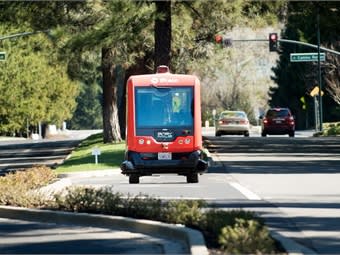
Contra Costa Transportation Authority is leading a pilot demonstration project testing electric, low-speed, multi-passenger autonomous vehicles manufactured by Easymile. Photo: CCTA
The Contra Costa Transportation Authority (CCTA) and GoMentum Station announced that permission was granted and testing of autonomous vehicles on public roads will begin at Bishop Ranch, the largest mixed-use business community in Northern California, located in the city of San Ramon. This is the first time the California Department of Motor Vehicles (DMV) has allowed a shared autonomous vehicle to travel on public roads in the state.
CCTA is leading a pilot demonstration project testing electric, low-speed, multi-passenger autonomous vehicles manufactured by Easymile, that are not equipped with a steering wheel, brake pedal, or accelerator. The California State Legislature passed pioneering legislation in 2016, Assembly Bill 1592, to allow for the pilot program. After successful testing at the GoMentum Station autonomous vehicle proving grounds in Concord, Calif. and in parking lots at Bishop Ranch, CCTA is advancing to the third phase of testing.
CCTA received permission from the U.S. Department of Transportation’s National Highway Traffic Safety Administration (NHTSA) in October 2017 and permission from the California DMV in January 2018, to operate the EasyMile shuttle on public streets within the business park.
“It is a huge step forward for safely developing a solution to the challenges that prevent people from using public transportation and will transform how we travel in Contra Costa and beyond,” said CCTA Executive Director Randell Iwasaki.
Shared autonomous shuttles offer safe, accessible service that could soon provide first- and last-mile transit solutions in office parks, campuses, suburbs, and town centers. Zero-emission, low-speed autonomous shuttles have the potential to ease congestion, reduce harmful emissions, and provide affordable access to transportation hubs throughout Contra Costa County.
As CCTA moves to the third phase of testing, members of the general public will not be able to ride the shared autonomous vehicles on public streets. The vehicles are currently staffed by trained testers. It is anticipated that during the upcoming year, additional predetermined testers and evaluators chosen from employees of various employers within Bishop Ranch will be able to ride the vehicles as they traverse public streets within the business park.
The permission for the EasyMile shuttles from the California DMV is separate from their autonomous vehicle testing program that has been underway since 2014.
More New Mobility

From Hardware to Digital Partner: Luminator Charts Its Next Chapter
CEO Magnus Friberg discusses Luminator’s shift toward becoming a digital partner, the growing importance of software and interoperability, and how AI can help agencies improve operations and passenger experience.
Read More →
Biz Briefs: Alstom Lands Canadian Contract, LYT to Supply California TSP, and More
In METRO's latest installment, we take a look at recent news from Complete Coach Works, Beep, FlixBus, and more partnerships making headlines across the transportation sector.
Read More →
CharterUP’s Armir Harris on Technology, AI, and the Future of Group Mobility
In a recent episode of METROspectives, CharterUP Founder/CEO Armir Harris discussed the company’s evolution from an online charter bus marketplace into a technology platform supporting public- and private-sector mobility and much more.
Read More →
Jacksonville’s NAVI Project Charts a New Course for Autonomous Public Transportation
Through its NAVI program, JTA is showing how autonomous vehicles, intelligent infrastructure, and coordinated operations can work together to deliver everyday public transportation.
Read More →
Biz Briefs: Luminator Marks Milestone and More
From manufacturers and suppliers to transit agencies and motorcoach operators, these updates offer a snapshot of the projects, partnerships and business moves driving the industry forward.
Read More →
New Tricks for Old Bureaucracies: Joshua Schank on Making Transit Innovation Stick
Former LA Metro Chief Innovation Officer Joshua Schank discusses why good ideas aren't enough, how transit agencies can overcome resistance to change, and why today's challenges demand more innovation.
Read More →
How DART's GoPass Is Redefining Regional Mobility
Serving 14 transit agencies, GoPass simplifies multimodal travel by allowing riders to plan, pay for, and manage an entire trip through one app.
Read More →
Biz Briefs: OCTA Taps Clean Energy for Hydrogen Station, Stadler to Supply Via Rail Vehicles, and More
From manufacturers and suppliers to transit agencies and motorcoach operators, these updates offer a snapshot of the projects, partnerships and business moves driving the industry forward.
Read More →CharterUP Expands Into New Mobility and Autonomous Transportation
Vice President of New Mobility Stephen Joos discusses how CharterUP is leveraging its nationwide transportation network, technology platform, and autonomous vehicle partnerships to expand into workforce mobility, campus shuttles, and transit solutions.
Read More →
METRO Magazine Announces 2026 Innovative Solutions Awards Winners
Projects Recognized for Advancing Mobility Through Technology, Accessibility, Workforce Innovation, and Operational Excellence
Read More →