



Texas' Capital Metro testing Alexander Dennis double-deck bus
This two-week pilot program will help Capital Metro’s leadership determine if double-decker buses are a feasible option on heavy commuter corridors such as IH-35, MoPac, and U.S. 183.

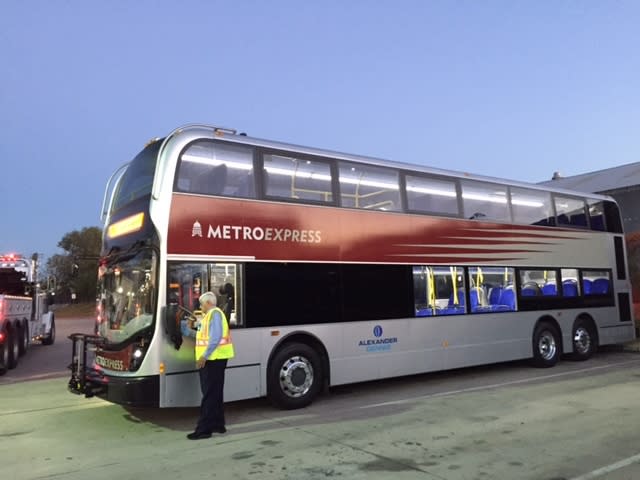
Austin, Texas’ Capital Metro will test a double-decker bus as a part of its regular MetroExpress service through Friday, Nov 11. The bus, built by British bus manufacturing company Alexander Dennis, is already on the road in other U.S. cities, including Seattle and Las Vegas.
This two-week pilot program will help Capital Metro’s leadership determine if double-decker buses are a feasible option on heavy commuter corridors such as IH-35, MoPac, and U.S. 183.
The public got its first look at the sleek, high-capacity vehicle on its inaugural trek along Route 935 on Monday, from the Tech Ridge Park & Ride to Riverside Drive. The double-decker bus will serve as an additional vehicle on the route, operating approximately five minutes ahead of the regular Route 935 bus, the Tech Ridge Express. No fare will be charged on the double-decker during the pilot period.
The new bus seats 89 riders and can accommodate up to 100 total. Capital Metro’s typical buses seat 36 riders and can carry 15 more standing passengers. The 42-foot double decker bus is 13 feet six inches tall, as compared to nine feet six inches for Local buses and 11 feet five inches for MetroExpress buses.
The double-decker is ADA compliant, is completely covered and has a bicycle rack. Riders will get to enjoy panoramic views, footrests, and soft reclining seats on its upper deck.
Capital Metro’s Community Involvement team will conduct surveys during the demonstration period to gauge how much support there might be for having a double-decker bus in service on a full-time basis.
Following the test period, input from riders, bus operators, and maintenance staff will be compiled and reviewed. Staff will then report to the Capital Metro board of directors with findings and recommendations.
More Bus

New York MTA Plans Largest Bus Fleet Upgrade in More Than a Decade
The agency is seeking manufacturers for 650 new CNG buses to replace aging vehicles, improve reliability, and advance its broader fleet modernization strategy.
Read More →
Building a Flexible Path to Transit Electrification
John Hroncich discusses BAE Systems’ modular and scalable approach, lessons learned from decades of real-world operations, and how agencies can identify electrification strategies that fit their fleets.
Read More →
Bus Tech Talk: Keeping Transit Technicians Ahead of the Technology Curve
LA Metro’s Obed Mejia discusses technician training, evolving maintenance technology, fleet replacement, and strategies for getting the most out of today’s transit fleets.
Read More →
Biz Briefs: RIPTA Unveils New Frontrunners, Clevland RTA Adds New Siemens, and More
In METRO's latest installment, we take a look at recent news from Siemens, Prevost, Dodge, and more partnerships making headlines across the transportation sector.
Read More →
People Movement: Holly Arnold Joins Transdev and More
In this edition, we also cover recent appointments and announcements at Pace, CamTran, MCI, and more, showcasing the individuals helping to shape the future of transportation.
Read More →
The High Cost of Transit Buses: Industry Leaders Look to Procurement Reform
Transit leaders and policymakers examine how standardized bus designs, streamlined procurement, and predictable funding could help agencies stretch budgets and deliver better service.
Read More →
The Business Voice Behind Public Transportation
As chair of APTA’s Business Members Board of Governors, Ray Melleady explains how more than 850 business members are partnering with transit agencies to advance funding, innovation, and industry-wide collaboration.
Read More →
From Surviving to Thriving: Building Stronger Transportation Organizations
Bus Business Consultants founder Brian Dickson shares lessons on leadership, organizational health, and creating options for long-term success in a changing transportation industry.
Read More →
Finding the ‘Happy Medium’: Optimizing Maintenance Without Sacrificing Reliability
The key to maintenance optimization isn’t doing less work—it’s doing the right work at the right time on the right assets.
Read More →
LA Metro, City of West Hollywood, and Partners Advance Smarter Bus Lane Enforcement
The award-winning partnership combines AI-powered detection with human oversight to improve bus reliability, accessibility, and enforcement efficiency.
Read More →