



The Angels and Villains of Public Transit, According to Twitter
Users have not been kind to public transit, a recent USC study shows.The nation’s top agencies earn more ire on the social media site than airlines and evoke as much disdain as police departments. Many systems had more angst directed at them in 140 characters than did the Internal Revenue Service.


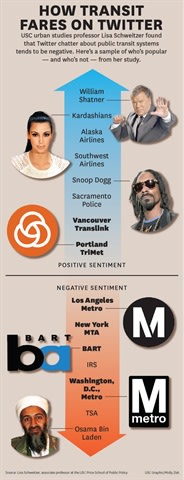
Twitter has not been kind to public transit, a recent USC study shows. The nation’s top agencies earn more ire on the social media site than airlines and evoke as much disdain as police departments.
Many systems had more angst directed at them in 140 characters than did the Internal Revenue Service.
The study, "Planning and Social Media: A Case Study of Public Transit and Stigma on Twitter," published in the Journal of the American Planning Association, used algorithms to analyze 64,000 comments on Twitter about public transit agencies, as well as police departments, parks and airlines. Celebrities and villains were used as controls on the most positive and negative ends of comments: former Star Trek star William Shatner represented the most positive Twitter celebrity and, on the negative end of the scale, the late al-Qaeda leader Osama bin Laden.
The most negative Twitter commentary among the 10 major public transit agencies studied was directed at the Washington, D.C. Metro; Boston (MBTA);Philadelphia (SEPTA) and Chicago (CTA) public transit systems.
Earning slightly less negative commentary on Twitter (and just ahead of the Internal Revenue Service) were Los Angeles (MTA),New York (MTA) and San Francisco (BART).
Vancouver’s Translink system fared the best, followed by Portland’s TriMet and Toronto’s TTC systems, which all had more positive Twitter sentiment on average than the other transit agencies.
Lisa Schweitzer, associate professor with the USC Price School of Public Policy and author of the study, said public transit has an especially acute Internet trolling problem; a large percentage of users take to Twitter to make discriminatory comments about other transit patrons.
“Negative and racist comments about transit patrons are a larger part of the negative comments about transit, much more so than parks, airlines or other services,” Schweitzer said. “Otherwise, commenters appear on balance to say equally happy and unhappy things about public transit and airline service.”
Agencies that use Twitter to respond to users’ complaints or answer questions get more positive Twitter reaction and more civil discourse online, Schweitzer said.
“It’s about the marketing potential of social media — a lot of public transit agencies are simply tweeting their problems to the world by blasting out late service announcements. That’s not a good use of Twitter,” Schweitzer said. “Agencies don’t want to stifle criticism or squash people’s concerns because those are valid. At the same time, you don’t want people walking away from social media thinking transit service is terrible, either, just because people complain.”
The most positively regarded agency of those studied, Vancouver’s Translink system, tweets 90 times a day to interact with its patrons, according to Schweitzer. On the other hand, a lack of Twitter interaction from the Washington Metro saw the rise of the parody Twitter account Unsuck DC Metro, which currently has nearly 29,000 followers, and which amplifies complaints about the DC Metro system. SEPTA, Philadelphia’s transit agency, greatly improved the tone of content about the agency when it introduced online customer service on Twitter, Schweitzer said.
“The analysis suggests that transit agencies can influence the tone of the discussion by interacting with patrons online,” she added. “It gives people something to respond to, and it reminds people that somebody is listening.”
This article, written by Merrill Ballisone, is courtesy of USC
More Management

METRO Opens Submissions for 2026 Motorcoach Awards
Nominations are now being accepted for METRO Magazine’s Operator of the Year and Innovative Operator of the Year awards.
Read More →
New York MTA Advances Final Contract for Second Avenue Subway Expansion
Contract Four is the largest in the Second Avenue Subway Phase 2 project and includes construction of station infrastructure, tracks, and signals for the subway expansion, MTA officials said. Work on Contract Four will begin in 2027.
Read More →
Transit Agencies Highlight Safety Gains at National Summit
Leaders from 15 major transit systems shared crime-reduction results and safety initiatives while discussing the role of continued federal support.
Read More →

NITA Names New Leadership, Expands Reduced-Fare Program at First Board Meeting
The new regional transit authority appointed its first board chair and interim executive director while extending reduced fares across CTA, Metra, and Pace for eligible riders.
Read More →
Beyond the Checklist: A Structured Approach to Transit Maintenance
Reliability-Centered Maintenance helps transit agencies move beyond routine checklists to focus limited resources on the assets and failures that have the greatest impact on safety, reliability, and service.
Read More →
APTA 2026 Nominating Committee Selects Leadership Slate, Names Chair and Vice Chair Nominees
Leadership changes will help shape the association’s priorities and its representation of the transportation industry during the 2026–2027 term.
Read More →
DART Launches Major Security, Fare Enforcement Initiative
The 90-day demonstration will deploy coordinated security teams at five light rail stations while testing controlled access and gathering data to guide future investments.
Read More →
Advancing Fare Collection Through Technology and Innovation
Learn about delivering 1300 gates at 91 stations while managing fare evasion. Explore the large scale deployment, solution customization and real-world results that affect the region. Prepare for deployment in your region now.
Read More →
Game Day in Motion: Moving Millions During the 2026 World Cup
Between packed transit stations and team motorcoaches, see how agencies and operators across North America tackled the transportation demands of the 2026 FIFA World Cup.
Read More →
Surface Transportation Extension Averts Shutdown, Leaves Transit Funding Gap
The stopgap keeps federal transportation programs moving, but missing advance funding could complicate the transit and rail projects agencies are planning next.
Read More →