



Transport for London taps artificial intelligence to 'chat' with customers
The 'TravelBot' tool, which is powered by AI, can "chat" with customers using Messenger and instantly tell them when their bus is due to arrive, as well as provide service updates and Tube maps.

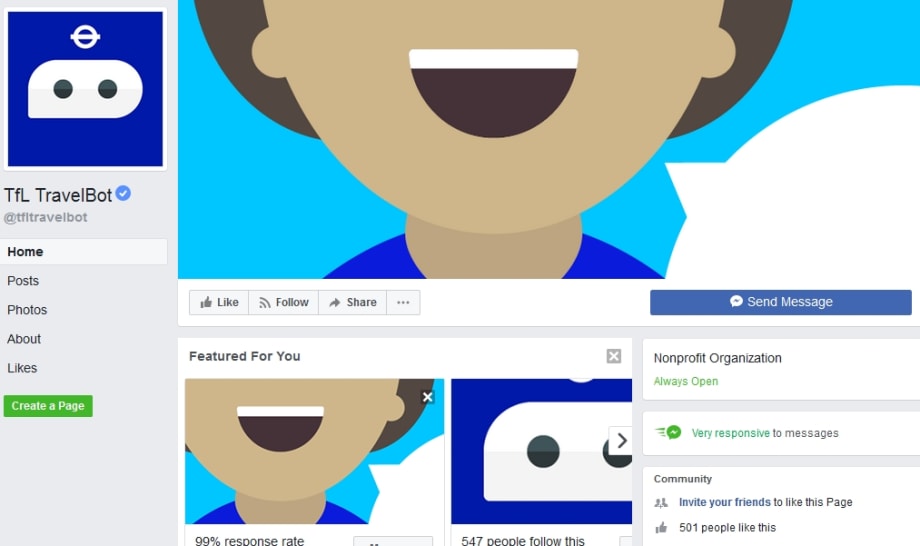
Via Facebook
Via Facebook
Transport for London (TfL) launched the next generation in customer service technology with its first ever “TravelBot.”
The new social media tool, which is powered by artificial intelligence, can "chat" with customers using Messenger and instantly tell them when their bus is due to arrive, as well as provide service updates and Tube maps. The TravelBot can also link direct to a customer service agent, making customer service queries easier.
TfL already deals with a huge number of queries every day through its two Facebook pages. The new technology makes it even easier for customers to get information on the Messenger platform in a way that's fast and straightforward. Features of the new service include:
Bus arrivals: Customers can check when their bus is due to arrive by simply sharing their location or providing the bus stop code available at every bus stop. This will be particularly beneficial for customers at bus stops that don't display “countdown” information.
Bus route status: Customers can ask for bus service updates, including information on bus route diversions.
Service updates: Customers can ask for the latest service updates for the Tube, TfL Rail, London Overground, DLR, and London Trams.
Maps: The TravelBot can provide Tube, Night Tube, and rail maps.
Message an agent: The TravelBot can refer customers to a customer service agent.
As people use the service, it will "learn" and become even more precise. TfL will explore the possibility of further features in the future including providing journey planning information and status alerts.
“Millions of people already use our Journey Planner and social media channels to help them get around London, and we are constantly seeking new ways to make the process even easier, said Shashi Verma, TfL's director, customer experience. “This TravelBot will make it simpler for people using Messenger to get the information they need as they move around the city. We think that this initial version will be a major step forward in how we provide travel information to our customers and we look forward to their feedback to help us improve the product over time.”
Chatbots are digital assistants that can quickly chat to customers. Powered by artificial intelligence, they provide instant information via messaging apps, where research suggests people increasingly prefer to spend their online time. By using a chatbot, people can move seamlessly between chatting with their friends and looking up information without having to exit an app and switch to a browser.
More Management

METRO Opens Submissions for 2026 Motorcoach Awards
Nominations are now being accepted for METRO Magazine’s Operator of the Year and Innovative Operator of the Year awards.
Read More →
New York MTA Advances Final Contract for Second Avenue Subway Expansion
Contract Four is the largest in the Second Avenue Subway Phase 2 project and includes construction of station infrastructure, tracks, and signals for the subway expansion, MTA officials said. Work on Contract Four will begin in 2027.
Read More →
Transit Agencies Highlight Safety Gains at National Summit
Leaders from 15 major transit systems shared crime-reduction results and safety initiatives while discussing the role of continued federal support.
Read More →

NITA Names New Leadership, Expands Reduced-Fare Program at First Board Meeting
The new regional transit authority appointed its first board chair and interim executive director while extending reduced fares across CTA, Metra, and Pace for eligible riders.
Read More →
Beyond the Checklist: A Structured Approach to Transit Maintenance
Reliability-Centered Maintenance helps transit agencies move beyond routine checklists to focus limited resources on the assets and failures that have the greatest impact on safety, reliability, and service.
Read More →
APTA 2026 Nominating Committee Selects Leadership Slate, Names Chair and Vice Chair Nominees
Leadership changes will help shape the association’s priorities and its representation of the transportation industry during the 2026–2027 term.
Read More →
DART Launches Major Security, Fare Enforcement Initiative
The 90-day demonstration will deploy coordinated security teams at five light rail stations while testing controlled access and gathering data to guide future investments.
Read More →
Advancing Fare Collection Through Technology and Innovation
Learn about delivering 1300 gates at 91 stations while managing fare evasion. Explore the large scale deployment, solution customization and real-world results that affect the region. Prepare for deployment in your region now.
Read More →
Game Day in Motion: Moving Millions During the 2026 World Cup
Between packed transit stations and team motorcoaches, see how agencies and operators across North America tackled the transportation demands of the 2026 FIFA World Cup.
Read More →
Surface Transportation Extension Averts Shutdown, Leaves Transit Funding Gap
The stopgap keeps federal transportation programs moving, but missing advance funding could complicate the transit and rail projects agencies are planning next.
Read More →