




RELATED: Portland St. U. transportation center earns $15M grant
U. of Oregon partners with TriMet on light rail project
The university's Sustainable City Year Program will engage hundreds of students in transit and transportation development plans.
March 6, 2017
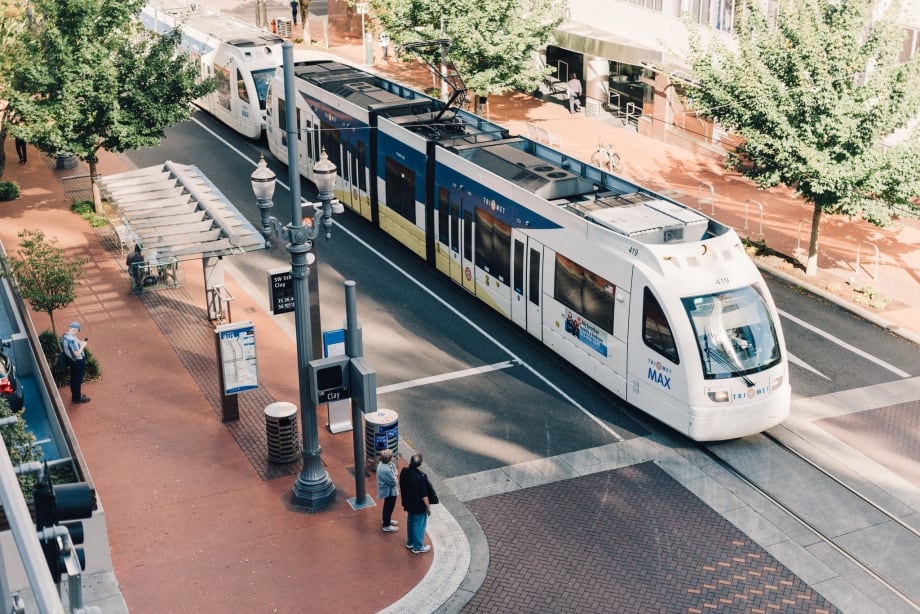
TriMet's MAX light rail service. Photo: TriMet
3 min to read
TriMet's MAX light rail service. Photo: TriMet
The University of Oregon’s Sustainable City Year Program (SCYP) has announced its partnership with TriMet for the 2017-2018 academic year. Starting in September 2017, TriMet and the University will begin coordinating on dozens of multidisciplinary projects that will focus on the Southwest Corridor Light Rail Project (SWC). The project aims to bring transit, bicycle, roadway and pedestrian improvements to communities in southwest Portland and southeast Washington County. Several SWC project partners will participate in the SCYP year, including Metro, Washington County, Oregon Department of transportation, and the Cities of Portland, Tigard, and Tualatin.
"The Southwest Corridor is growing quickly, and so is the need for better transportation choices, housing options, and access to parks and nature,” said Elissa Gertler, Metro Planning and Development Director. “The students' energy and fresh perspectives will be a big help as we work to meet growing demand."
Students will explore concepts related to urban mobility, climate change, environmental habitat and restoration, urban design and placemaking, and public outreach. The partner agencies have proposed projects that investigate policies for autonomous vehicles, creation of a renewable energy districts, redefining regional transit projects as habitat corridors, and public outreach for conceptual design support within communities.
Now in its eighth year, the Sustainable City Year Program seeks to apply students’ innovation, ingenuity, and fresh perspectives, to local governments and agencies seeking a transition to a more sustainable future. The model, now being implemented in 27 universities across the country, typically links the students from the University of Oregon with an Oregon city, county, special district, or partnership of governments for an entire academic year. This will be the first year that the UO is partnering with a transit agency.
In a typical SCYP year, more than 500 students across 12 disciplines work on dozens of partner-directed projects. By the end of the partnership, student will have devoted over 40,000 hours to helping TriMet realize its sustainability goals.
About the Southwest Corridor Light Rail Project
The proposed 12-mile transit line between Downtown Portland, Tigard, and Tualatin will provide faster, more frequent service to a growing corridor.
The project will improve connections to key destinations, including Portland State University, OHSU, Portland Community College Sylvania, the Tigard Triangle, Kruse Way and Tualatin.
A fast growing corridor with more than 10% of the region’s population.
The area is expected to grow by over 70,000 residents and 60,000 jobs by 2035.
With congestion expected to double in the next 20 years, it’s the last major corridor in the region without high-capacity rail service.
Roads, sidewalks and bikeways will also be constructed or improved along the project alignment.
Cost is estimated at $2.4 billion with 50 percent of the funding coming from the Federal government.
Construction expected to begin in 2021 with the project opening in 2025
More Bus

New York MTA Plans Largest Bus Fleet Upgrade in More Than a Decade
The agency is seeking manufacturers for 650 new CNG buses to replace aging vehicles, improve reliability, and advance its broader fleet modernization strategy.
Read More →
Building a Flexible Path to Transit Electrification
John Hroncich discusses BAE Systems’ modular and scalable approach, lessons learned from decades of real-world operations, and how agencies can identify electrification strategies that fit their fleets.
Read More →
Bus Tech Talk: Keeping Transit Technicians Ahead of the Technology Curve
LA Metro’s Obed Mejia discusses technician training, evolving maintenance technology, fleet replacement, and strategies for getting the most out of today’s transit fleets.
Read More →
Biz Briefs: RIPTA Unveils New Frontrunners, Clevland RTA Adds New Siemens, and More
In METRO's latest installment, we take a look at recent news from Siemens, Prevost, Dodge, and more partnerships making headlines across the transportation sector.
Read More →
People Movement: Holly Arnold Joins Transdev and More
In this edition, we also cover recent appointments and announcements at Pace, CamTran, MCI, and more, showcasing the individuals helping to shape the future of transportation.
Read More →
The High Cost of Transit Buses: Industry Leaders Look to Procurement Reform
Transit leaders and policymakers examine how standardized bus designs, streamlined procurement, and predictable funding could help agencies stretch budgets and deliver better service.
Read More →
The Business Voice Behind Public Transportation
As chair of APTA’s Business Members Board of Governors, Ray Melleady explains how more than 850 business members are partnering with transit agencies to advance funding, innovation, and industry-wide collaboration.
Read More →
From Surviving to Thriving: Building Stronger Transportation Organizations
Bus Business Consultants founder Brian Dickson shares lessons on leadership, organizational health, and creating options for long-term success in a changing transportation industry.
Read More →
Finding the ‘Happy Medium’: Optimizing Maintenance Without Sacrificing Reliability
The key to maintenance optimization isn’t doing less work—it’s doing the right work at the right time on the right assets.
Read More →
LA Metro, City of West Hollywood, and Partners Advance Smarter Bus Lane Enforcement
The award-winning partnership combines AI-powered detection with human oversight to improve bus reliability, accessibility, and enforcement efficiency.
Read More →