




RELATED:Crowdsourced transit app Moovit hits 1 million users.
U.S. Commuters Wait Approximately 40 Mins. a Day for Public Transit
Not knowing when train or bus will arrive is number one commuter frustration, more than actual wait times, safety, overcrowding, and unfamiliar routes, according to a report by public transit app Moovit.
December 11, 2014
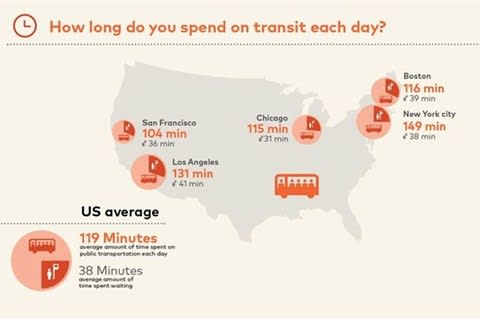
Long waits are a major factor in causing dissatisfaction with public transit.
Photo: Moovit
3 min to read
People in major U.S. cities wait approximately 40 minutes per day for public transit, costing them 150 hours per year, according to a new report by leading public transit app Moovit.
This accounts for 31% of their commute time. Los Angeles topped the list with the worst waiting time in the world, with Boston taking third place.
The Waiting is the Hardest Part
These long waits are a major factor in causing dissatisfaction with public transit. In the five major cities surveyed in the U.S., 31% of the people surveyed are dissatisfied with public transportation. The primary frustration across all U.S. cities surveyed is a lack of information — not knowing when or if the bus or train is going to arrive. This was considered more important than actual wait times, safety, overcrowding, and unfamiliar routes. This frustration can be significantly reduced by providing people with better transit data.
“Based on these findings, it is clear that people would use public transit more often if they knew when their next train or bus is coming,” says Nir Erez, CEO and co-founder of Moovit. “Technology can solve this challenge. Real-time location and estimated arrival of people’s buses and/or trains is now being made available. With more than 400 global cities and 10 million downloads under our belt, Moovit is doing its part to get the word out. We are rapidly expanding to cities across the globe.”
Results across the four major U.S. cities were relatively consistent in terms of level of dissatisfaction and wait times, but there were significant differences in terms of time spent on public transit:
New York City: Respondents spend an average of 149 minutes on public transport each day, 38 minutes (26 percent) idly waiting for the bus or train to arrive, with a 40% dissatisfaction rate
Los Angeles: 131 minutes per day on public transport, 41 minutes (31%) waiting, 43 percent dissatisfaction
Boston: 116 minutes per day on public transport, 39 minutes (34%) waiting, 38% dissatisfaction
San Francisco: 104 minutes per day on public transport, 36 minutes (35%) waiting, 35% dissatisfaction
Chicago: 115 minutes per day on public transport, 31 minutes (27%) waiting, 19 percent dissatisfaction
Time Spent on Public Transit U.S. vs. Global
In the U.S., people spend an average of 105 minutes per day on public transit. New York City topped the list in terms of longest commute time in the world at 149 minutes. Globally, Sao Paulo and Toronto came in next with 138-minute average commutes. Los Angeles and Rio de Janeiro topped the list in terms of longest wait times at 41 minutes, followed by Boston at 39 minutes.
Commuters in Barcelona and Milan spend the shortest amount of time on public transit at 63 and 74 minutes per day, as well as waiting for trains and busses with wait times of 18 and 19 minutes respectively.
More Paratransit

Driving Smarter Paratransit
John Hanlon shares how AlphaRoute is leveraging AI-powered technology to help paratransit providers optimize operations, support frontline staff, and enhance the rider experience.
Read More →
People Movement: Dan Dipert Coaches Adds Third-Generation Leader, Keolis Names New Valley Metro VP/GM, and More
In this edition, we also cover recent appointments and announcements at the Wabtec, SilverRide, HNTB, and more, showcasing the individuals helping to shape the future of transportation.
Read More →
Biz Briefs: RIPTA Unveils New Frontrunners, Clevland RTA Adds New Siemens, and More
In METRO's latest installment, we take a look at recent news from Siemens, Prevost, Dodge, and more partnerships making headlines across the transportation sector.
Read More →
King County Metro Makes ADA Paratransit Easier to Navigate
METRO's Innovative Solutions Award winner replaces complex service-area descriptions with an accessible, interactive map that puts paratransit information directly in customers’ hands.
Read More →
Jacksonville’s NAVI Project Charts a New Course for Autonomous Public Transportation
Through its NAVI program, JTA is showing how autonomous vehicles, intelligent infrastructure, and coordinated operations can work together to deliver everyday public transportation.
Read More →
Driving Smarter Paratransit
John Hanlon shares how AlphaRoute is leveraging AI-powered technology to help paratransit providers optimize operations, support frontline staff, and enhance the rider experience.
Read More →
METRO Magazine Announces 2026 Innovative Solutions Awards Winners
Projects Recognized for Advancing Mobility Through Technology, Accessibility, Workforce Innovation, and Operational Excellence
Read More →
Biz Briefs: STV teams with Amtrak, Motorcoach Operators Boost Fleet and Land Contracts, and More
From manufacturers and suppliers to transit agencies and motorcoach operators, these updates offer a snapshot of the projects, partnerships and business moves driving the industry forward.
Read More →
Biz Briefs: Masabi Teams with St. Louis Metro and More
In METRO's latest installment, we take a look at recent news from Transdev, Hitachi, and more partnerships making headlines across the transportation sector.
Read More →
New York MTA Leverages Zoning Program to Advance Station Accessibility
Accessibility enhancements at Nevins St Station will be financed through a development agreement tied to the MTA's Zoning for Accessibility initiative.
Read More →