



U.S. DOT launches council to support emerging transportation tech
Will identify and resolve jurisdictional and regulatory gaps that may impede deployment of new tech, such as hyperloop and AVs.

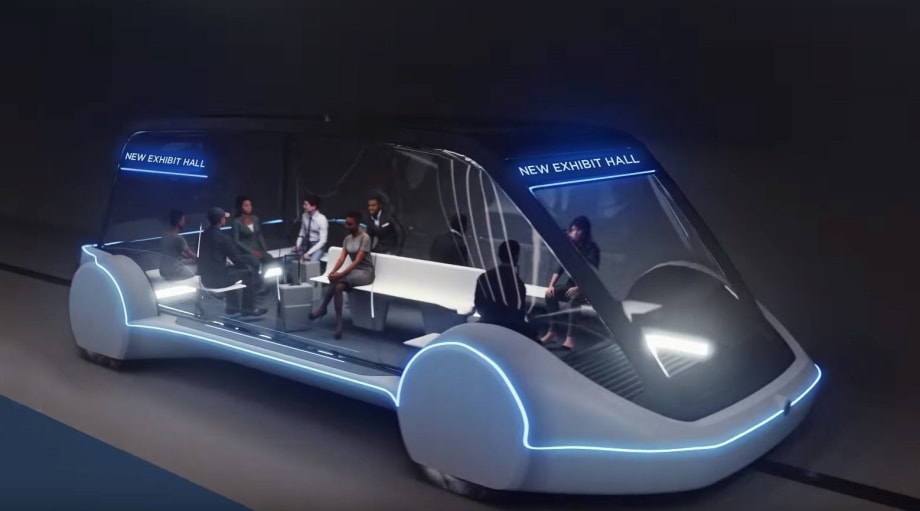
The internal council will hold its organizing meeting this week and will first take on the topic of tunneling technologies seeking various approvals in several states.
The Boring Co.
The internal council will hold its organizing meeting this week and will first take on the topic of tunneling technologies seeking various approvals in several states.
The Boring Co.
U.S. Secretary of Transportation Elaine L. Chao announced the creation of the Non-Traditional and Emerging Transportation Technology (NETT) Council, an internal deliberative body at the U.S. Department of Transportation (U.S. DOT) tasked with identifying and resolving jurisdictional and regulatory gaps that may impede the deployment of new technology, such as tunneling, hyperloop, autonomous vehicles, and other innovations.
Secretary Chao made the announcement during her remarks at the South by Southwest (SXSW) conference in Austin, Texas.
“New technologies increasingly straddle more than one mode of transportation, so I’ve signed an order creating a new internal department council to better coordinate the review of innovation that have multimodal applications,” said Secretary Chao.
U.S. DOT consists of 11 operating administrations, each with its own traditional jurisdiction over certain environmental and regulatory approvals. New technologies may not always fit precisely into the department’s existing regulatory structure, potentially resulting in a slower pace of transportation innovation. Inventors and investors approach U.S. DOT to obtain necessary safety authorizations, permits, and funding and often face uncertainty about how to coordinate with the department.
The NETT Council will address these challenges by ensuring that the traditional modal silos at U.S. DOT do not impede the deployment of new technology. Furthermore, it will give project sponsors a single point of access to discuss plans and proposals.
The NETT Council represents a major step forward for U.S. DOT in reducing regulatory burdens and paving the way for emerging technologies in the transportation industry. The internal council will hold its organizing meeting this week and will first take on the topic of tunneling technologies seeking various approvals in several states.
Representatives from the department held a series of interactive sessions and demonstrations at SXSW to showcase the department’s overarching efforts to support innovation and market solutions to address transportation challenges across the country.
More Technology

From Hardware to Digital Partner: Luminator Charts Its Next Chapter
CEO Magnus Friberg discusses Luminator’s shift toward becoming a digital partner, the growing importance of software and interoperability, and how AI can help agencies improve operations and passenger experience.
Read More →
Beyond the Checklist: A Structured Approach to Transit Maintenance
Reliability-Centered Maintenance helps transit agencies move beyond routine checklists to focus limited resources on the assets and failures that have the greatest impact on safety, reliability, and service.
Read More →
NJ TRANSIT Advances Bus Technology Upgrades Across Statewide Fleet
More than 1,500 buses now feature upgraded technology designed to improve arrival predictions and provide free Wi-Fi, with deployment expected to reach nearly 2,000 buses by the end of 2026.
Read More →

Building a Flexible Path to Transit Electrification
John Hroncich discusses BAE Systems’ modular and scalable approach, lessons learned from decades of real-world operations, and how agencies can identify electrification strategies that fit their fleets.
Read More →
Biz Briefs: Alstom Lands Canadian Contract, LYT to Supply California TSP, and More
In METRO's latest installment, we take a look at recent news from Complete Coach Works, Beep, FlixBus, and more partnerships making headlines across the transportation sector.
Read More →
From Legacy Silos to Conversational Intelligence
What if transit leaders could ask any operational question and get a trusted answer in seconds? Conversational AI is transforming how agencies use their data.
Read More →
USDOT Announces Rail Vehicle Replacement Grants, Chattanooga AV Shuttle Funding
More than $191 million in federal funding will help three transit agencies replace aging rail vehicles and support a new autonomous shuttle service in Chattanooga.
Read More →
Bus Tech Talk: Keeping Transit Technicians Ahead of the Technology Curve
LA Metro’s Obed Mejia discusses technician training, evolving maintenance technology, fleet replacement, and strategies for getting the most out of today’s transit fleets.
Read More →
Biz Briefs: RIPTA Unveils New Frontrunners, Clevland RTA Adds New Siemens, and More
In METRO's latest installment, we take a look at recent news from Siemens, Prevost, Dodge, and more partnerships making headlines across the transportation sector.
Read More →
Why Simulating Pedestrian Movement Has Become Essential for Modern Rail Stations
Pedestrian microsimulation is helping rail planners identify bottlenecks, test station designs, and prepare complex transit hubs for growing passenger volumes.
Read More →