



UConn rolls out 10 New Flyer buses
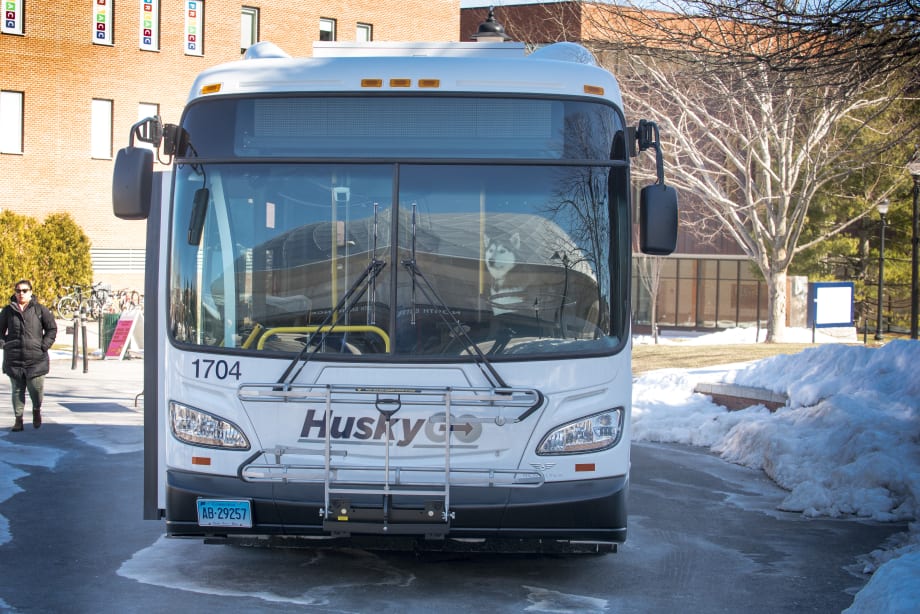
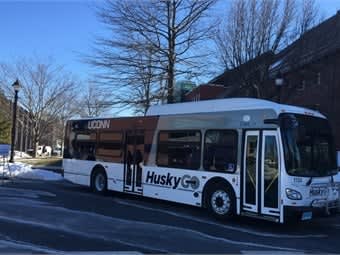
Each bus seats 31 passengers, not including people who prefer to stand; has two positions for wheelchairs; and carry “Husky GO” designs on the exterior, introducing the new brand by which the bus service will be known.

All photos Sean Flynn/UConn photo
By Stephanie Reitz - UConn Communications
Bus service at UConn has certainly changed since the school’s early days, when students rode in an old Pierce-Arrow they jokingly called the “Black Maria,” a common nickname for police paddy wagons.
From that time almost 100 years ago, UConn’s bus fleet has improved substantially in style and reliability — and the 10 new vehicles introduced last week represent a significant jump forward into the next generation of high-tech buses.
UConn Transportation Services put the new buses into service starting Thursday, and parked one of them on Fairfield Way to give students and employees the chance to check out the new 35-foot vehicles, ask questions, and provide suggestions about UConn’s bus service.
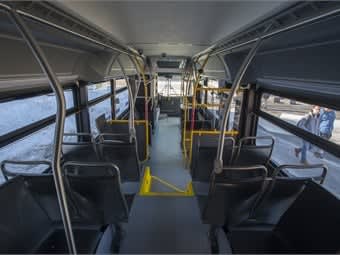
The new buses each have 16 USB ports along with bike racks, “kneeling” technology that lowers the front to help people get on and off more easily, soft blue LED lighting, and other technology. Starting in the next academic year, they’ll also have Wi-Fi service.
“The new buses are state-of-the-art, modern vehicles that will be dependable and far more cost-efficient to operate,” said Dennis Solensky, GM of transportation and fleet services at UConn Transportation, which operates the bus system.
“Our expectation is that with our talented maintenance staff, we will be able to run them for at least the next 12 years,” Solensky said, noting the 10 new buses alone will transport more than one million passenger trips annually on the Storrs campus, not including trips on other buses already in the fleet.
The buses were built by New Flyer Corp. in St. Cloud, Minn., and represent the latest in large transit bus technology. In addition to the improved passenger amenities, they also have cameras to capture the view inside and outside of the buses; automated passenger counters; and suspensions and seats that offer a more comfortable ride.
Each bus seats 31 passengers, not including people who prefer to stand; has two positions for wheelchairs; and carry “Husky GO” designs on the exterior, introducing the new brand by which the bus service will be known.
The university has strongly supported the state’s plan to extend its CTfastrak service east to Storrs. Once that service launches, the Husky GO buses will also travel off campus to link Storrs with a local stop near I-84, connecting students to network of bus lines throughout central Connecticut.
“I love the new Husky GO brand,” Solensky said. “It’s catchy and it dovetails well with the marketing efforts being conducted by our partners at the state Department of Transportation.”
Some of the university’s oldest buses will be taken out of service because they have become too costly to maintain and have exceeded their useful life, but the popular and relatively new “Ice Bus” and other buses with UConn scenes on them will remain in the fleet for several more years.
Today’s buses are a far cry from the vehicles used to transport the Huskies of yesteryear — or, more accurately, the “Aggies” of what was then known as the Connecticut Agricultural College.
A news story from a 1921 version of the student paper, The Connecticut Campus, includes a colorful description of the transportation options in previous years: a 25-passenger Kissel car that often lost its front wheel on Spring Hill; a Studebaker that was faster but lasted only a few years; and that renowned “Black Maria,” a Pierce-Arrow — or “Fierce Sparrow,” as some called it.
“Students will remember a good many times when they gave vent to their feelings because of Maria’s mulish behavior. Maria was an old model ‘Fierce Sparrow’ that could be really fierce at times,” the newspaper wrote in an April 1921 profile of the driver, who transported students three times daily between Willimantic and “the Hill,” as they called the campus.
The Black Maria even found a place in a poem written in the student paper in January 1920 to honor members of the college’s Student Army Training Corps who served in World War I:
“You went across in nice big boats
And landed safe in France;
We came up here in the Black Maria,
Now who took the greater chance?”
While UConn’s new buses may not inspire poetry or gain catchy nicknames, transportation officials hope students will see them as a pleasant, reliable part of their daily routines.
“We really want our students and campus community to have a comfortable and enjoyable experience on the buses,” Solensky said, “and these new vehicles will be a great addition to that.”
More Bus

People Movement: Dan Dipert Coaches Adds Third-Generation Leader, Keolis Names New Valley Metro VP/GM, and More
In this edition, we also cover recent appointments and announcements at the Wabtec, SilverRide, HNTB, and more, showcasing the individuals helping to shape the future of transportation.
Read More →
New York MTA Plans Largest Bus Fleet Upgrade in More Than a Decade
The agency is seeking manufacturers for 650 new CNG buses to replace aging vehicles, improve reliability, and advance its broader fleet modernization strategy.
Read More →
Building a Flexible Path to Transit Electrification
John Hroncich discusses BAE Systems’ modular and scalable approach, lessons learned from decades of real-world operations, and how agencies can identify electrification strategies that fit their fleets.
Read More →
Bus Tech Talk: Keeping Transit Technicians Ahead of the Technology Curve
LA Metro’s Obed Mejia discusses technician training, evolving maintenance technology, fleet replacement, and strategies for getting the most out of today’s transit fleets.
Read More →
Biz Briefs: RIPTA Unveils New Frontrunners, Clevland RTA Adds New Siemens, and More
In METRO's latest installment, we take a look at recent news from Siemens, Prevost, Dodge, and more partnerships making headlines across the transportation sector.
Read More →
People Movement: Holly Arnold Joins Transdev and More
In this edition, we also cover recent appointments and announcements at Pace, CamTran, MCI, and more, showcasing the individuals helping to shape the future of transportation.
Read More →
The High Cost of Transit Buses: Industry Leaders Look to Procurement Reform
Transit leaders and policymakers examine how standardized bus designs, streamlined procurement, and predictable funding could help agencies stretch budgets and deliver better service.
Read More →
The Business Voice Behind Public Transportation
As chair of APTA’s Business Members Board of Governors, Ray Melleady explains how more than 850 business members are partnering with transit agencies to advance funding, innovation, and industry-wide collaboration.
Read More →
From Surviving to Thriving: Building Stronger Transportation Organizations
Bus Business Consultants founder Brian Dickson shares lessons on leadership, organizational health, and creating options for long-term success in a changing transportation industry.
Read More →
Finding the ‘Happy Medium’: Optimizing Maintenance Without Sacrificing Reliability
The key to maintenance optimization isn’t doing less work—it’s doing the right work at the right time on the right assets.
Read More →