



Veovo unveils social distancing solution for passenger rail
It shows how people move into, out of, and between stations, average wait times, and even occupancy on trains.


By combining data drawn from various sensor technologies, with advanced machine learning and intelligent automation, the solution gives operators a real-time, reliable overview of passenger volumes and movements.
Veovo
Veovo introduced its Passenger Density Management solution, designed to assist rail and metro operators in measuring, understanding, and managing crowd density to support social distancing.
COVID-19 lockdowns have meant that train and rapid transit stations around the globe have seen much less traffic than before. Now, with the gradual lifting of restrictions, they can expect to see a significant influx of travelers. However, social distancing is expected to remain the norm as health considerations take precedence. Operators will, therefore, need to adopt measures to prevent crowding and ensure everyone has adequate space.
Fluctuating passenger numbers, increased cleaning schedules, and other variables, however, mean that operators will need to keep a close eye on passenger flow and station capacity. To do this, data that accurately reflects the way people move and dwell is critical.
By combining data drawn from various sensor technologies, with advanced machine learning and intelligent automation, the solution gives operators a real-time, reliable overview of passenger volumes and movements. It shows how people move into, out of, and between stations, average wait times, and even occupancy on trains. It monitors crowd density in specific areas, such as concourse, stairwell, platform, and vehicle, and can be expanded to provide station-wide density and flow insights.
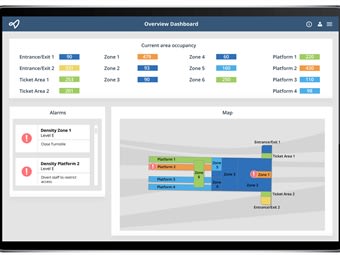
The information enables travelers to choose a less-crowded station or platform or alter their travel time to reduce risks and maintain social distance.
Veovo
Using live dashboards and heatmaps, the solution highlights the degree of risk in real time, based on social distancing recommendations, crowd movement patterns, and area size. Alarms and actions are triggered when threshold limits are reached, enabling rapid responses, like directing passenger flows, closing turnstiles, and updating digital signage, among others. In addition, operators could also improve their sanitation responsiveness, directing teams to where cleaning is most needed.
To help passengers plan their journeys, operators can also share data via websites, apps, and other platforms. The information enables travelers to choose a less-crowded station or platform or alter their travel time to reduce risks and maintain social distance.
As with all of Veovo's solutions, this one also includes predictive capabilities, which will help operators not only manage crowding in real time but also plan for days, weeks, and even months ahead. It provides insights into people's habits, how times of day, or day of the week, are affected differently, and understand passenger profiles better. With this data to hand, operators can even more efficiently tackle the long-standing issue of fare evasion.
More Rail

New York MTA Advances Final Contract for Second Avenue Subway Expansion
Contract Four is the largest in the Second Avenue Subway Phase 2 project and includes construction of station infrastructure, tracks, and signals for the subway expansion, MTA officials said. Work on Contract Four will begin in 2027.
Read More →
San Diego MTS Breaks Monthly Trolley Ridership Record
Agency officials said July’s ridership indicates MTS’s continued recovery from the pandemic.
Read More →
Report Examines NJ TRANSIT Reliability, Funding Challenges
The Garden State Initiative analysis examines the roles of Amtrak infrastructure, fleet management, and agency operations while recommending a more performance-based approach to improving reliability.
Read More →
Stadler, CapMetro Sign Long-Term Rail Fleet Support Agreement
Beginning in 2027, Stadler will provide on-site technical expertise, spare parts support, training, and obsolescence management to help extend the reliability and longevity of CapMetro’s GTW fleet.
Read More →
Biz Briefs: Alstom Lands Canadian Contract, LYT to Supply California TSP, and More
In METRO's latest installment, we take a look at recent news from Complete Coach Works, Beep, FlixBus, and more partnerships making headlines across the transportation sector.
Read More →
CATS Gold Line Marks 5 Years of Service, 2.8M Passenger Trips
With a six-mile expansion planned, the Charlotte streetcar is positioned to connect more neighborhoods and major transit hubs across the region.
Read More →
Why Simulating Pedestrian Movement Has Become Essential for Modern Rail Stations
Pedestrian microsimulation is helping rail planners identify bottlenecks, test station designs, and prepare complex transit hubs for growing passenger volumes.
Read More →
Amtrak Begins Major Construction at New York’s Sunnyside Yard
The new maintenance facility will support Amtrak’s Airo trainsets while improving maintenance efficiency and turnaround times in New York.
Read More →
Chicago Leaders Unveil Plans for O’Hare Airport Express Train
The privately developed project would offer a 15-minute trip between downtown and O’Hare’s Terminal 2, with trains operating every 15 minutes on a dedicated track. The service would use battery-electric trains and three existing freight rail rights-of-way.
Read More →
OCTA Maps Out 30-Year Strategy to Protect Coastal Rail Corridor
The draft feasibility report identifies strategies to protect the coastal rail line for decades as the agency continues near-term stabilization and sand placement efforts.
Read More →