



Volvo Group Breaks Ground on U.S. Vehicle Propulsion Lab
The facility will be the first in North America to allow comprehensive testing of current and future products for Prevost, Volvo Bus, Volvo Trucks, and Mack Trucks to meet evolving government regulations.
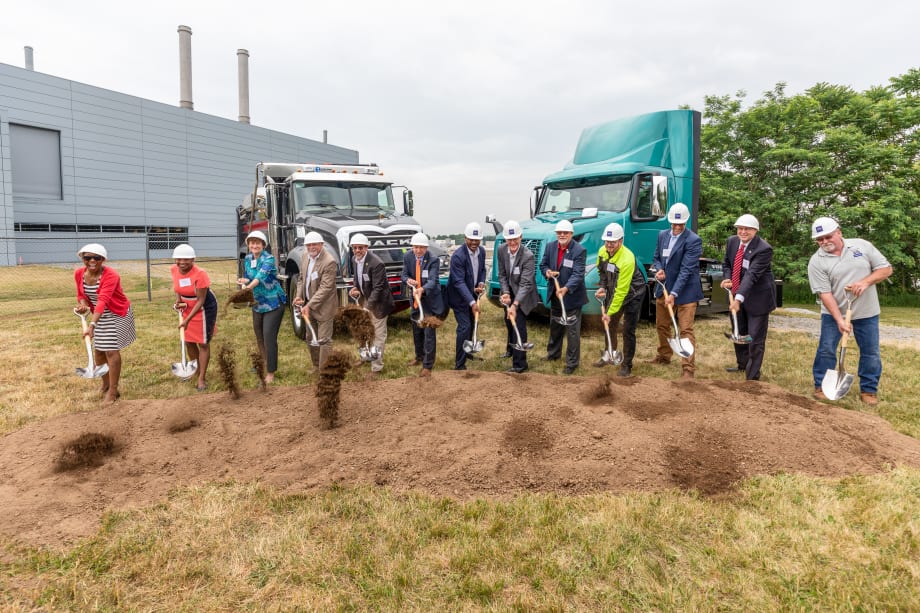
Volvo Group executives were joined by several Delegates of the Maryland State Assembly and Maryland Senator Paul Corderman at a groundbreaking ceremony for the construction of a new, state-of-the-art Vehicle Propulsion Lab, representing a $33 million expansion of its powertrain research and development site in Hagerstown, Md.
Volvo
During a groundbreaking ceremony, the Volvo Group announced a $33 million expansion of its powertrain research and development site in Hagerstown, Md., for the construction of a new, state-of-the-art Vehicle Propulsion Lab (VPL).
Volvo’s VPL will be the first facility in North America to allow comprehensive testing of current and future products for Prevost, Volvo Bus, Volvo Trucks, and Mack Trucks to meet evolving government regulations. Housed under one roof, the lab will consist of two environmental chambers. One chamber will have a chassis dyno capable of emissions measurements and simulating extreme-weather and altitude conditions. The second will offer testing of fully operative vehicles, including highway and vocational trucks, as well as coach buses, for starting in a variety of weather conditions.
“The Hagerstown powertrain technology site plays a significant role in the Volvo Group’s efforts to offer advanced transportation solutions that meet customers’ needs today and down the road,” said Lars Stenqvist, chief technology officer of the Volvo Group. “The all-new VPL, slated to open in the second quarter of 2023, will enable us the ability to more quickly develop and test battery-electric and hydrogen-based fuel cell solutions, as well as internal combustion engines, which will be powered by fossil-free fuels in the future, for our Class 8 trucks and coach buses.”
Additional testing features in the VPL will include:
Operating from -22 degrees F to 104 degrees F for development and verification activities.
Wind speed simulation up to 85 mph.
Vehicle absorbing and motoring capability up to 1600 horsepower.
Altitude simulation up to 14,000 feet.
Various types of performance and emissions testing for battery electric, fuel cell, hybrid, natural gas, and diesel technologies.
Capability to test highway and vocational Class 8 trucks and coach buses for North American, South American, and European applications.
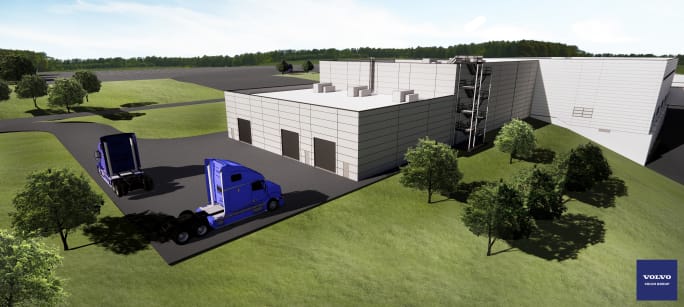
A rendering of Volvo's competed VPL expansion.
Volvo
“Our engineers currently rely on long-distance travel for extreme-weather testing or tap various third-party labs that specialize in specific types of testing,” said Audley Brown, vice president of powertrain engineering for Volvo Group North America. ”The VPL will be one of the few places in operation that offers vehicle emissions and on-board diagnostics requirements at all expected operating conditions for trucks, buses and powertrains.”
The company also expects the new lab to help drive ongoing product-quality improvements and speed-to-market capabilities due to the strategic migration from on-road testing to controlled, lab-environment testing.
At final construction, the VPL will be more than 35,000 square feet, two-stories high, and connected to the existing engine development lab on the Hagerstown campus. It’s been 15 years since the current lab went into operation, which involved a $40 million investment at the time. Since then, the company has spent an additional $12 million upgrading the test cells, a portion of which was used to enable the creation of electricity regeneration when operating the dyno tests.
The Volvo Group employs more than 250 people at the current site from engineering, procurement, environmental, health and safety functions, and the new VPL will add around 10 new jobs, including both non-bargaining and United Auto Workers union-represented team members. The company’s Hagerstown campus is also home to the Volvo Group’s powertrain manufacturing facility, producing engines, transmissions and axles for Mack Trucks, Volvo Trucks, Prevost coaches, and Volvo Buses sold in North America.
More Technology

From Hardware to Digital Partner: Luminator Charts Its Next Chapter
CEO Magnus Friberg discusses Luminator’s shift toward becoming a digital partner, the growing importance of software and interoperability, and how AI can help agencies improve operations and passenger experience.
Read More →
Beyond the Checklist: A Structured Approach to Transit Maintenance
Reliability-Centered Maintenance helps transit agencies move beyond routine checklists to focus limited resources on the assets and failures that have the greatest impact on safety, reliability, and service.
Read More →
NJ TRANSIT Advances Bus Technology Upgrades Across Statewide Fleet
More than 1,500 buses now feature upgraded technology designed to improve arrival predictions and provide free Wi-Fi, with deployment expected to reach nearly 2,000 buses by the end of 2026.
Read More →

Building a Flexible Path to Transit Electrification
John Hroncich discusses BAE Systems’ modular and scalable approach, lessons learned from decades of real-world operations, and how agencies can identify electrification strategies that fit their fleets.
Read More →
Biz Briefs: Alstom Lands Canadian Contract, LYT to Supply California TSP, and More
In METRO's latest installment, we take a look at recent news from Complete Coach Works, Beep, FlixBus, and more partnerships making headlines across the transportation sector.
Read More →
From Legacy Silos to Conversational Intelligence
What if transit leaders could ask any operational question and get a trusted answer in seconds? Conversational AI is transforming how agencies use their data.
Read More →
USDOT Announces Rail Vehicle Replacement Grants, Chattanooga AV Shuttle Funding
More than $191 million in federal funding will help three transit agencies replace aging rail vehicles and support a new autonomous shuttle service in Chattanooga.
Read More →
Bus Tech Talk: Keeping Transit Technicians Ahead of the Technology Curve
LA Metro’s Obed Mejia discusses technician training, evolving maintenance technology, fleet replacement, and strategies for getting the most out of today’s transit fleets.
Read More →
Biz Briefs: RIPTA Unveils New Frontrunners, Clevland RTA Adds New Siemens, and More
In METRO's latest installment, we take a look at recent news from Siemens, Prevost, Dodge, and more partnerships making headlines across the transportation sector.
Read More →
Why Simulating Pedestrian Movement Has Become Essential for Modern Rail Stations
Pedestrian microsimulation is helping rail planners identify bottlenecks, test station designs, and prepare complex transit hubs for growing passenger volumes.
Read More →