



W. Va. University modernizing PRT system
Ten cars have already been outfitted with digital onboard computers, and a signed contract will deliver 61 systems for the remainder of the fleet in approximately the next year.

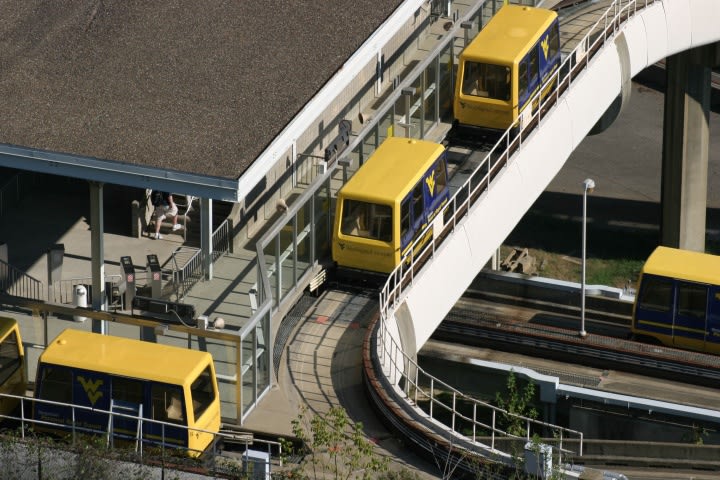
Photo courtesy West Virginia University.
[IMAGE]WVirginia-PRT-system-full-3.jpg[/IMAGE]West Virginia University’s (WVU) iconic Personal Rapid Transit (PRT) system isn’t getting any younger. Since it opened in 1975, the system has transported students, faculty, staff and members of the Morgantown community for a total of 60 million passengers.
The PRT’s time has come again as cities across the country look for transportation that is sustainable, automated and carries thousands a day. To Arlie Forman, associate director of transportation, the system isn’t just the university’s transportation, it’s a research station; a working model for designers to copy as they re-imagine the country’s transportation options.
Unlike other mass transit systems throughout the world, the PRT’s 71 cars can travel directly from point to point without stopping at other stations along the way.
Well out of its youth, the PRT is getting some of the needed changes to maintain its capacity to move people and serve as an example.
One fix is well on its way to completion. Each PRT vehicle originally used an analog system to send and receive communications between the cars and control station, Forman said. Ten cars have already been outfitted with digital onboard computers manufactured by Azimuth Inc. A signed contract valued at approximately $3.6 million will deliver 61 systems for the remainder of the fleet in the next year.
“That will bring us from 1970s technology to current,” Forman said. “The next project that we have to address is the propulsion system. We are currently involved in a development project to construct a prototype propulsion system, which will be tested here at our facility over the summer.”
If the testing works, the university will order five propulsion units manufactured by Bombardier Transportation — a controller between the onboard computer and the car’s electric motor. Then, as funding allows, all the cars could be outfitted with propulsion systems.
“A few of the major causes of downtime are the onboard computer system, the propulsion system and the train control system,” Forman said. “So, if we can get two of those three out of the way, and hopefully, that third one in the future, we should become more reliable, dependable and sustainable.”
As the university upgrades the system, it looks for products that would have substantial vendor support, unlike the original aircraft-grade parts made by Boeing, which no longer designs ground transport. Forman said the goal in updating the PRT with new technology is to select products that can be fixed as inexpensively and quickly as possible.
Forman wants to be prepared as the university explores funding options to make major changes, including funding a new propulsion system and replacing the train control system. Because there is no other direct-to-station transport vehicle, the university has issued a request for proposals for a criteria developer who will create specifications that companies could use to mesh their products with the PRT’s needs.
Aside from university funding, the PRT receives some federal funding based on ridership and other performance parameters.
Currently, WVU receives approximately $1.2 million for capital projects from the FTA annually. This summer’s capital projects include replacing an uninterruptible power supply at the medical PRT station, replacing a circuit breaker in the Evansdale switch yard, conducting bridge repairs, replacing boilers and roofing systems at two boiler plants, replacing a segment of high voltage cable and adding remote motor controllers to switch gear at each maintenance facility.
WVU also received $309,339 in funding through last year’s American Reinvestment and Recovery Act (ARRA) to make key improvements that helped employ skilled workers to implement improvements. The ARRA upgrades included purchase and installation of closed circuit TV cameras, a public address system and message boards for each of the five passenger stations along the system.
“We use our grant money in the most effective way possible to address things that can shut the system down just because of a failure due to a component or system nearing the end of their life cycle,” he said.
The PRT was the first of its kind in the country and is still the only known system that allows riders to ride a car directly to their intended station instead of along a circuitous route, according to a WVU statement.
More Rail

New York MTA Advances Final Contract for Second Avenue Subway Expansion
Contract Four is the largest in the Second Avenue Subway Phase 2 project and includes construction of station infrastructure, tracks, and signals for the subway expansion, MTA officials said. Work on Contract Four will begin in 2027.
Read More →
San Diego MTS Breaks Monthly Trolley Ridership Record
Agency officials said July’s ridership indicates MTS’s continued recovery from the pandemic.
Read More →
Report Examines NJ TRANSIT Reliability, Funding Challenges
The Garden State Initiative analysis examines the roles of Amtrak infrastructure, fleet management, and agency operations while recommending a more performance-based approach to improving reliability.
Read More →
Stadler, CapMetro Sign Long-Term Rail Fleet Support Agreement
Beginning in 2027, Stadler will provide on-site technical expertise, spare parts support, training, and obsolescence management to help extend the reliability and longevity of CapMetro’s GTW fleet.
Read More →
Biz Briefs: Alstom Lands Canadian Contract, LYT to Supply California TSP, and More
In METRO's latest installment, we take a look at recent news from Complete Coach Works, Beep, FlixBus, and more partnerships making headlines across the transportation sector.
Read More →
CATS Gold Line Marks 5 Years of Service, 2.8M Passenger Trips
With a six-mile expansion planned, the Charlotte streetcar is positioned to connect more neighborhoods and major transit hubs across the region.
Read More →
Why Simulating Pedestrian Movement Has Become Essential for Modern Rail Stations
Pedestrian microsimulation is helping rail planners identify bottlenecks, test station designs, and prepare complex transit hubs for growing passenger volumes.
Read More →
Amtrak Begins Major Construction at New York’s Sunnyside Yard
The new maintenance facility will support Amtrak’s Airo trainsets while improving maintenance efficiency and turnaround times in New York.
Read More →
Chicago Leaders Unveil Plans for O’Hare Airport Express Train
The privately developed project would offer a 15-minute trip between downtown and O’Hare’s Terminal 2, with trains operating every 15 minutes on a dedicated track. The service would use battery-electric trains and three existing freight rail rights-of-way.
Read More →
OCTA Maps Out 30-Year Strategy to Protect Coastal Rail Corridor
The draft feasibility report identifies strategies to protect the coastal rail line for decades as the agency continues near-term stabilization and sand placement efforts.
Read More →